Follow Us on Google

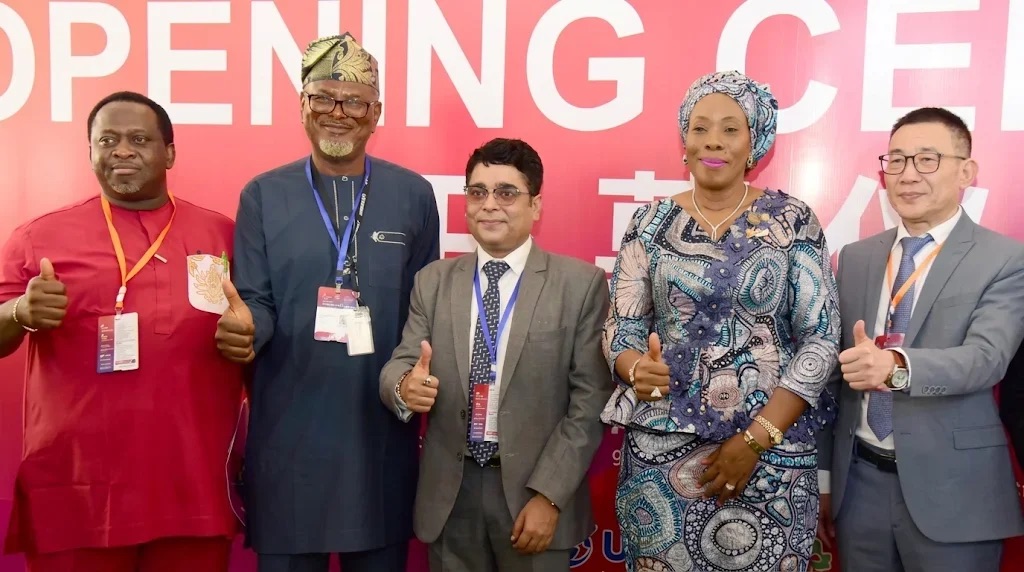
The Lagos state government has called for a more balanced trade relationship that prioritises Nigerian exports, local manufacturing, technology transfer and sustainable investment rather than continued dependence on imported finished products.
The Commissioner for Commerce, Cooperatives, Trade and Investment, Mrs Folashade Ambrose-Medebem, made the call at the opening ceremony of the 5-in-1 Nigeria-China Trade Fair 2026 in Lagos,(Zhejiang International Trade (Nigeria) Exhibition), a three day event, where she noted that bilateral trade between Nigeria and China exceeded $28 billion in 2025, representing an increase of more than 28 per cent, while trade between both countries reached approximately $18 billion in the first half of 2026, indicating a further 35 per cent growth.
The commissioner said the growing trade figures presented an opportunity for both countries to deepen economic cooperation and expand industrial capacity.
She disclosed that Chinese imports from Nigeria grew by 81 per cent in the first half of 2026, describing the development as an indication of the expanding economic relationship between the two countries.
“These figures demonstrate that we are engaging within an economic corridor already worth tens of billions of dollars. However, they should not be regarded as the ceiling of our ambition.
They should be the foundation for a more balanced and mutually beneficial relationship built on increased Nigerian exports, local value addition, manufacturing partnerships and sustainable investment,” she said. Ambrose-Medebem stressed that Nigeria must move beyond a trade relationship largely defined by the importation of finished products, insisting that the next phase of cooperation should focus on local manufacturing, industrial machinery, renewable energy, agro-processing, digital trade and joint ventures capable of creating sustainable employment.
According to her, China’s manufacturing capacity, technological innovation and access to global supply chains complement Nigeria’s large consumer market, abundant resources, entrepreneurial population and strategic position within the African Continental Free Trade Area (AfCFTA).
“Our responsibility is to combine these complementary strengths. We must move beyond a relationship defined principally by the importation of finished products,” she stated.
She urged Chinese investors to consider Nigeria not merely as a market for selling products but as a destination for manufacturing, innovation and industrial partnerships.
“To our Chinese exhibitors and investors, Lagos does not invite you merely to sell within our market. We invite you to manufacture with us, innovate with us, develop Nigerian suppliers, build local capacity and use Lagos as your gateway to Africa,” she said.
Other News
The commissioner identified textiles, automotive parts and equipment, home products and gifts, hardware, tools and mechatronics, as well as photovoltaic power and energy storage, as interconnected sectors capable of strengthening Nigeria’s industrial economy.
In his address, President of United Asia Exhibition Company Limited, Mr Ni Liquin, said the International B2B Trade Fairs, established in 2017, had continued to expand as platforms for connecting global businesses, promoting cross-border trade and facilitating international cooperation.
He said the 2026 edition brought together five specialised exhibitions covering hardware, tools and mechatronics; photovoltaic power and energy storage; automotive parts and equipment; home products and gifts; and textiles.
According to him, the five exhibitions occupy approximately 10,000 square metres of exhibition space, with about 300 international exhibitors from more than 10 countries and regions, including China, India, Nigeria, Germany and the United Arab Emirates.
He added that the event had also attracted more than 60,000 pre-registered visitors, reflecting growing international interest in the Nigerian market.
He said the organisers had also introduced a Smart B2B system, known as Uninet, to connect verified importers and buyers from West Africa and other parts of the world with exhibitors based on their specific purchasing requirements.
“We have launched our Uninet Smart B2B System for the Fairs. The Uninet System pairs verified importers and buyers from West Africa and the world, matching precisely according to their purchasing needs. Smart B2B will operate throughout the Fairs to boost business opportunities,” he said.
He explained that the organisers had equally introduced an online-to-offline trade platform powered by MatchupExpo.com to extend business engagements beyond the physical exhibition.
The platform integrates a three-day physical fair, a 10-day digital fair and one year of continuous online trade, offering digital invitations, intelligent business matching, instant contact and virtual meeting facilities.
According to him, the initiative would enable exhibitors to maintain business relationships and sustain commercial opportunities long after the physical exhibition had ended.