Follow Us on Google

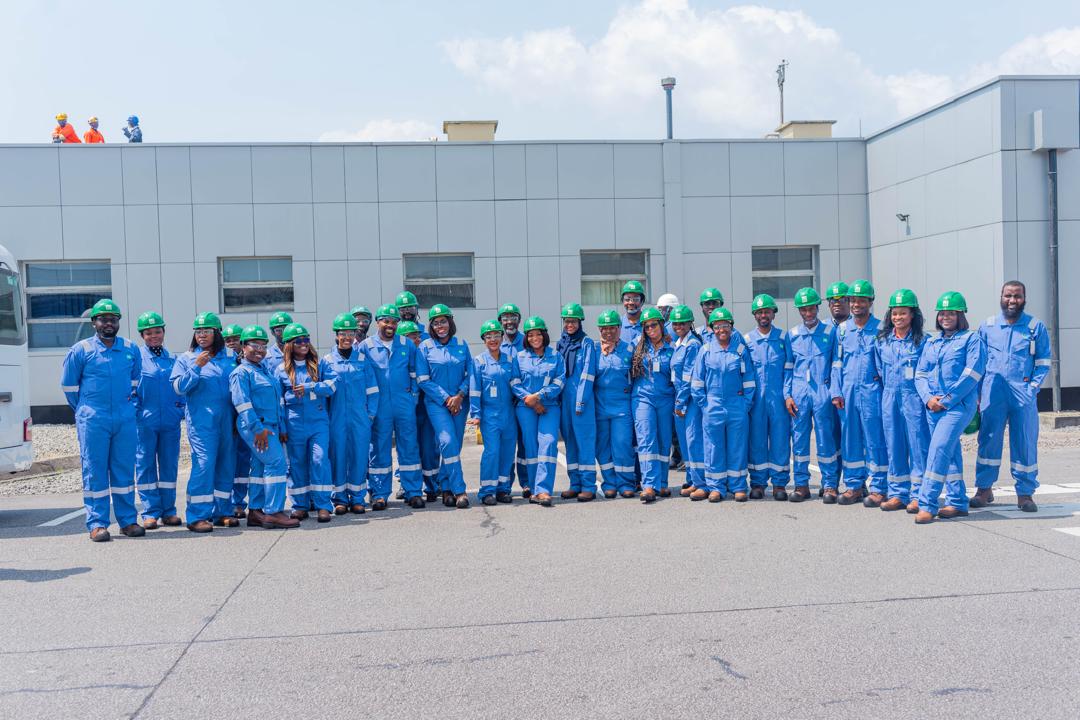
34 young professionals from across Nigeria’s oil and gas industry have visited the Nigeria LNG Limited (NLNG) facility on Bonny Island, Rivers State, to gain first-hand exposure to gas processing, liquefaction, storage and export operations under the Decade of Gas Capability Building Programme.
The visit, which covered NLNG’s operational Trains 1 to 6 and the ongoing Train 7 expansion project, was designed to bridge the gap between theoretical training and practical industry experience.
Led by the Coordinating Director of the Decade of Gas Secretariat, Mr Ed Ubong, the delegation was received by NLNG’s Managing Director and Chief Executive Officer, Mr. Adeleye Falade, and members of the company’s management team.
Speaking during the visit, Ubong said the initiative was designed to equip young professionals with the practical knowledge and competence required to drive Nigeria’s ambition of building a gas-powered economy by 2030.
He said classroom training alone was insufficient to prepare the next generation of industry leaders, stressing the importance of exposing participants to world-class gas operations.
“What we are building is not just knowledge, but confidence and competence. You cannot drive a gas-powered economy from theory alone. Our young professionals must see, touch and understand how gas is processed, liquefied, stored and exported to the world,” he said.
Ubong described NLNG as a leading example of Nigeria’s gas development potential, adding that the visit would enable participants to appreciate operational excellence and take valuable lessons back to their respective organisations.
He said the programme was targeting more than 150 professionals by 2030, including engineers, geoscientists, commercial analysts and policymakers, who would drive the development of gas-based industries, power generation, LPG penetration, CNG adoption and gas-to-chemicals projects.
According to him, capacity building is one of the seven strategic pillars of the Decade of Gas Programme, which seeks to develop the human capital required to translate Nigeria’s vast gas resources into economic growth and industrial development.
In his welcome address, Falade said NLNG was pleased to host the young professionals, noting that developing the human capital required to sustain the gas industry was critical to achieving Nigeria’s energy ambitions.
“At NLNG, we believe that gas is not just a commodity; it is a platform for national transformation. And transformation is driven by people. That is why we are delighted to host this group of bright, young professionals,” he said.
He said NLNG’s operations, from the successful running of Trains 1 to 6 to the ongoing Train 7 expansion, demonstrated the capacity of Nigerians to deliver complex industrial projects through innovation, partnership and commitment to excellence.
Falade urged the participants to see themselves as the next generation of professionals who would consolidate Nigeria’s position in the global gas industry.
“What you have seen today on Bonny Island is what Nigerians can build and sustain when we are committed to excellence and safety. As you go back, I want you to carry this spirit — that Nigeria can lead in gas, not just in Africa, but globally,” he said.
He also charged them to uphold the highest standards of safety, sustainability and local content in their professional careers.
According to him, the decisions they make over the next decade would be critical to determining how effectively Nigeria harnesses its more than 200 trillion cubic feet of gas reserves for power generation, industrial development, job creation and national prosperity.
The programme featured technical sessions on LNG production processes, plant integrity, health, safety and environment, shipping and export logistics, as well as interactive engagements with NLNG engineers and managers.
Some participants described the experience as eye-opening, noting that it was their first opportunity to visit an LNG liquefaction plant and observe the operations involved in producing and exporting liquefied natural gas.
Speaking on behalf of the participants, one of them said the tour had significantly broadened her understanding of the gas value chain.
“Touring Trains 1 to 6, gaining insights into the Train 7 expansion project and appreciating the complexity behind every cargo that leaves Bonny have broadened my perspective. This is more than just a programme; it is a career-defining experience,” she said.
The Decade of Gas Programme seeks to position natural gas as a major driver of Nigeria’s energy transition, economic diversification and industrial growth, in line with President Bola Tinubu’s commitment to leveraging the country’s gas resources for national prosperity.
The Secretariat said the Bonny Island visit was one of several practical learning engagements planned for the cohort, with subsequent exposure to regulators, upstream producers and gas infrastructure companies.