Follow Us on Google
By Chukwuma Umeorah
Lagos State has secured N244.82 billion from its latest bond issuance under the N1 trillion Debt and Hybrid Instruments Issuance Programme, following strong investor demand that pushed subscriptions well above initial targets. The state said the proceeds will be channelled into critical infrastructure projects spanning transportation, housing, environmental sustainability, healthcare, and education.
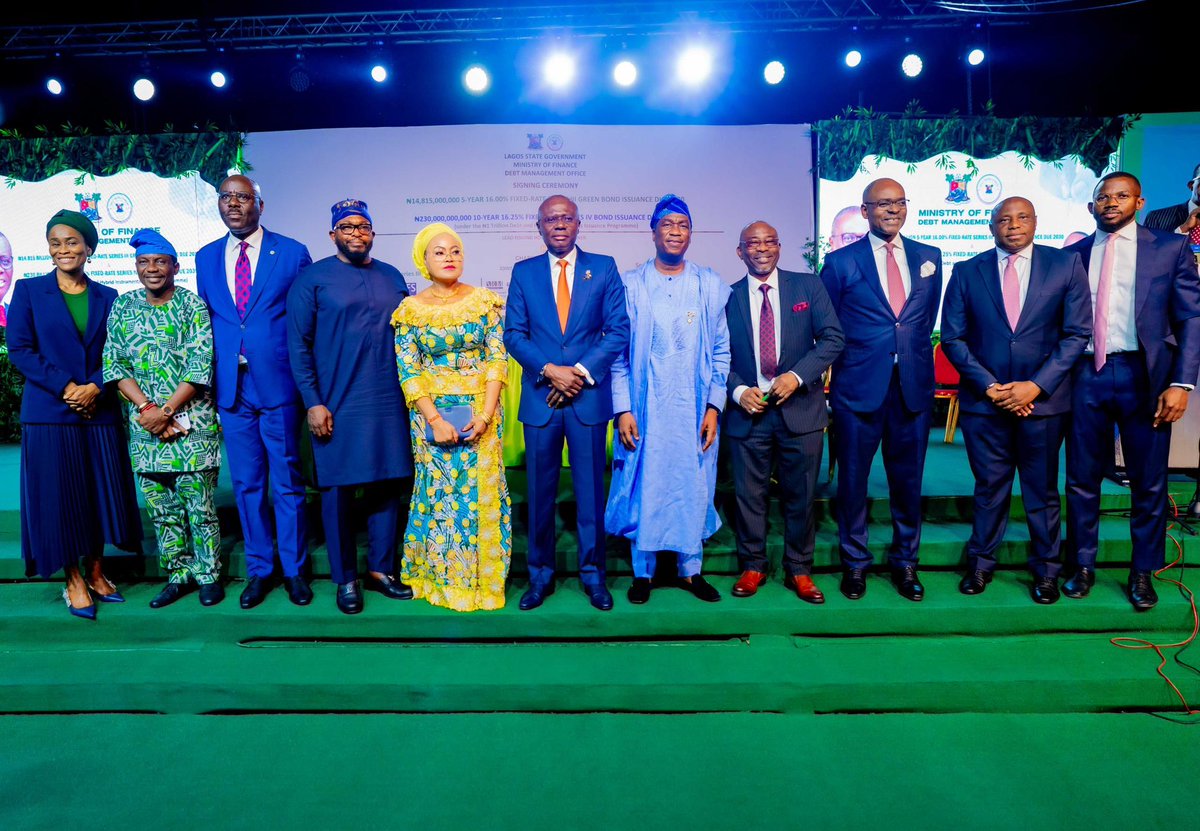
The announcement was made at the Lagos State Ministry of Finance and Debt Management Office bond signing ceremony in Lagos on Thursday.
Governor Babajide Sanwo-Olu said the response from investors reflects confidence in the state’s fiscal management and long-term development strategy. He said, “we are here to finalize the documentation for the issuance of our Green Bond and Conventional Bond as part of the Lagos State N1 trillion Debt and Hybrid Instruments Issuance Programme,” adding that Lagos had progressively grown its bond market interventions since 2020.
“The first bond we issued in 2020, valued at approximately N100 to N110 billion, marked a record at the time. Each subsequent bond has surpassed its predecessor, and today we embark on another groundbreaking opportunity.”
Lagos issued Nigeria’s first subnational Green Bond, raising N14.815 billion from bids that totalled N29.29 billion, with N27.79 billion received within the advised price guidance.
Sanwo-Olu said this aligns with the environmental pillar of the THEMES+ Agenda and the state’s long-term ambition to build a resilient and environmentally secure Lagos. He added that the Series 4 Conventional Bond, initially targeted at N200 billion, attracted N310.06 billion in bids, with N304 billion falling within the advised range, prompting the state to raise N230 billion.
Other News
“This issuance now stands as the largest bond issuance in Lagos State’s history and indeed for any subnational government in Nigeria. It serves as a testament to the vision, governance, and fiscal discipline present within Lagos State. We deeply value this trust and are wholly committed to honoring it,” he said.
Commissioner for Finance, Abayomi Oluyomi, said the project selection process was designed to ensure that the funded initiatives support the United Nations Sustainable Development Goals and deliver measurable environmental and social outcomes. He noted that both the conventional and green issuances benefited from strong investor participation despite regulatory limits that restricted the amount Lagos could take up.
He explained that the Series III Green Bond meets global standards and is certified by the Climate Bonds Initiative. “The State has raised N230 billion compared to the N200 billion we initially set out to raise. Our benchmark is now N300 billion,” he said, adding that the proceeds will support projects including expansion of the Blue and Red Rail lines, construction of the Lekki-Epe Airport Road, development of affordable housing schemes, upgrade of healthcare facilities, solar installations across public schools, and agro-produce hubs to strengthen food security.
Chapel Hill Denham CEO and lead issuing house, Bolaji Balogun, said Lagos continues to distinguish itself in the market through transparency and adherence to best practices. He stated that “this N230 billion issuance marks not only the largest ever by a sub-national entity in Nigeria but also the most substantial issuance by any entity, aside from the national government. Furthermore, being the first sub-national in Africa to issue a Green Bond is a remarkable milestone.”
Representing the British High Commission, Temilola Akinrinade said the dual issuance demonstrates the strength of investor confidence in Lagos State and in economic reforms being implemented at both federal and state levels. She described the bond programme as an outcome of longstanding collaboration between Lagos and the UK Government, including technical support in developing the state’s green bond framework. “The UK’s support for Nigeria includes backing federal green bond issuances, providing guarantees for infrastructure investment, and collaborating on the Lagos International Financial Centre project to enhance Lagos as a financial hub,” she added.
She noted that the oversubscription signals Lagos’ ability to attract sustainable financing in a period where countries are seeking long-term, climate-competitive capital.
Lagos State officials said the administration remains committed to transparency, accountability, and prudent use of borrowed funds, emphasising that the bond proceeds will be deployed to projects that support sustainable and inclusive economic growth.