Follow Us on Google
By Chukwuma Umeorah
Nigeria’s leather industry stakeholders are intensifying efforts to address persistent shortages of raw materials, hardware and financing that have constrained the sector’s growth, as the 2026 Lagos Leather Fair (LLF) set to focus on practical solutions aimed at strengthening the industry’s fragmented value chain.
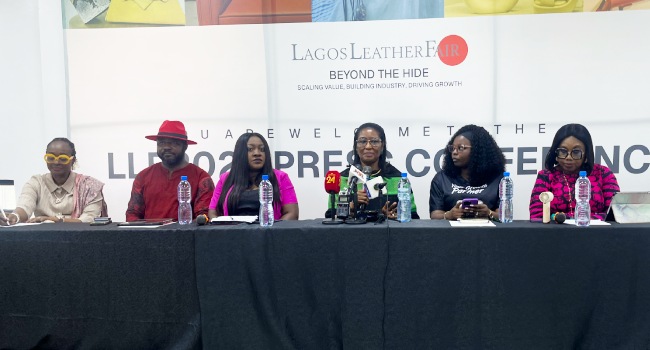
Speaking at a press briefing in Lagos, Convener of the Lagos Leather Fair, Femi Olayebi, said the industry’s potential has remained largely untapped despite Nigeria’s position as one of Africa’s largest leather producers. According to her, many leather businesses continue to grapple with a fragmented value chain, inadequate access to quality materials and accessories, limited visibility, funding challenges and insufficient technical capacity.
She added that the event scheduled to hold on June 27 – 28 with Ecobank as headline sponsor will “shift focus beyond raw materials to strengthening market value, infrastructure, and creating pathways for sustainable cross-continental growth within Africa’s leather and creative industries.” She said,
Olayebi explained that the challenges informed the establishment of the Lagos Leather Fair in 2017 as a platform to connect stakeholders across the value chain and stimulate conversations around the industry’s development.
She noted that while the leather industry is frequently described as a billion-dollar opportunity, significant work remains to convert that potential into measurable economic outcomes.
Other News
Themed “Beyond the Hide: Scaling Value, Building Industry and Driving Growth,” this edition will focus on addressing structural constraints limiting the sector’s expansion. Olayebi added that organisers are broadening discussions beyond finished leather products to include the wider ecosystem and partnerships needed to strengthen industry standards, systems and production capacity. “We need to identify partners and collaborators that will help us strengthen our systems, that will help us elevate our standards, that will help us begin to address those critical gaps that limit our ability to grow,” she said.
She disclosed that over the years, businesses have emerged through collaborations and partnerships fostered by the platform, although some enterprises have also struggled to survive.
Responding to questions on measurable impact, Olayebi said the initiative has trained more than 1,000 emerging designers through accelerator and mentorship programmes, while also creating opportunities for local designers to participate in international exhibitions and industry events.
“We’ve been able to train over a thousand emerging designers through our accelerator programs.” She added that organisers have intensified engagement with government agencies and industry regulators to address long-standing bottlenecks in the sector. “We have come to the realization that if you want to move forward you can’t do it alone. So we need these partnerships,” she said.
Speaking on the role of financial institutions, Simisola Olaseinde, EcoBank SME Partnerships & Collaborations Manager said support for businesses in the leather ecosystem goes beyond funding to include market access, business development, mentorship and regional trade opportunities.
She said “finance, markets, networks and knowledge remains critical for businesses seeking to scale operations and compete across Africa under the African Continental Free Trade Area (AfCFTA).”
The Lagos Leather Fair 2026 will feature exhibitions, industry discussions, masterclasses, networking sessions, fashion showcases and awards aimed at promoting collaboration across the leather value chain.