Follow Us on Google
By Henry Uche

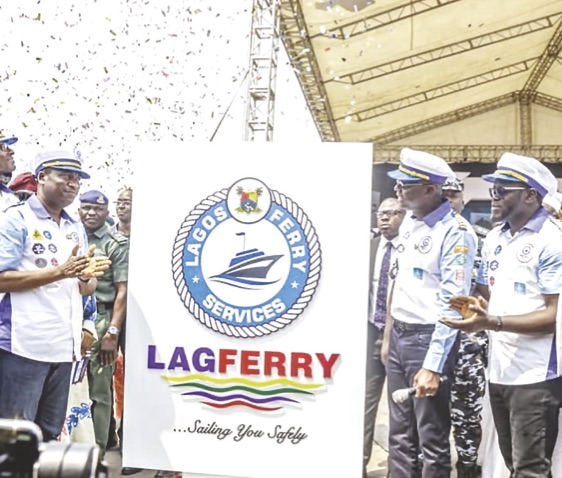
•Lagos State Governor, Babajide Sanwo-Olu (2nd R) with MD/CEO, LAGFERRY, Hon. AbdoulBaq Ladi Balogun (R) and Dep.Gov. Obafemi Hamzat (L) at the launch of the commercial operations of Lagos Ferry Services at the Badore Terminal, Ajah, Eti-Osa.
There is excitement in Lagos as the government and residents celebrate 1,000 days of improved water transportation in the state. Though the economic capital of the country, Lagos is faced with numerous challenges in its transportation sector.
The ever-increasing population, congested roads and inadequate public transport infrastructure have made it crucial to explore alternative modes of transportation. For this reason, Governor Babajide Sanwo-Olu on February 10, 2020, launched the commercial operations of Lagos Ferry Services at the Badore Terminal, Ajah, Eti-Osa.
According to Akeem Odusina, Director of Public Affairs, Lagos Ferry Services (LAGFERRY), it has been an eventful journey of one 1000 days of commuting Lagosians and businesses in Lagos on the inland waterways.
He pointed out that “under Gov. Babajide Sanwo-Olu’s administration, the re-invigorated Lagos Ferry Services is running water transport in 24 routes from 16 terminals/jetties with 19 commercial boats, while the government is rehabilitating and constructing 15 new terminals/jetties across the state, dredging of routes, channelisation removal of wrecks and water hyacinths, etc.”
Odusina, in his assessment of the journey so far, explained that the primary objective of LAGFERRY is to provide safe, efficient, and reliable water transportation services to the people of Lagos, with a vision “to be the go-to model and alpha solution provider in the business of water transportation which is in consonance with the Lagos State T.H.E.M.E.S PLUS Agenda of the Sanwo-Olu’s administration, aim at enabling intermodal movement options and promotion of commerce and tourism, through the provision of safe efficient and technologically-driven ferry services manned by competent workforce to ensure environmental sustainability.”
He stated that Sanwo-Olu’s passion for improving water transportation is evident in his commitment to creating an integrated multi-modal transport that seamlessly connects road, rail, and water transportation as encapsulated in the THEMES PLUS agenda.
By promoting water transportation as a viable alternative to road transport, Sanwo-Olu aims to ease traffic congestion and significantly reduce travel time for commuters. Under his leadership, the government has demonstrated unwavering commitment to transforming water transportation by allocating substantial resources and implementing comprehensive policies and projects. This commitment is driven by the belief that efficient and sustainable water transportation is vital for the economic growth and development of the state.
To achieve his vision of transforming water transportation, the governor has assembled a team of experienced and dedicated professionals. These individuals, including experts in maritime, transport, and urban planning, work together to comprehensively assess the existing infrastructure and bottlenecks as well as collaborate with various stakeholders to identify the key challenges and develop strategies for improvement.
In order to facilitate seamless water transportation, the state has invested in the establishment and renovation of terminals, landings, jetties along various waterways. These terminals serve as key transit points, enabling commuters to board and disembark from boats and ferries comfortably and safely. Furthermore, water transportation in Lagos caters to a diverse range of passengers with different backgrounds. From daily commuters to tourists and business travelers, the water transport system offers a convenient and efficient mode of travel. The inclusive approach of the initiative has ensured that the needs and preferences of all passengers are taken into consideration.
Despite all the good sides to the success story, the transformation of water transportation in Lagos has not been without challenges. There are issues such as inadequate infrastructure, encroachment on waterways, insufficient public awareness, insufficient boats/ferries and the need for increased security and safety measures. However, the government remains committed to addressing these challenges through sustained efforts and collaborations with relevant stakeholders (LASWA, NIWA, Marine Police and Navy). This collaboration has ensured adequate security, swift, and emergency responses on the waterways.
Odusina said: “The development of water transportation in Lagos goes hand in hand with the optimization of the blue economy. By harnessing the potential of the waterways, the state is creating employment opportunities and economic growth in industries such as fishing, aquaculture, tourism, and maritime activities. In addition to the infrastructure improvements and technological advancements, the government has also encouraged creative initiatives to promote water transportation. These include cultural events like Lagos Water regatta, weddings, tourism campaigns, and educational programmes that highlight the historical and environmental significance of Lagos’ waterways. By fostering community engagement, these initiatives aim to increase public appreciation for water transportation.”
A crucial aspect of the water transportation transformation is that the government aims to reduce reliance on private vehicles and alleviate traffic congestion in the state. With the commencement of operations of the blue and red line rails, commuters have been given transport movement options to their respective destinations.
To enhance the overall water transportation experience, the government has embraced technological innovations. These include the implementation of modern ticketing systems, real-time tracking and monitoring of vessels, and the development of user-friendly mobile applications for trip planning and information dissemination. These innovations make water transportation more accessible, reliable, and appealing to commuters.
Furthermore, Odusina disclosed more strategic investments made by the Lagos government to enhance water transportation in the state.
“The government has made strategic investments in ensuring the availability of amenities like well-equipped and furnished as well as state-of-the-art terminals, jetties, ticketing booths, waiting areas, and security measures to improve the overall passenger experience. Furthermore, efforts have been made to improve last-mile connectivity by providing connectivity between waterways and other modes of transportation, such as buses and motorcycles.
“Sanwo-Olu’s administration has worked towards developing a standard model for water transportation in the state. This involves defining regulations, safety protocols, and quality standards to ensure a reliable and secure commuting experience for all passengers.”
The overhaul of water transportation in Lagos has set a standard for other states in Nigeria and beyond. The success achieved by Sanwo-Olu and his sailors serves as an inspiration for other states and countries grappling with transportation challenges.