Follow Us on Google
• As major roads turn cattle routes, minister says long-distance migration of animals’ll soon stop
By Kehinde Aderemi
Ademola Ajayi is an information technology expert working and living in Lagos. He was far from happy as he narrated an experience he had recently while driving home.

“I was exhausted by the time I left the office in Maryland that Thursday night. It was 11:30 p.m., and all I wanted was to get home to Ikorodu, take a warm shower, and sleep. The roads were usually quiet at that hour, so I thought I would be home in 40 minutes. But I was wrong.
“By the time I hit Lagos Road, traffic had grounded to a complete halt. Brake lights stretched as far as I could see, and people were stepping out of their cars to figure out what was going on.
“I rolled down my window and heard it before I saw it: the sound of hundreds of hooves on asphalt and low mooing mixed with shouts.
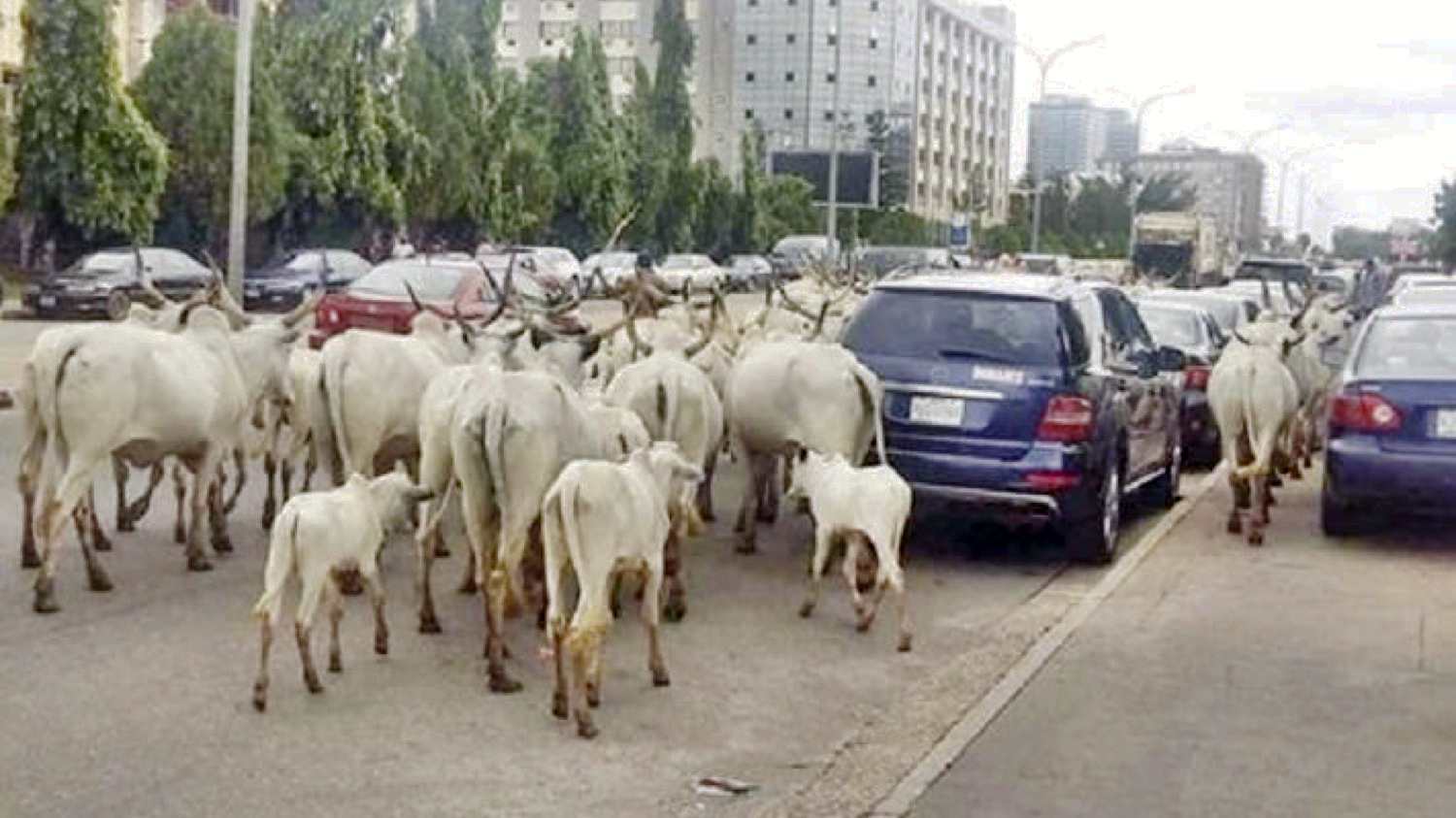
“Ahead, over a thousand cattle were being herded across all lanes of the road. The herders, with sticks and whistles, were moving slowly, completely blocking both sides of the highway. Not even the BRT corridors were spared.

“Private cars, commercial danfo buses, and even a fire truck were all trapped. No one was going anywhere. Some drivers started honking aggressively, but the herders ignored them. One of them said, ‘Wait small, we are passing.’ ‘Wait small’ turned into nearly one hour.
“I watched my fuel gauge drop and my phone battery was down while we sat there. People were arguing. Some got out to buy snacks from roadside vendors who used the opportunity to sell their products. Others just waited in their cars.
“By 12:30 a.m., the last cow finally crossed. We moved forward in silence, frustrated and angry. That night, I didn’t get home until 1 a.m.
“It wasn’t traffic. It wasn’t an accident. It was an illegal act that turned a major Lagos road into a cattle route and we, the motorists, paid for it with our time, fuel, and the hours we waited.”
This was the experience of a Lagos- based Information Technology expert, Ademola Ajayi, as he told the reporter his recent encounter on Lagos road inward Ikorodu.
Like Ajayi, many Nigerians have also witnessed the harrowing experiences of herders taking over major highways in Lagos State and Abuja. Their stories are all the same: frustration and helplessness.
In Abuja, the problem is a daily occurrence, according to Alhaji Taofeek Adeola, an Abuja-based journalist.
“The cows usually cross major highways. The herders also move their cattle for free range very close to Aso Rock Villa, near a place popularly called the Three Arms Zone.
“People don’t bother anymore because it has become a normal routine. At times, motorists stop for a few minutes for cows to cross major highways before they continue their journey,” he stated.
Adeola recalled a time when the FCT Minister, Nyesom Wike, wanted to take action against the herders but went quiet. He speculated that President Bola Tinubu may have advised against raising the issue for political reasons.
“When the cows are on highways, they stop the free flow of traffic, litter the roads, and cause confusion and delay,” he explained.
Adeola urged the Federal Government, through the Ministry of Agriculture and the new Ministry of Livestock Development, to act decisively and stop the embarrassing movement of cattle on roads and highways in Nigeria’s capital city and seat of government.
“Abuja is a big city, and such infractions should not be tolerated in the Federal Capital Territory.
“Many of the cows are owned by top military officers, prominent businessmen, and first-class traditional rulers in our society. That is why the herders feel they are at liberty to graze on highways and nothing will happen.
“They value the cows more than human beings because they see the cows as their major source of economic survival. So they will not toy with anything that has to do with their cows,” he explained.
However, free range grazing is rare in the South-South, according to Mr. Jelili Adedayo, who lives in Port Harcourt.
“In many South-South states, free range is not common because there are designated places for those who rear or sell cows. The Fulanis are not allowed to practise free range in the area. They have designated places where they sell their cows,” he said.
In Ilorin, Kwara State, open grazing is also uncommon, said Hamid Awujoola, a business man and political analyst. But his experiences in Abuja remain fresh.
“In Abuja, it is part of their culture. In places like Gwagwalada, you see cows crossing the highways. Cows are seen everywhere in Abuja.
“At times you see them cross four-lane highways in places like City Gate and Umar Musa Yar’Adua Road, where many Secretariat and Headquarters of government parastatals are located. So, open grazing in Abuja is next to none. It is a daily routine,” he explained.
For Ambassador Soji Amusan, Managing Director, Abuja Ride and Camel Mobility the issue goes beyond traffic. It is a matter of diplomacy, environment, and logistics.
“In my diplomatic engagements, I see the environmental impact in Abuja and Lagos as a governance failure. Open grazing in the Federal Capital Territory is a direct affront to the Abuja Master Plan. We are seeing a rapid loss of urban soil health and the destruction of expensive landscaping and green infrastructure.
“In Lagos, the high humidity combined with unmanaged livestock waste creates a bio-hazard. When cattle roam through water-logged areas, they contaminate the very drainage systems the government is spending billions to clear. It is an environmental ‘silent killer’ that leads to preventable diseases in high-density urban populations.
Other News
“From a logistical standpoint, open grazing in 2026 is economic sabotage. When a herd slows down traffic on the Third Mainland Bridge or the Abuja-Airport road, it isn’t just a delay. It’s a disruption of the national supply chain. We are trying to attract foreign investment, yet our logistics involve animals competing with cars on major highways.
“This creates a high-risk environment for road users and results in significant cargo delays. You cannot build a world-class logistics hub in Lagos or a diplomatic centre in Abuja while maintaining a nomadic transport model for cattle.”
Amusan recommended a Smart Ranching blueprint with firm policy enforcement. His proposals include, creation of designated, fenced ranching corridors far from metropolitan centres, and equipped with modern veterinary clinics and solar-powered boreholes.
“Government should introduce a digital livestock registry. Every herd entering Abuja or Lagos should be digitally tagged and registered using RFID technology to track movement and ensure accountability and Imposition of high penalties and fines.
“Government must be determined to restore order, even if it means impounding livestock found in city limits, while providing tax holidays for herders who transition to commercial ranching. It must be ready to Develop Public-Private Partnerships in meat processing. Abattoir hubs at state borders would ensure only processed meat enters the city in refrigerated trucks, solving traffic and sanitation issues,” he said.
A Marketing Consultant, Mr. Femi Odusanya pointed out that the issue of open grazing is a national problem that requires decisive action.
“I think the issue of open grazing in metropolitan areas and on highways is something everybody knows is happening in Nigeria. It happens in Lagos, Abuja and mostly in the northern part of the country.
“It is one of the major problems causing insecurity in Nigeria, and the government knows this. Over the years, the issue has been on the front burner as a major and critical security threat to the coexistence of Nigerians.
“I have seen it and witnessed it myself. In other climes, things are not done this way. We should move away from traditional methods and do things rightly.
“There are economic, political, social, and security effects. It causes rifts among tribes because we know our brothers from the North are the major stakeholders in cattle rearing.
“There are environmental effects, including damage to infrastructure and open defecation of faeces on the roads. There are also social and political effects, such as the polarisation of Nigeria along ethnic and religious lines. Economically, it leads to the destruction of farmlands and crops, invariably resulting in high food costs and shortages.
“Therefore, the Federal Government must be conscious of all these factors and address the problem once and for all,” he stated.
But the Federal Government has stated that it is not sitting idly while things continue into awry in that aspect. Minister of Livestock Development, Idi Mukhtar Maiha, in a recent encounter with journalists, said the ministry is determined to facilitate a gradual, structured transition from traditional open grazing to modern, sedentary ranching systems.
According to him, the ministry is working on the upgrading and equipping of 273 gazetted grazing reserves covering over 4.5 million hectares nationwide, turning them into “livestock villages” with amenities like veterinary clinics, water supply, and pastures to encourage the relocation of Pastoralist.
“The ministry is actively driving reforms to move from nomadic herding to ranching, which is deemed safer, more sustainable, and better for reducing farmer-herder conflicts.
“Our focus is on the development of three pilot grazing reserves in Abuja as a model for nationwide adoption, specifically to clear livestock from city centres.
“This will be done in collaboration with state governments. We also intend to attract investment to the sector to build necessary and up- to – date infrastructure for the modernisation, with the goal of raising productivity and enhancing the economic value of livestock.
“Our goal is to stop long-distance migration of animals and turn livestock rearing into a formal, business-oriented sector,” the minister assured.
For instance in Lagos State there is a law prohibiting open cattle grazing and the trespass of cattle on land.
The law, signed in 2021 by Governor Babajide Sanwo-Olu, prohibits grazing cattle in public areas and moving them on streets. A task force comprising the Nigeria Police Force, the Lagos State Neighbourhood Watch, and other security agencies, is responsible for the enforcement of the law.
“Yes, there is a law- the anti-open grazing Law in Lagos State. The law forbids open grazing of cattle. It is to prevent conflicts and protect public infrastructure.
“However, herdsmen are required to operate ranches instead, but as far as I am concerned, the anti-grazing law is not effective because we see herders and their cattle still roaming the streets of Lagos, especially on highways,” a retired civil servant who craved anonymity stated.
In Oyo State, the Anti-Open Rearing and Grazing Law of 2019, it was gathered is also very effective.
The Oyo State Rule of Law Enforcement Authority (OYRLEA) is a body created by Governor Seyi Makinde to ensure compliance with the state’s laws and uphold public order. Justice Aderonke Aderemi (retd) stands at the helms of the agency. And since its inception, the agency has brought both legal expertise and a firm commitment to fostering an environment of legality and peace in the state.
According to Aderemi, the law enforcement authority has not been established to witch-hunt anybody. It is to ensure that the laws are complied with.
“The first incident that shocked me most was those cows in front of the Oyo State Government secretariat- the seat of power in Oyo State. It’s an affront.
“It’s a shame on the people not respecting our own seat of power. I felt it so much. And immediately I saw the cows. I said, arrest them. Once you arrest the cow, the owners will come up.
“And lo and behold, who was the owner? He’s a Yoruba man. He is not Fulani. And what did the owner of the cow say? He said, and I have listened to the jingles on the radio. I didn’t know these cows would come here again.
“So, we arrested and we prosecuted the Alhaji and everyone involved. So, what I’m trying to say is that whether you are Yoruba, Igbo, Fulani or Hausa, once you flout our laws in Oyo State, we’ll prosecute you,” she stated
Minister of the Federal Capital Territory (FCT), Nyesom Wike, last Monday publicly apologised and accepted responsibility for the continued presence of cattle roaming the streets and major roads across Abuja.
He however admitted that the situation persists despite ongoing efforts to improve the capital city.
He spoke during his monthly media briefing in Abuja.
He expressed regret over the development and assured residents that the administration is working to address it.
“I apologise that up till now there are cows still roaming the streets of Abuja; I take responsibility,” the minister said.