Follow Us on Google
By Omoniyi Salaudeen
It’s now barely eight days to the zero hour of the outgoing 2023 and the ultimate arrival of the New Year.
As usual, excitement is already in the air, while governments, corporate bodies, business concerns and individuals are engaged in routine stocking-taking to serve as a guide of action for their future endeavours.
For the polity, the highlight of the review is largely on the key events that shaped the democratic governance in the country, focusing on the high and downside of the activities of the state political actors.
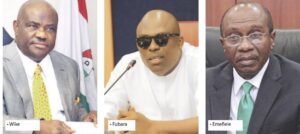
Like the previous years, the last few months of the outgoing year have been as eventful as they are challenging. Notable among the issues that currently top the lead in public discourse are the just concluded power transition process and its aftermath, new regime of subsidy removal and its attendant hardship, Ondo State power intrigues, Wike/Fubara feud, appointment of 11 new justices of the Supreme Court, the ongoing trial of former CBN governor, Godwin Emefiele, as well as the growing trend of military coup d’état in the neigbouring West African countries, among others.
General elections and change of batons
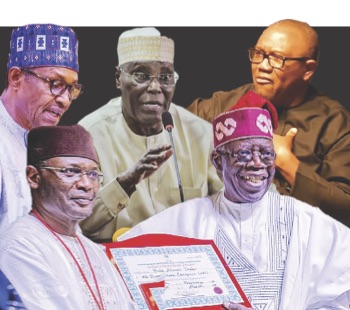
Coming at a new session of election, the year began with intense electioneering jamboree, climaxing the conduct of the February 25 presidential and National Assembly elections. Announcing the results of the poll, the INEC Chairman, Prof Mahmood Yakubu, declared: “That Tinubu Bola Ahmed of the APC, having satisfied the requirements of the law is hereby declared the winner and returned elected.”
The declaration culminated in the exchange of baton between him and his immediate predecessor, Muhammadu Buhari, on May 29.
Tinubu scored 8,794,726 votes to beat his two other close challengers, Atiku Abubakar of the Peoples Democratic Party (PDP) and his counterpart in the Labour Party, Peter Obi, who went up to the Supreme Court to challenge the declaration, but all to no avail.
Since the final pronouncement of the apex court, there has been an outburst of public commentaries with some critics questioning the integrity of the judiciary for the controversial judgments.
Subsidy removal
Until his ascension to power, fuel subsidy issue had been a hard nut to crack for successive administrations because of the power interests benefitting from it. However, daring the possible consequences of the removal, Tinubu declared, “no more fuel subsidy” in his inaugural address, after he was sworn in at the Eagle Square in Abuja. The audacious declaration is one of the defining moments that shaped the economic status of Nigeria. While some criticized the decision for being inauspicious and premature, many economic experts and political enthusiasts applauded the boldness and the courage with which he took the bull by the horns.
However, in spite of the anticipated benefits, Nigerians are yet to see the positive gains of the removal. Instead, the decision has continued to push up food inflation as well as the cost of transportation, thereby plunging more people into poverty and economic hardship than had been experienced before.
Naira redesign and cash policy
Nigerians cannot also forget in a hurry the hardship occasioned by the naira redesign and cashless policy introduced by the former governor of the Central Bank of Nigeria, Godwin Emefiele. The embattled erstwhile governor had announced the new policy directive in October last year to, among other things, strengthen the value of the naira, curb vote-buying, kidnapping and ransom-taking.
The policy initiative was, however, faced with a barrage of criticisms due to the inauspicious moment, the hardship foisted on the people, as well as his controversial foray into partisan politics.
At the height of the electioneering, Tinubu had claimed that the policy was deliberately designed to hinder his chances of winning the presidential election.
Upon assumption of office, therefore, Tinubu immediately directed Emefiele to hand over the affairs of his office to a deputy governor.
According to a statement by the presidency, this was sequel to an ongoing investigation of his office and the planned reforms in the financial sector.
The report of the special investigation on the CBN and related entities submitted to the president indicated that Emefiele illegally lodged billions of naira in 593 bank accounts in the United States, UK and China without the approval of the board of directors and the CBN Investment Committee.
Months after his dismissal, the embattled former governor is still languishing in Kuje Correctional Centre as he undergoes court trial for other sundry allegations bordering on “financing terrorism, fraudulent activities, and economic crimes of national security dimension.”
Niger coup and war-mongering
President Tinubu had barely spent three weeks in office when the military struck in Niger and took over the reign of power from the ousted President Mohamed Bazoum. As the new emerging Chairman of the regional body, ECOWAS, Tinubu threatened to lead military action against the junta as a step to restore democratic governance in the country. But the declaration and its attendant war-mongering sparked off a wave of cricitisms as many political analysts and foreign affairs commentators described it as a misplaced priority.
Bowing to public opinion, the National Assembly rejected the request for parliamentary backing for military adventure in Niger Republic. This followed a letter sent to the Senate seeking its support for sanctions jointly agreed with other ECOWAS member countries, and “military build-up and deployment of personnel for military intervention to enforce compliance of the junta in Niger should they remain recalcitrant.”
Instead, the NASS voted for realistic economic, diplomatic, and cultural sanctions; but stood firmly against military action.
Niger coup d’état followed the bandwagon effect of military overthrowment of democratically elected governments in Mali, Guinea and Burkina Faso. All three were slammed with economic and diplomatic sanctions, but to no avail.
To stave off the threat to democratic governance in the sub-region, therefore, sanctions were swiftly imposed on Niger. Land borders were closed, communications severed and trade suspended. In addition to all of these, the president also ordered the electricity supply be cut off, a move which was seen as a hard blow to the landlocked country whose economic survival depends on 70 per cent energy supply from Nigeria.
Seven Northern states – Sokoto, Kebbi, Zamfara, Jigawa, Katsina, Yobe and Borno – share borders with Niger Republic. Therefore, while the controversy was raging, Northern interest groups rightly reminded Tinubu that any war with the country would impact Nigerian communities.
Ondo political crisis
Ondo has been embroiled in protracted crises over the controversy surrounding Governor Rotimi Aderedolu’s ill-health. Akeredolu had in June applied to the state House of Assembly for a 21-day medical leave abroad, but ended up spending 171 days. Yet, since his return to Nigeria, the governor has been governing the state from his private residence in Ibadan, the Oyo State capital. He had handed over power to his deputy, Lucky Aiyedatiwa, in June, but took it back upon his return to Ibadan, leading to a crack within his cabinet.
In August this year, speculations were rife that the governor presented each of the 26 members of the state House of Assembly with an SUV worth millions of naira while on a sick bed. He also allegedly extended a similar gesture to 30 permanent secretaries in the state.
At the height of the intrigues, Akeredolu moved to impeach his deputy, a move that has led to a prolonged litigation battle. The issue has evoked criticisms from the opposition parties, who believe his absence leaves a governance vacuum in the state.
However, with the intervention of President Tinubu in the protracted impasse, the state assembly has confirmed the deputy as the acting governor, while Akeredolu proceeded on further medical treatment abroad.
The development followed the receipt of a letter from Akeredolu approving Aiyedatiwa as acting governor.
“Following doctor’s advice on the need for medical follow-up after recuperating, Ondo State governor, Oluwarotimi Odunayo Akeredolu, has forwarded the letter on medical leave to the state House of Assembly,” he said in the statement.
Meanwhile, the INEC has fixed the governorship election in the state for Saturday, November 16, 2024.
Wike/Fubara face-off
The ongoing face-off between the former Rivers State governor and Minister of the Federal Capital Territory (FCT), Nyesom Wike, and his successor, Governor Sim Fubara, is an unfolding political drama which no one can predict how it will end. The tussle for political structure in the oil-rich state recently burst open when unknown explosives rocked the Rivers State House of Assembly after it was rumoured that there was a plot to impeach Governor Fubara.
For now, there is peace of the graveyard in the state following the intervention of President Tinubu and the resolutions signed by the warring parties. On the flipside, it appears that the battle line has already been drawn, especially with the recent defection of 27 house members loyal to Wike from the Peoples Democratic Party (PDP) to the ruling All Progressives Congress (APC) and the subsequent threat of impeachment. As Wike had already stated, losing his political base would result in losing his political relevance. So, for him, it is a fight to the finish. For the embattled governor also, who is equally battle ready to protect his job by all means, any impeachment move will rather lead to the total collapse of the roof. This, he has already demonstrated, by the recent demolition of the state assembly complex to show that no one has a monopoly of violence.
Part of the peace resolutions signed by the two gladiators is for the state assembly to stop impeachment moves against Fubara while also Amaewhule remains the Speaker. Some cynics have predicted the imminent collapse of the agreement, saying it is not a fair deal.
Edo Crisis
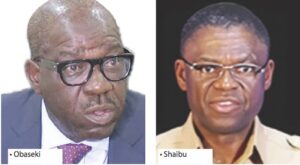
The rift between Governor Godwin Obaseki and his deputy, Philip Shaibu, was also another major political event that rocked the polity. This followed Shaibu’s declaration of intent to contest the coming governorship election in the state. Obaseki, whose tenure ends next year, accused his deputy of planning a coup against him to become the state governor. Obaseki, while addressing some PDP loyalists, disclosed that he began to doubt the loyalty of Shaibu when he discovered that he was working for another governorship aspirant against his candidature as Speaker of the state House of Assembly. Up till now, the crisis of confidence is still festering.
Supreme Court gets new 11 justices
On Thursday, the Senate screened and confirmed 11 justices recommended for the Supreme Court bench.
The confirmation followed Tinubu’s request for the approval of recommended 11 nominees by the National Judicial Council headed by the Chief Justice of Nigeria, Justice Olukayode Ariwoola.
According to the Senate, the approval is to ensure speedy dispensation of justice. Until now, the Supreme Court had only 10 Justices as opposed to the 21 constitutionally recommended. This had become a matter of public concern, particularly as only four out of the six geo-political zones of the country were hitherto represented on the Supreme Court bench. While the Southwest and Northeast have three Justices each; the South-south and Northwest have two each. But the Southeast and the North-central have no representation. The two zones lost their last representatives with the retirement of Justice Muhammad Dattijo from Niger State (North-central) in October, and the death of Justice Centus Nweze from Enugu State (Southeast) in July. The 11 shortlisted Justices, whose names were contained in Tinubu’s letter to the Senate, included Justice Haruna Tsammani (Northeast); Justice Moore Adumein (South-south), Justice Jummai Sankey (North-central), Justice Chidiebere Uwa (Southeast) and Justice Chioma Nwosu-Iheme (Southeast).
Others are Justice Obande Ogbuinya (Southeast), Justice Stephen Adah(North-central), Justice Habeeb Abiru (Southwest), Justice Jamilu Tukur (Northwest), Justice Abubakar Umar (Northwest) and Justice Mohammed Idris (North-central).
With the confirmation of the recommended Justices, Southeast and the Northcentral now have representatives on the Supreme Court bench.
Sack of 133 senior army officers
The latest in the list of major events that shaped the power politics in the country is the recent sack of 113 senior military officers by the Nigerian army. Those retired included one General, one Lieutenant General, 67 Major Generals, and 44 Brigadier Generals.
In a swift reaction, the Minister of Defence, Abubakar Badaru, hailed the support of the Nigerian Army in the growth of democracy in the country.
In a statement issued on Wednesday by the Director, Army Public Relations, Brig.-Gen. Onyema Nwachukwu, the minister spoke at the Regimental Dinner Night organised in honour of newly retired and retiring Nigerian Army senior officers in Abuja.
Badaru described the Nigerian Army as a shining example in the West African region and beyond, urging other services in the country to take a cue from the organization.
The minister, according to the statement, enjoined the Army to continue to remain loyal to the constitution and support the development of democracy in the country.