Follow Us on Google
•Pupils sit on bare floor in overcrowded classrooms ν600,000 out-of-school children, 1 teacher to 84 pupils ratio in the state
From Noah Ebije, Kaduna
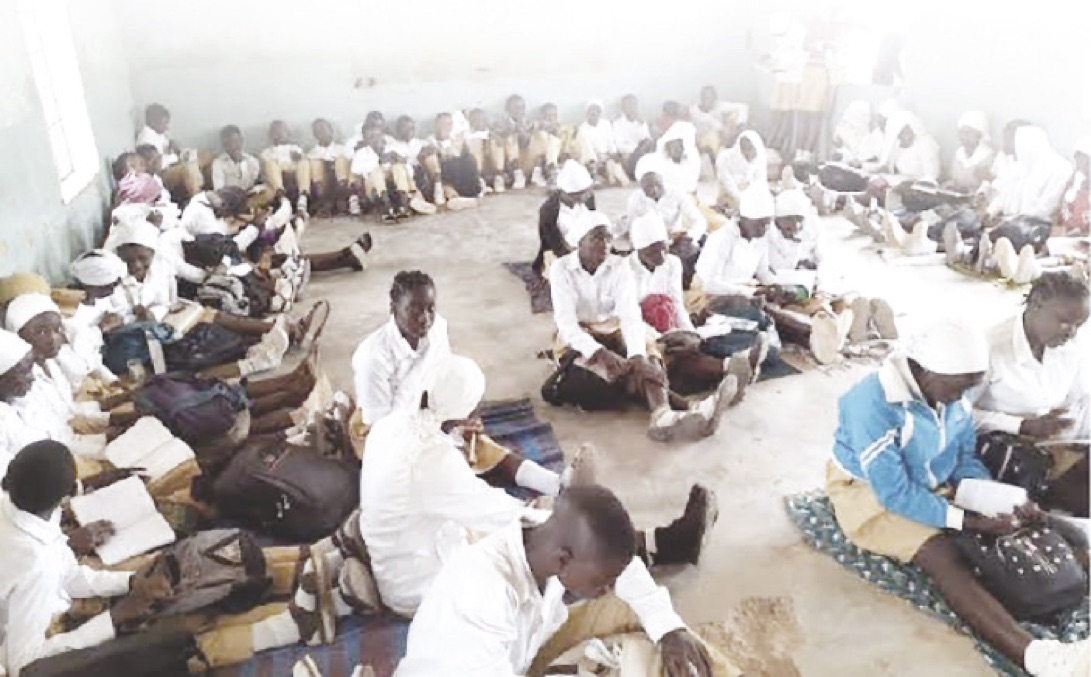
In Kaduna State, many pupils sit on the bare floor to learn because of lack of chairs and desks. In some schools, scores of pupils are made to share only two desks.

•Students learning on floor
According to parents, this poor and congested classes contribute in no small measure to the bad social atmosphere that brings morale decadence in the society.
A member of Kaduna Teachers/Parents Association, Elder John Fwah, expressed worry over crowded classrooms, saying that government should be blamed for bad education policies over the years.

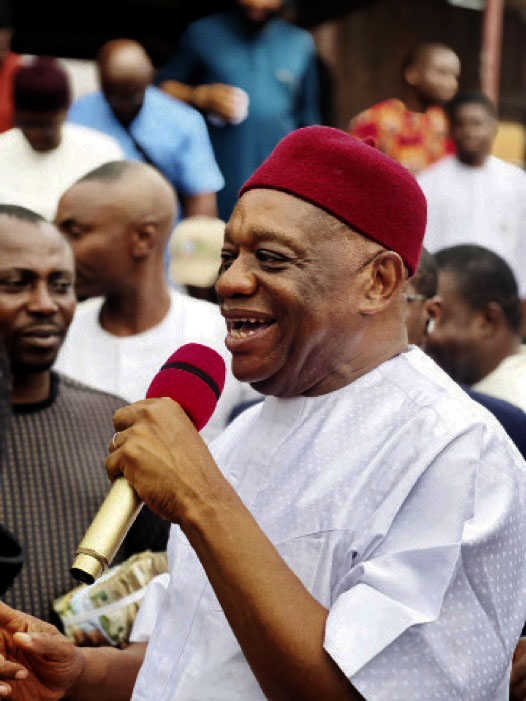
•Gov. Sani
He said: “Let me say that the issue of over-crowded pupils to one teacher in Nigeria in general and Kaduna State in particular is worrisome. It’s a shame that all the noise about reformation in education is on the lips and in commissioners’ files gathering dust.
“Before your question, I had engaged one of the pupils on why she was rushing to school as early as before 7am. She said she wanted to get a seat because they are too many in our class while they have only two desks. According to her, she didn’t want to sit on the bare floor because it’s cold and dirty.
“This is a tip of the iceberg from my conversation with the 12-year-old. While chatting with her, she innocently said that the windows and other removable items are being carted away by unknown persons. But the teachers can’t do anything because they are not the government. All this boils down to the bad politics of takeover of schools in the 1970s.
“The answer by the innocent pupil sums up the tragedy and the burden of the campaign to send your children to school. The impromptu chat had revealed the gravity of undeserved torture and punishment our greater tomorrow undergo in midst of plenty, even where they’re ready for education.

•Pa Fwah
“It’s really pathetic and disappointing that the so-called people’s governments cared less about the people’s children. It’s outrageous and ridiculous that it is one teacher to 84 pupils, which is a sign that the government is just paying lip service to what it refers to as ‘improved quality’ education at that level and by extension to post-primary also.

•Another set of pupils sitting on bare floor
“These poor and congested classes no doubt contribute in no small measure to the bad state of social atmosphere that brings morale decadence. This is irresponsible compared to those days when it used to be 30 pupils per class. It makes nonsense of the annual budget allocation and expo-laden external examination results. So, the blame of poor quality education is crafted by lackadaisical attitude of the government itself as compared with the parents of the pupils.
“The government should without further delay reopen and/or re-establish the Grade Two teachers’ colleges, which were erroneously shut or converted into secondary or other schools. The vacuum created by the closure of teachers’ training colleges is clearly identified with the poor quality products of these overpopulated classes.
“It’s unthinkable and unimaginable in Kaduna of this millennium for a teacher to effectively manage or impact on such a large number of underage pupils. There’s no gainsaying that there is need to train and retrain teachers at various stages of their career for better and improved impact on the pupils. Not forgetting regular remuneration, as their reward is no more in heaven but here on earth.
“This is the age of growth and, therefore, they desire a conducive learning atmosphere, including furniture anf learning materials. These pupils are future leaders of this country and they deserve better learning atmosphere and materials as well as well trained trainers.”
Some of the primary and junior secondary school teachers who spoke on the condition of anonymity expressed worry over academic workloads, attending to over 80 pupils in one class, apart from the rowdiness they have to battle with during lesson hours.
“We are appealing to the relevant authorities to find lasting solutions to this situation because it is not easy controlling a crowded class. We also suffer when marking examination scripts because it will take us weeks to finish the marking. The normal number of pupils and students in a class should not be more than 30 and at most 35,” the teachers said.
Meanwhile, Governor Uba Sani appears sad, as far as the issue of out-of-school children and 1:84 teacher-pupil ratio are concerned, and he has vowed to leave no stone unturned to find solutions to the problems.
The governor disclosed that the state has over 600,000 out-of-school children who needed to be returned to school without further delay, otherwise they would become security risks to the state and the country as a whole.
However, recently, he received a signal from the government of Kuwait supporting his administration with $28 million to send the children back to school.
While the issue of out-of-school children was gradually being resolved, the 1:84 teacher-pupil ratio reared its ugly head.
Daily Sun’s investigation showed that the state government may not have much a problem bridging the gap in the teacher-pupil ratio as it is set to recruit an additional 10,000 teachers to reinforce the 35,000 teachers strength across its primary and junior secondary schools.
The recruitment exercise, according to government officials, is to handpick the 10,000 teachers from the 17,500 already interviewed and passed by the immediate past administration of Nasir El-rufai. They were waiting for employment letters before El-rufai’s government came to an end.
Governor Sani said: “Many states in the North-West, including Kaduna, have a large number of out-of-school children, which is unacceptable. Even access to healthcare, which is not a privilege but a right, is poor.
“In Kaduna State, we have over 600,000 out-of-school children. But, because they realized how proactive we have been, Kuwait Fund is supporting us with $28 million to take out-of-school children back to school.
“Education is the greatest enabler. So, we must educate the children of the poor to compete favourably with the children of the rich. If we don’t do that, the problem of insecurity cannot be addressed. I’m happy that a lot of people are already looking at that.”
However, as a part of efforts to address the current 1:84 pupils to a teacher gaps in its 4,437 lower and upper basic schools, the director, Human Resources, Kaduna State Universal Basic Education (KADSUBEB), Ahmed Sani, said every effort was being made by the state government bridge the ratio gap.
The director tabled the issue for discussion at a media parley and stakeholder roundtable to commemorate this year’s International Day of Education, with the theme “Learning for lasting peace,” organised by Kaduna Basic Accountability Mechanism (KADBEAM), in collaboration with Partnership for Learning for All in Nigeria (PLANE).
According to the director, Kaduna State Government has the lower basic 1-6 (primary 1-6) and upper basic 7, 8 and 9 (junior secondary school 1-3) with about 30,000 teachers for the lower and middle basics and about 4,000 teachers for the upper basic.
The teachers’ gap analysis was conducted by the state government to identify the teachers’ needs over the next four years. That analysis revealed that the state will need about 13,000 teachers in the next four years.
He said: “The government has already approved the recruitment of the 13,000 teachers in batches. In 2022, we opened a recruitment portal and about 73,000 applied.
“We processed that number and shortlisted about 30,000 and conducted a computer-based test for them. At the end of that exercise, about 17,500 passed.
“These are the people we will be interviewing, from where we will select the first batch of 10,000 teachers. This, we hope, will reduce the currentteacher-pupil ratio of 1:84 (on average) to about 1:60 in the state.
“That will help in improving teaching and learning outcomes. It will also help us to address the imbalance of teachers.
“Partnership for Learning for All in Nigeria is the embodiment of the governments of Nigeria and the United Kingdom’s Foreign, Commonwealth, and Development Office’s shared commitment to deliver sustainable improvements in learning outcomes for Nigeria’s children.”