Follow Us on Google
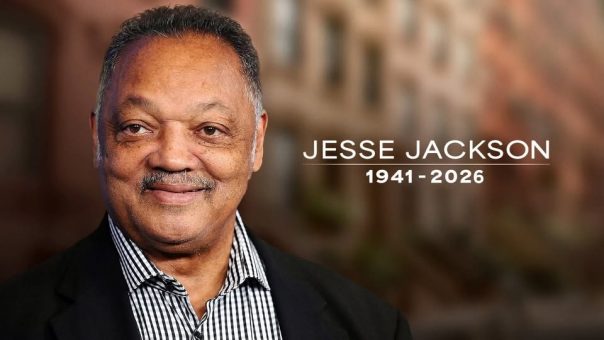
The legendary American rights activist, politician and Baptist minister, Reverend Jesse Jackson, passed away recently at the age of 84. He died on February 17, 2026, at home in Chicago after battling a rare neurological disorder that affected his mobility and ability to speak. His demise is a great loss to the United States, the black race and the world. Born on October 8, 1941, Rev. Jesse Jackson was a protégé of Rev. Martin Luther King Jr., one of the most influential civil rights and political figures in American history. Despite his physical challenges, he continued going to work until last year. He communicated using gestures.
Jackson was a global citizen who embarked on many pursuits that took him around the world. He will be remembered as a man who championed the cause of the poor and the marginalised in society. He canvassed for voting rights, health care, job opportunities and education of black people in the United States. Through his Rainbow PUSH Coalition, he took the self-determination crusade of African-Americans to corporate boardrooms and decision-makers, ensuring that executives made America an equitable and open society.
Rev. Jackson was an orator at the forefront of the civil rights movement for decades after King’s assassination in 1968. He learnt activism the hard way from the feet of Dr. King as a teenager. Images from that era showed blacks being attacked by the police and humiliated by whites. He stood up for blacks who were jailed for attempting to vote or sitting with dignity in the front of city buses. He passed through an era in America when blacks were jailed for trying to integrate with “whites only” neighbourhoods.
He contributed immensely to the socio-political freedom enjoyed by African-Americans today by putting his life on the line. He was repeatedly jailed for civil rights protests throughout the 1960s. At 18 as a college freshman, he, together with seven other black teens, were jailed for reading books at a whites-only public library in Greenville, S.C., Jackson’s birthplace. Throughout adulthood, be was called by African-Americans to scenes where racial injustice had occurred, including murders. He said no when blacks across America were wrongly convicted of crimes and treated as sub-humans. Despite witnessing the murder of Martin Luther King Jr., he never lost faith in the struggle for racial equality and social justice.
Other News
Rev. Jackson also inspired many people with his crusade for equity and justice, and his “keep hope alive” mantra. He ran for the highest position in American politics – the presidency – in 1984 and 1988 – as a Democrat. People of colour, young people and working-class Americans rallied round, pushing him to become a frontrunner once, but he narrowly missed the party’s presidential ticket. Credit must be given to Rev. Jackson for influencing black presidential aspirants like former President Barack Obama and former Vice President Kamala Harris, among others, to run for the presidency. Until his emergence on the American political scene, it was unthinkable for American blacks to run for the presidency.
His death has attracted tributes from prominent Americans and world leaders. In his eulogy, President Donald Trump said: “I knew him well, long before becoming President. He was a good man, with lots of personality, grit and ‘street smarts.’ He was very gregarious – someone who truly loved people! Jesse was a force of nature like few others before him.”
Former President Obama stated that, “Reverend Jackson helped lead some of the most significant movements for change in human history. Reverend Jackson also created opportunities for generations of African-Americans and inspired countless more, including us. Michelle got her first glimpse of political organising at the Jacksons’ kitchen table when she was a teenager. And in his two historic runs for President, he laid the foundation for my own campaign to the highest office in the land.”
Though so much has been achieved to integrate blacks into contemporary American society, more still needs to be done for people of colour in America. Blacks still complain of suppressed voting rights, unnecessarily killing of unarmed, peaceful protesters and authorities mistreating black immigrants. This calls for new Rev. Jacksons to rise and fight the cause of blacks in America peacefully. In his heyday as an activist, Jackson never deployed violence as a tool to redress injustice. His “hope alive” mantra should continue to guide both black and white communities in America who believe that society must be better. We commiserate with his family, the black community and the entire American nation on the loss of the selfless and visionary leader.