Follow Us on Google
By Zika Bobby
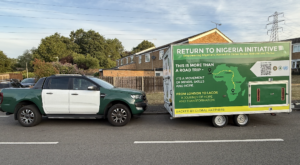
In the on-going grueling 6,200-mile overland journey from London to Nigeria to witness the vulnerabilities faced by young migrants, Dr. John Aikeremiokha is bringing his findings directly to lawmakers. As the Global Nigeria Student Ambassador, Aikeremiokha — alongside Nuhu Aminu Nuhu, president of the National Association of Nigerian Students in Diaspora (NANS-D)—has petitioned Senate President Godswill Akpabio and Speaker Tajudeen Abbas for an audience.

Their goal is to pitch a revolutionary accountability tool: an international, United Nations-recognised framework that leverages data analytics and blockchain technology to transform local governance and build structural pathways for the diaspora to invest back home.
The Watershed Moment at the Presidential Villa
Aikeremiokha notes that every movement needs a watershed moment—the exact point an idea stops being a conversation whispered in conference rooms and becomes a mandate carried by a nation. For this initiative, that moment arrived at the Presidential Villa in Abuja during the National Diaspora Convention, where the movement was formally launched in the presence of Nigeria’s First Lady, Senator Oluremi Tinubu.
To those in the room, it may have looked like a standard ceremonial gathering, but it was a reckoning. For the first time, the critical question of how Nigeria collects, protects, and deploys data reached the highest office in the country.
Alongside it came a more urgent question the nation can no longer afford to ignore: How do we stop losing our best minds?
We call it Japa now, as if giving the exodus a colloquial name makes it smaller. It does not. It is the quiet bleeding out of an entire generation.
Young Nigerians, educated at great cost and full of immense promise, are standing in visa queues instead of boardrooms, choosing departure lounges over the communities that raised them. Every single departure takes a piece of Nigeria’s future with it. This is not simply brain drain; it is a nation slowly emptying itself of the vital human capital it needs to rebuild.
But the message delivered at the Villa was one of partnership. Nigerian students – both at home and scattered across the globe – came to stand beside leadership with an offer no forward-thinking government should refuse: to build, hand-in-hand with the state, the modern data infrastructure this country has lacked for a generation.
6,200 Miles of Advocacy: London to Lagos
The initiative was born on the road. Aikeremiokha’s transcontinental journey retraced in reverse the very path so many young Nigerians take to leave. Mandated by Nigeria’s Ministry of Foreign Affairs, the trek began at the Nigeria High Commission in London. Along the 6,200-mile route, the ambassador received formal engagement and administrative support from 17 Nigerian foreign missions, reinforcing a singular truth: the diaspora is an active, necessary participant in Nigeria’s future.
Aikeremiokha undertook this journey to bear witness to the dangers, desperation, and deception that thousands face while chasing a dream abroad – and to plant, in its place, a different vision: the Return to Nigeria Initiative. This movement calls the diaspora back to active nation-building, one local government area at a time.
Other News
From Concept to Active System
That call is no longer just a concept; it is an active digital portal where every LGA can publish vetted development needs. Through this platform, Nigerians in the diaspora can directly bid, design, and deliver projects specific to their home communities.
Every completed project – whether a borehole, a classroom block, a community clinic, or a teacher development program – is published, verifiable, and slated to be permanently anchored to blockchain technology. This ensures that what was built, and by whom, can never be quietly erased from the public record.
An audience is currently being sought with the Association of Local Governments of Nigeria (ALGON) to onboard every LGA chairman in the federation. Once diaspora-led implementation shows the world that local leadership is ready to transparently welcome them, it unlocks scaled funding and institutional partnerships from international development agencies. This is how you reverse an exodus: with a bridge sturdy enough to carry people back across it—one project, one community, one homecoming at a time.
The world was listening: A relaunch at the United Nations
What started in Abuja soon caught the attention of the international community. The initiative was published as an official impact story on the United Nations Office on Drugs and Crime (UNODC) platform under the title: “The Return to Nigeria Initiative: Empowering Migrants and Combating Organized Crime.” This global recognition coincided with the inaugural International Day for the Prevention of and Fight Against All Forms of Transnational Organized Crime.
This international validation matters because the initiative addresses a dark truth: too many Nigerians who leave home are met with brutal exploitation, trafficked and preyed upon by criminal networks that thrive where data is scarce. The Return to Nigeria Initiative interrupts this cycle by connecting returning migrants with job training, psychological support, and community networks that restore their dignity.
For the UN to spotlight a Nigerian, student-led initiative signals that this domestic call for data-driven governance has matured into a recognized front line in the global fight against human trafficking.
Bringing Government Home: Engaging Local Leadership
The initiative’s next major front will be a direct engagement campaign with LGA Chairmen across the federation. The goal is to drive grassroots development by embedding trained, data-equipped young Nigerians directly at the level of government closest to the people.
Nigeria’s governance failures compound most acutely at the local level, where budgets are thin and oversight is minimal. By bringing ALGON into this initiative, the movement ensures that data-driven accountability reaches the ward, the village, and the immediate community – the places where government is felt first and trusted least.
To support this, the Office of the Global Nigeria Student Ambassador is actively running specialized training programs, certifying young Nigerians as data analysts, engineers, and scientists. These graduates are ready to work within government agencies, feeding verified data into real-time dashboards for public officials.
The Letter to the National Assembly
It is against this backdrop of local action and global validation that Aikeremiokha and NANS-D President Nuhu Aminu Nuhu formally wrote to the National Assembly. They are seeking a formal opportunity to present the initiative’s training framework, discuss the legislative support required to absorb these data graduates, and explore how this movement aligns with Nigeria’s ongoing digital governance strategies.
”At its core, this is an investment offer rather than a political demand,” Aikeremiokha stated. “It is an entire generation of Nigerian students, highly trained and ready, asking not for favors, but for the institutional space to build the nation alongside the leaders who govern them.
”A country does not suddenly run out of talent; it runs out of patience. Every year, citizens watch public resources vanish into decisions that cannot be traced, while watching their brightest sons and daughters leave across borders. Tragically, some never make it – swallowed instead by the dangerous human trafficking rings this very initiative was established to combat.”
He concluded: “This movement has stood in the Presidential Villa. It has been recognized by the United Nations. It is mobilizing local governments through ALGON, and it has crossed continents over 6,200 miles on the absolute strength of its conviction.
“It is no longer a request whispered from the margins; it is an organized mandate. The question is no longer whether Nigeria possesses the talent to fix what is broken. We clearly do. The only question left is whether the National Assembly will open its doors and engage this generation before they stop asking – and start building for someone else.”