Follow Us on Google
• Kano residents groan over fuel price hike as poverty spreads
From Desmond Mgboh, Kano
Ebuka Eneh, 40, could never have imagined that years after graduating from university, he would still be trekking on the streets of Kano like he used to do as an undergraduate. With over decade of employment and an old vehicle to show for it, he thought he was done with trekking.
But he was wrong. Since the subsidy removal on May 29, 2020, he has reverted to his old life style as he cannot afford the price of fuel. He uses the car sparingly, drops his kids in school, go to the office and on Sundays for worship or to socialise.
Like Ebuka, the new fuel hike has forced many average earners resident in Kano to abandon their cars. There is new culture of mass trekking. Streets like Igbo Road, Court Road in Sabon-Garri, or business districts like Murtala Mohammed Way, Ahmadu Bello Way or even market by Bata axis, usually busy car posts now records a sizable number of commuters, either trekking home or going to work.
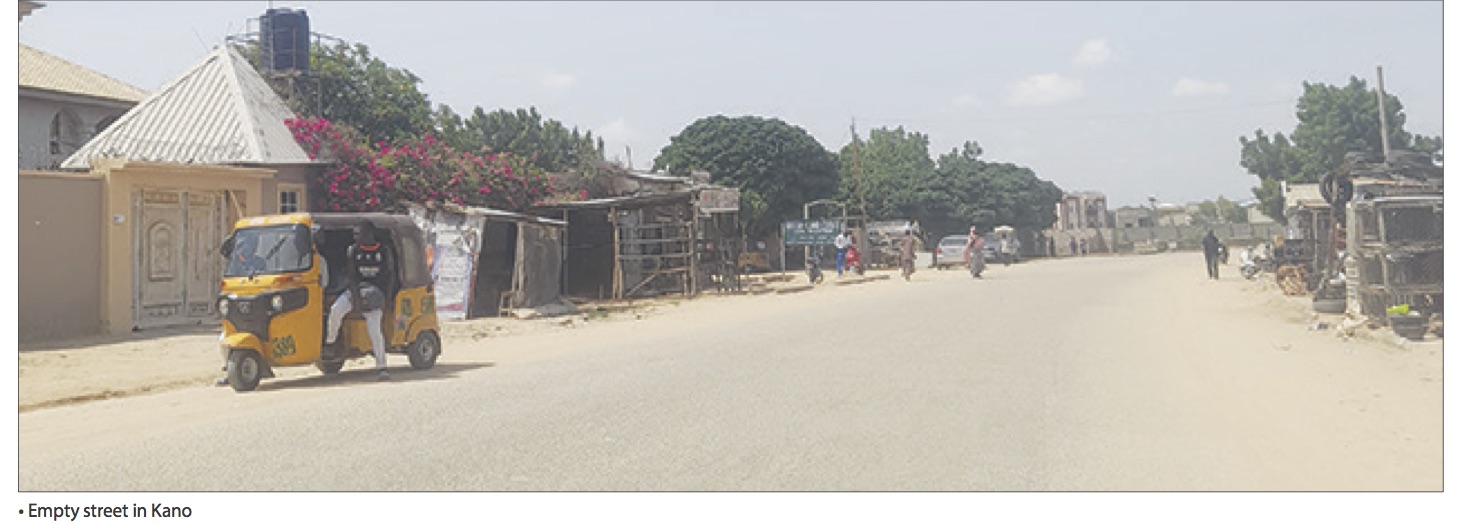
During the holidays or at weekends, the traffic is light and pale as cars on the streets are reduced to a countable few while tricycles and motorcycles are taking over.
Mohammad Biu is a commercial tricycle operator from Gombe State. He has been in the business for some years now. He confessed that since the adjustment of the price of fuel, there has been a sharp drop on the number of cars on the road.
He told Daily Sun: “Sometimes, you will count as much as 20 Keke (tricycles) before you run into a car from the opposite direction on some of the roads. There are more cars on the road in the morning, either driving to work or dropping kids at school.
“But in the afternoons, we drive on almost empty roads. Even junctions like Bata and Airport Road by Murtala Mohammed Way or France Road in Sabon-Garri that used to snarl with traffic are a bit lighter now.
“Contrary to the assumption that we now have more passengers and are making more money, nothing much has changed. Many passengers don’t have the ability to pay.
“We have doubled our fares. But in actual sense, one of every two passengers you pick begs his way through for a reduction. So you still have N70 instead of N100 to N150 per short distance drop.
“Many people too have reduced their movements to only very essential places. Thus, there is a slight reduction in the number of passengers we carry. That was what happened during the Sallah celebrations. We did not get the volume of the passengers we used to get during the occasion.”
The changing times have given impetus to the rebirth of several old motorcycles. They were previously banned for commercial purposes. But they are back, especially after 10.00pm. Many car owners are returning back to motorcycles just to beat the cost of fuel.
Hardship in families
Despite the repeated assurances of the Tinubu administration, subsidy removal has taken a heavy toll on the over 10 million population of the city, many of whom are not very familiar with extreme hardship and pains.
A university lecturer who pleaded anonymity said: “It is like hell dawning on us all. In Kano, we have a cycle of a rich few surrounded by an overwhelming population of extremely poor ones, who are less-educated or uneducated, less exposed and has far fewer options in the light of the present economic travail.
“Despite the federal allocation, we have fewer industries and a weak private sector. Tell me how can we cope with this economic hardship? Where do we start?
“Does this government think that every part of Nigeria is like Lagos or the South West where education and economic activities are booming and poverty is lower?
“The number of beggars in our midst has simply exploded. Apart from the young beggars that besiege you with their bowls and the old ones that trade on their physical deformities, a lot of able-bodied persons now walk around from office to office to beg for urgent N2,000 or N3,000.”
For the non-indigenous communities in places like Sabon-Garri, Badawa, Brigade, Dakata and Zango, the true story of Tinubu’s “pepper soup” is hard to imagine. These settlements feature by old and deteriorated compounds.
But their tenants seemed worse off. Some families, though jobless, have four and seven children. Meals are hardly regular and survival has become desperate following the changing economic times.
Many of their middle-age women engage in one trade or the other. At noon, some sell different kinds of native foods such as Abacha and Achi or hawk rice and stew.
At night, some roast corns, cook groundnuts, peas, boil eggs, peppered gbomo and peppered meats. There is hardly enough to cater for the endless bills to settle in many of these homes.
Tunde Olamide, a private school teacher, lives at Jaba, Ungogo Local Government, said: “Before this time, I used to give madam N10,000 to go to Sabon-Garri Market and she somehow managed to get us what to eat. But now, that amount can buy purely nothing.
“By the time she buys meat, rice, red oil, groundnut oil and vegetables, that money is gone. There is nothing anybody can do.
“The election was an opportunity for Nigerians to select from among themselves based on the policies were presented before them. But I doubt if we selected the best option that was presented before us.”
Nightlife
Ada resides at Brigade Quarters and an attendant at a beer parlour on Aitken Road, Sabon-Garri. She said: “Tinubu hardship is heavier than Buhari’s yoke. I feel like going back to Benue State to stay with my parents.
“My salary is just N15,000, out of which I will go to work and feed. I have not been paid since last month because Oga said business is poor.”
The ban on commercial tricycles from operating beyond 10.00 pm had long affected night businesses. But the subsidy removal nailed it.
George, an old hotelier and executive member of hoteliers’ association told Daily Sun: “Over eighty per cent of these night joints cannot afford to power their generators any more, even we the hoteliers cannot afford generators anymore. It is all bad business coming at a bad time.
“How do you expect a lodger to leave his home for your hotel, when in all sincerity, the comfort of his home is better than your hotel? It ought to be the reverse. The lodgers come to pay you because you are giving them something better or more exquisite than what they have at home.”
Walking across the streets, it was obvious that things have fallen apart. Many beer parlours had no electricity or generators. What they have are thin rechargeable lamps at the centres of their spots, lights that are barely enough to shadow figures of fun seekers.
The tables were lit with bottles and only a few outlets were showing premiership matches. Gone with the subsidy also was the usual music that went deep to relax the soul.
There is no doubt that the economic hardship is biting hard in Kano. But many people, especially the religious ones are optimistic that it shall be well again. “If we could survive the cashless policy, one day this too will be history.” they all seemed to echo.