Follow Us on Google

From Joe Obukata Ogbodu, Warri
Irate youths protesting the controversial delineation of electoral wards in Warri Federal Constituency, Delta State, on Wednesday disrupted a stakeholders’ meeting convened by the Independent National Electoral Commission (INEC) in Asaba, threatening to stop the conduct of the 2027 general elections in the constituency unless the commission addresses their grievances.
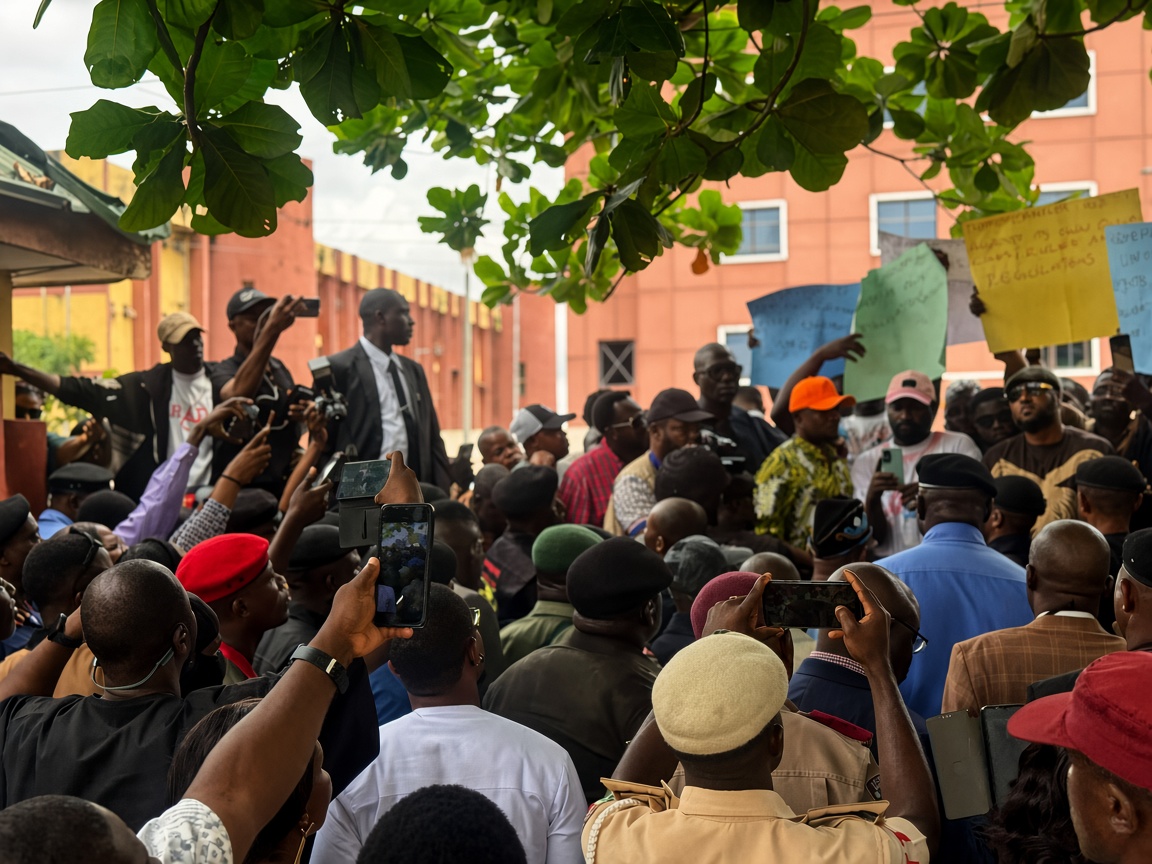
The protesters, mainly Itsekiri and Urhobo/Agbarha-Warri youths, stormed the venue of the meeting, chanting solidarity songs and displaying placards condemning what they described as the arbitrary creation of electoral wards and alleged manipulation of geographical boundaries in favour of particular ethnic interests.
The protest threw the meeting into confusion as security operatives, including police and military personnel, moved to prevent the situation from degenerating into violence, while participants inside the conference hall reportedly scrambled towards the exit.
Videos from the scene showed a large crowd confronting security personnel outside the INEC Delta State Conference Hall, while tension mounted inside the building as attendees surged towards the entrance.
Some of the placards carried inscriptions such as “There Is No Ijaw In Warri South LGA”, “Warri South Constituency Delineation Is Totally Wrong And Unacceptable” and “INEC Cannot Go Against Its Own Guidelines.”
The protesters accused the electoral commission of disregarding established geographical boundaries, historical settlements and its own delineation guidelines in the allocation of electoral wards among the Itsekiri, Ijaw and Urhobo ethnic nationalities in Warri Federal Constituency.
They specifically rejected the allocation of three wards to Ijaw communities in Warri South Local Government Area, insisting that no Ijaw community could legitimately claim aboriginal ownership of any territory within the council area.
According to them, the commission allegedly created fictitious electoral wards, particularly those described as the “Ewein wards”, and carved three disputed wards out of what they maintained were ancestral Okere and Pessu lands.
The protesters further alleged that INEC relied on geographical coordinates outside Warri Federal Constituency, including locations in Udu, Burutu and Ughelli South local government areas of Delta State, as well as Arogbo in Ondo State, to justify some of the disputed wards.
They demanded the publication of the maps, geographical coordinates and polling-unit registers used in the delineation exercise to enable stakeholders to independently verify the boundaries and locations of the affected communities.
Warning against the implementation of the report for the 2027 general elections, the youths maintained that any attempt to proceed with the disputed ward arrangements without addressing their objections could trigger further protests and disrupt electoral activities in the constituency.
“If INEC insists on using this fraudulent report in 2027, there will be no election in Warri Federal Constituency,” one of the protesters declared.
Eyewitnesses at the meeting claimed that the Delta State Resident Electoral Commissioner was forced to leave the venue through a rear exit as tension escalated and security operatives struggled to contain the protesters. The claim could not be independently verified.
The latest confrontation represents another escalation in the protracted dispute over the delineation of electoral wards and polling units in Warri Federal Constituency, which comprises Warri North, Warri South and Warri South-West local government areas.
The controversy followed the Supreme Court judgment delivered on December 2, 2022, in George U. Timinimi and Others v. INEC, which directed the electoral commission to undertake a fresh delineation of electoral wards and polling units in the three local government areas for the purpose of future elections.
Other News
In compliance with the judgment, INEC conducted fieldwork between July 8 and 20, 2024, and subsequently presented its delineation report to stakeholders in Asaba on May 20, 2026.
Under the report, Warri North was allocated 20 wards, comprising 10 Itsekiri and 10 Ijaw wards, while Warri South-West received 20 wards, consisting of 13 Ijaw and seven Itsekiri wards.
Warri South was similarly allocated 20 wards, with nine assigned to Urhobo communities, eight to Itsekiri communities and three to Ijaw communities.
The allocation immediately generated controversy, particularly among Itsekiri stakeholders, who questioned the geographical basis of the exercise and accused the commission of undermining historical settlement patterns and traditional territorial boundaries.
Itsekiri organisations, including the Ugbarajo Itsekiri Youths (UIY) and the Itsekiri National Youth Council (INYC), rejected the report and demanded that INEC make public the underlying maps, coordinates and polling-unit registers used in arriving at the disputed allocations.
The disagreement subsequently attracted presidential intervention on June 11, 2026, when President Bola Tinubu convened a peace meeting in Abuja involving Delta State Governor Sheriff Oborevwori, National Security Adviser Nuhu Ribadu and seven representatives each of the Itsekiri, Ijaw and Urhobo ethnic nationalities.
The intervention was intended to calm rising ethnic tension, encourage dialogue among the affected communities and prevent the electoral dispute from degenerating into a wider communal crisis.
However, disagreements over the implementation of the delineation report have persisted despite the presidential intervention and subsequent engagements among stakeholders.
An Itsekiri leader, Chief Ayirimi Emami, had earlier accused INEC Chairman, Prof. Joash Amupitan, of disregarding the President’s intervention, alleging that Tinubu had directed that the nomenclature of three controversial wards around the Government Reservation Area, Pessu and Dore Market axis be changed.
Emami maintained that the commission’s handling of the disputed wards was inconsistent with the understanding reached during the presidential peace initiative.
Ijaw stakeholders, on the other hand, have defended the delineation exercise, describing the allocation of wards to their communities as a long-overdue correction of what they considered decades of political marginalisation.
They maintained that the exercise represented an important step towards restoring equitable political representation after 29 years of disputed ward allocations and urged INEC to implement the report.
The sharply opposing positions have continued to complicate efforts to secure a lasting resolution, with the three ethnic nationalities advancing competing claims over territorial ownership, electoral representation and the legitimacy of the delineation exercise.
Wednesday’s disruption has heightened concerns over the conduct of the 2027 general elections in Warri Federal Constituency, particularly as the protesters have threatened to resist the use of the disputed report.
As of press time, INEC had not issued an official statement on the disruption, while security agencies had yet to comment on the incident or the circumstances surrounding the reported evacuation of electoral officials from the venue.