Follow Us on Google
Form Scholastica Hir, Makurdi
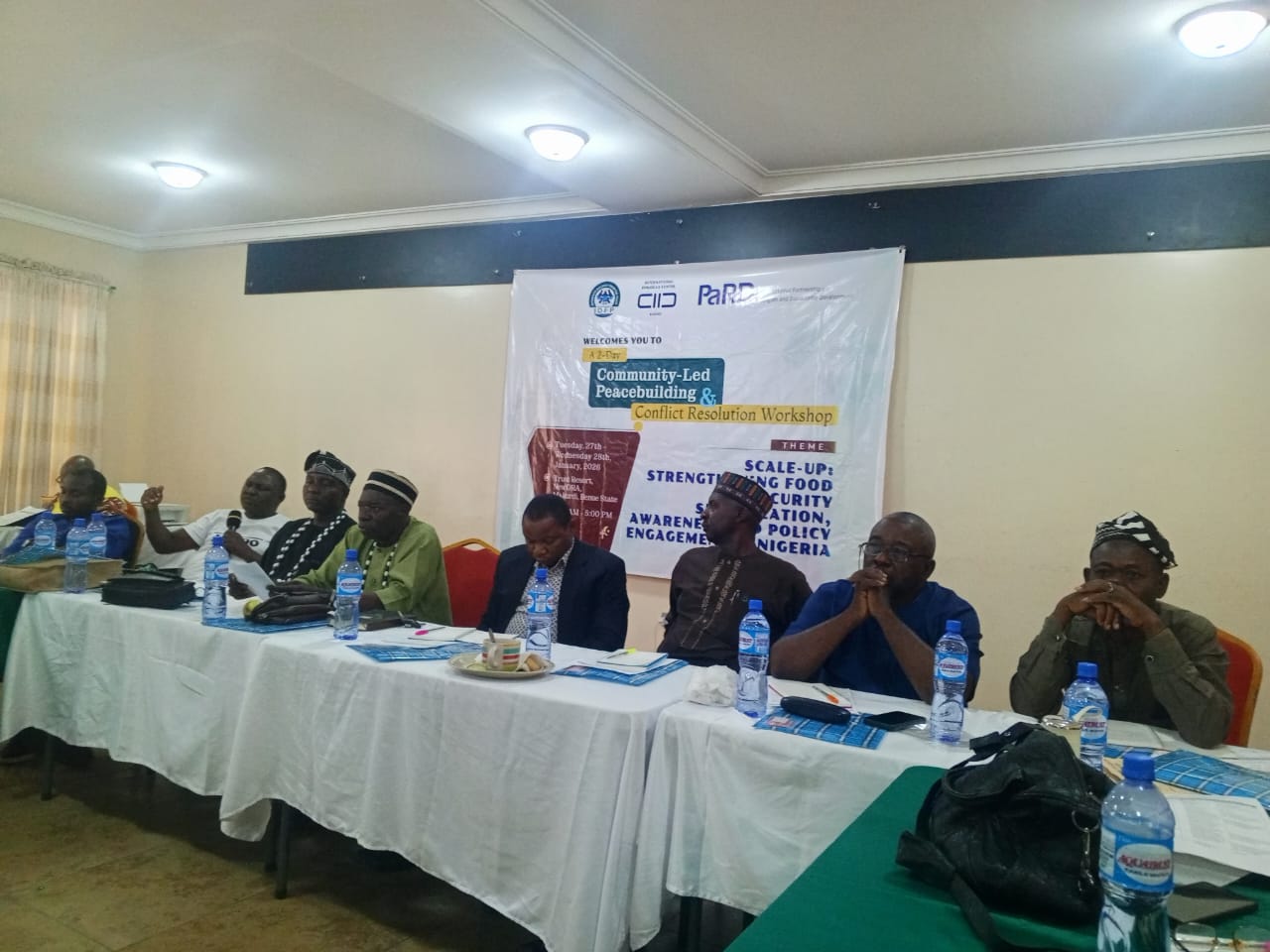
Stakeholders from faith-based organisations, traditional institutions and academia have converged in Benue State for a two-day community-led peacebuilding and conflict resolution workshop aimed at strengthening food security sensitisation, policy engagement and sustainable peace across conflict-affected communities.
The workshop, themed “Scale-Up: Strengthening Food Security Sensitization, Awareness and Policy Engagement in Nigeria,” was organised by the Interfaith Dialogue Forum for Peace (IDFP) in collaboration with the Interfaith Dialogue Network (IDN), Benue State chapter, with support from the International Partnership on Religion and Sustainable Development (PaRD) and King Abdulaziz International Center for Interreligious and Intercultural Diologue (KAICIID).
Welcoming participants, the Co-chair of IDFP, Rev. Fr. Joseph Nomhwange, charged participants to be deliberate and actively committed to the peace process in order to achieve lasting stability in Benue State.
He described peace as a collective responsibility and stressed that meaningful engagement by community leaders was critical to ending recurring conflicts.
Rev. Fr. Nomhwange also provided insight into the operations of IDFP, describing it as a Nigerian interfaith non-governmental organisation established in 2017 and comprising over 120 Christian and Islamic religious leaders.
According to him, the organisation is active in 10 states affected by conflict and climate risks and has implemented more than 50 initiatives, reaching over 2,000 beneficiaries nationwide, with a focus on interreligious dialogue, conflict prevention, mediation and community peacebuilding.
The Co-secretary of IDFP, Imam Shefiu Majemu, said the workshop was a continuation of engagements that began in November 2022. He explained that the current programme represents the first phase of a three-phase project, with the second phase expected to commence in February 2026.
Majemu noted that the project is part of a flagship initiative linking food security, peacebuilding and climate resilience, and explained that Benue State was selected due to its strategic importance as Nigeria’s “Food Basket” and the severe challenges it faces from farmer-herder conflicts, climate change and weak agricultural systems.
Other News
He noted that the challenges have resulted in food insecurity, malnutrition, displacement of families and persistent community violence and emphasized the rationale for faith-based action.
He described religious leaders as trusted voices deeply embedded in communities and influential in shaping attitudes and behaviour saying faith actors have proven effective in mediating conflicts, promoting peaceful coexistence and supporting food security and community resilience.
The workshop, he added, aimed to strengthen community-led responses to conflict, address the intersection of food security, climate change and peace, empower faith leaders as agents of dialogue and mediation, and support sustainable peace in Benue communities while articipants are expected to be trained in conflict analysis, mediation techniques and peacebuilding strategies to enable them serve as local peace champions.
In her presentation on “Understanding Peace and Security,” Hajiya Lantana Abdullahi described peace as more than the absence of violence, explaining that it also involves freedom from fear and the presence of justice and stability. She drew from religious and academic perspectives, referencing the concept of negative peace as the mere cessation of hostilities and positive peace as sustainable and structural peace built on strong institutions and values.
Former Benue State Commissioner for Education and IDN State coordinator, Prof. Peter Agogo, alongside Mallam Ahmad Baba, who spoke on behalf of Alhaji Garba Baba, Co-chair and Chairman of Jama’atu Nasril Islam (JNI), commended IDFP for its consistent mediation efforts and also acknowledged the role of the Benue State Government in supporting peace initiatives.
The Ter Makurdi, His Royal Highness Vincent Aule, the kindred head of Walomayo welcomed the IDFP delegation to Benue State and thanked the organisation for prioritising the state in its peacebuilding efforts.
In the same vein, IDN desk officer Dr Abigail Gire thanked the IDFP for considering the plight of Benue people.
Participants at the workshop identified persistent crises and climate change as major factors undermining Benue’s status as the nation’s food basket and called for stronger collaboration to end violence.
The workshop is expected to culminate in the launch and signing of a peace and policy commitment document, the validation of a programme activity framework for interfaith dialogue, and the inauguration of an Alternative Dispute Resolution community of practice, aimed at ensuring practical implementation and measurable outcomes beyond previous engagements.