Follow Us on Google

By Chinelo Obogo
A social media experiment carried out by a Nigerian X user has revealed the impact of Nigeria’s prolonged inflation crisis.
Olabode Ifeanyi, a Lagos-based X user, revealed how in 2025, he repurchased every item from a five-year-old supermarket receipt and his findings showed that groceries which cost ₦25,225 at a Lekki supermarket in 2020 now cost ₦147,050 at the same store, showing a 582% increase.
“Last night I decided to buy every single item on this receipt from 2020. To find out how bad things really are. If your salary in 2020 has not increased by 600 percent, you are poorer,” he said.
Both receipts, one from 2020 and the other from 2025 showed an astronomical price increase in everyday food staples. For instance, a 350g box of Nasco cornflakes he bought which cost ₦575 in 2020 now sells for ₦3,200, while Golden Morn cereal (600g) went from ₦670 in 2020 to ₦3,850 in 20205 and a 420g container of Quaker oats jumped from ₦530 to ₦3,250.
Other News
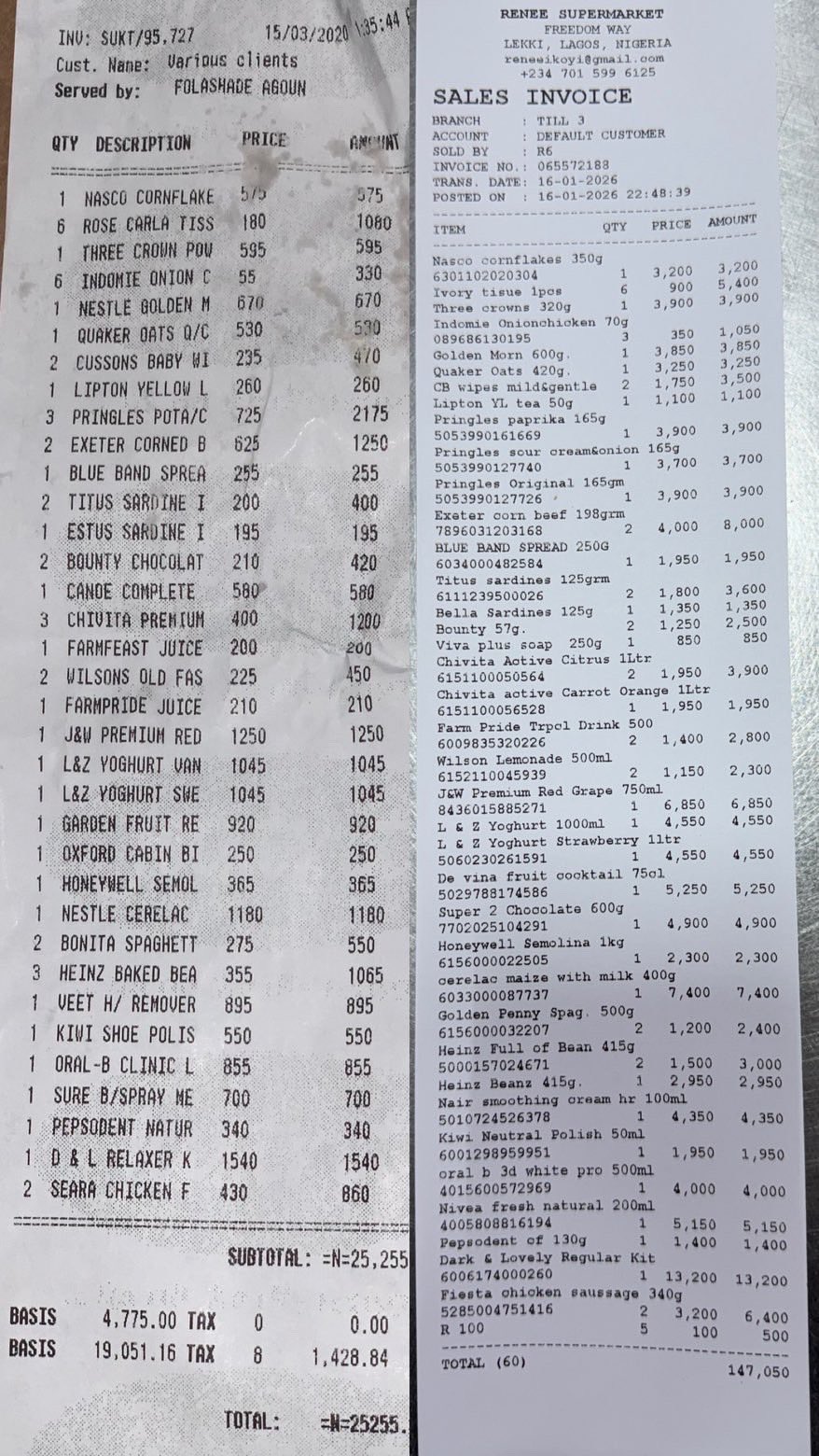
Nigerians responded to his post while documenting their own experiences with prices increase. Many shared that even those fortunate enough to receive salary increases have seen their purchasing power evaporate. “My salary has increased maybe 1.5 times since 2020. I used to think I was doing okay. This receipt just showed me I’ve been I am now poorer,” an X user said.
In 2020, Nigeria’s inflation rate stood at 13.25% as the country grappled with COVID-19 pandemic. Food inflation was at 16%, driven by insecurity in farming regions, and currency pressures. By 2021,inflation climbed to 16.95% as the naira weakened further. Food prices continued increasing, with staples like rice, beans, and cooking oil becoming increasingly unaffordable for average families.
In 2022, inflation got to 18.76% and by 2023, it was 24.53%. As of late 2024 and early 2025, food inflation has frequently exceeded 35%, making basic nutrition a struggle for millions of Nigerian households.