Follow Us on Google
By Remi Adefulu
Imobi, a sleepy community in Ijebu East Local Government, may not be a familiar terrain for a lot of Nigerians. But the story is gradually changing courtesy of an agricultural revolution never seen in many parts of the country.
Indeed, though several administrations had mouthed the idea of large-scale investment in agriculture, the actuality is that only few have walked the talk.
This is despite the fact that Nigeria, the acclaimed giant of Africa, has all that is needed to feed its people and export to other parts of the world. The glorious era was the era when Nigeria was yet to discover petroleum, thus making lots of revenue from cocoa, rubber, and other products.
But Imobi and several communities across the country seem determined to change the narrative by being at the front burner of the Federal Government’s agric revolution through cotton farming. This initiative is courtesy of a daring entrepreneur, Ms. Ololade Adeneye in collaboration with local and international partners who are determined to change the narrative.
This was buoyed by the agric masterplan of the Buhari administration through the Anchor Borrowers Programme which sought to provide a lifeline to many sectors, including agriculture.
Adeneye, who holds a degree in fashion and sustainable textile design and an MBA from the University of West London, left her United Kingdom base to key into the project with her full chest She was not just coming, she had a clear focus on the cotton value chain through her organisation, House of Dorcas Integrated Services (HDI)
For the records, Nigeria, Africa’s largest population, grows long staple cotton, a premium variety known for superior fibre as a diverse producer of raw materials for textile applications. The diversity allows Nigeria to cater to both domestic and international markets. However, as a result of an underutilised industry, the country loses an estimated $6 billion annually, relying on imports despite having the resources for local production.
With a well-developed local industry, experts say Nigeria can generate over $10 billion into the country’s economy, significantly reduce imports and boost employment. Indeed, the roll call of stakeholders who gathered in Imobi for the harvest of the Nigeria Cotton Society was more than impressive and showed the significance attached to the event.
The list included the Minister of State for Industry, Senator John Enoh, top echelon of the Bank of Industry (BoI), Raw Materials Development and Research Council (RMRDC), National Cotton Society, Cotton Farmers Cooperative Society, Cotton Producers in Nigeria, All Farmers Association of Nigeria (AFAN), Federal University of Agriculture, Abeokuta (FUNAAB), international technical partners, Imobi community and more.
As evident at the event, it was not an accidental journey, but the climax of an event that took years of painstaking planning. In one of the sessions. The Vice Chancellor of Federal University Abeokuta, Prof. Olusola Kehinde one of the partners of the project, noted that the agric held so much in terms of prospects. He however noted that for agriculture to produce expected outcomes, there is the need for thorough research and innovation.
“Drawing from successful models in Brazil and Egypt, we must restore our commitment to driving Nigeria’s agric sector through research, data-driven practices and best agronomical techniques. “Emphasis must be on science-led agric, structured extension services and climate-smart farming to achieve food security and economic diversification. We therefore express our readiness to support the revamp of Nigeria’s cotton industry, focusing on high quality cotton production for textile manufacturing and export”.
Keying into that assurance from Ms. Adeneye and her team, including technical partners from Brazil and others organised training programme on best practices for all connected with the initiative with the aim of raising the bar in the next farming season. They were taken through theoretical and practical aspects of the cotton and garment value chain, with participants being exposed to some of the latest cotton planting techniques and equipment.
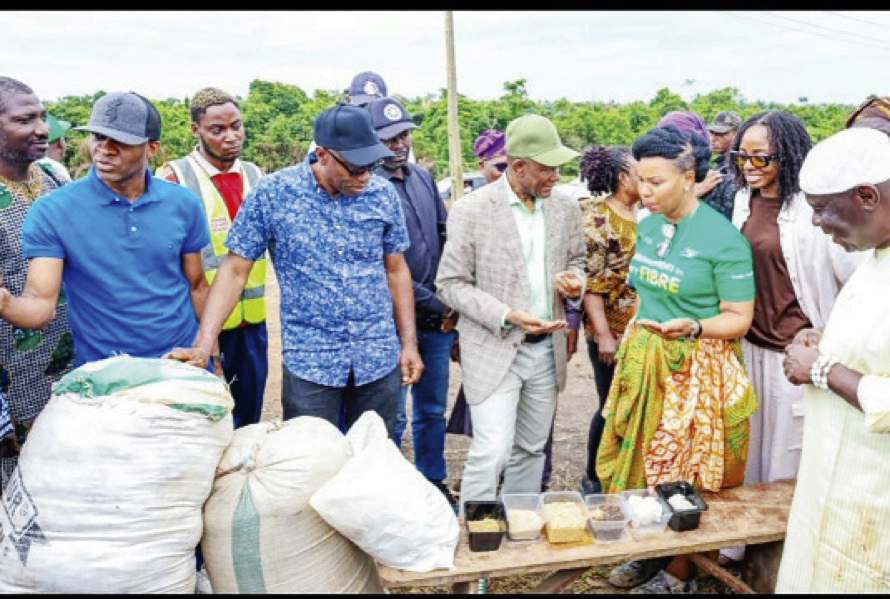
All these eventually paid off with a bountiful harvest, which attracted several stakeholders to witness what is now seen as an emerging revolution in the industry. Speaking at the event, an elated Minister of State for Industry, Senator John Enoh, seized the opportunity to reiterate his call for all hands to be on deck to get the best from the cotton and garment value chain for a prosperous Nigeria.
Said he: “As part of the on-going implementation of the National Cotton, Textile and Garment Industrial Transformation Plan (NCTG-ITP), I led a field visit to HDI demonstration cotton farm in Imobi, Ogun State.
“The visit enabled direct engagement with the farmers, technical partners and Phase 1 pilot stakeholders, while providing on-site visibility into improved cotton cultivars and irrigation systems supporting year-round production. “We were joined by key institutions including Bank of Industry, Bank of Agriculture (BOA), the RMRDC, as well as representatives from textile associations.
“The HDI demo farm serves as a practical pilot for Nigeria’s cotton revival, focused on validating production systems that can reliably supply raw materials to the textile industry. Two distinct approaches stand out: best practice cultivation to optimize yield and fibre quality, and stress-tested plots designed to build resilience under real field conditions.
“A key highlight for me was HDI’s strong community engagement model. The farm serves as a training and knowledge transfer platform, equipping local farmers through hands-on support/extension services and technical collaboration.
“We remain committed to working with stakeholders, unlock sustainable growth, improve livelihoods and reposition Nigeria’s cotton, textile and garment industry for long-term competitiveness.”
His views were corroborated by Prof Nnanyelugo of the RMRDC, who noted that their presence at the event reflected the council’s commitment to promoting effective use of local raw materials. In her speech, Ms Adeneye declared that the Cotton, Textile and Garment (CTG) conversation has moved beyond policy, noting that it is now about execution.
“Industrialisation begins with raw materials. If we do not get cotton production right in quality and quantity, the entire value chain cannot function. We must begin to see the CTG value chain differently. Cotton production, ginneries, textile manufacturing and garment production must operate as independent industries, but also as interdependent systems. That is how sustainable industrial ecosystems are built.
“At HDI, we have taken a structured approach. We are not just growing cotton, we are building a system that integrates farmer training, extension development and research collaboration, digitalization of farmers data, tracking and traceability, market linkage, grading and standardization, because without structure and systems, there is no sustainability and without sustainability, there is no industry.”
The journey to that proposition may have just begun as two key stakeholders in the project, BOI and RMRDC, have signed a Memorandum of Understanding (MoU) to enter into a strategic partnership to strengthen the agric value chain. The agreement will help to convert research into bankable projects, add value, create jobs and retain wealth within the economy, among others.