Follow Us on Google
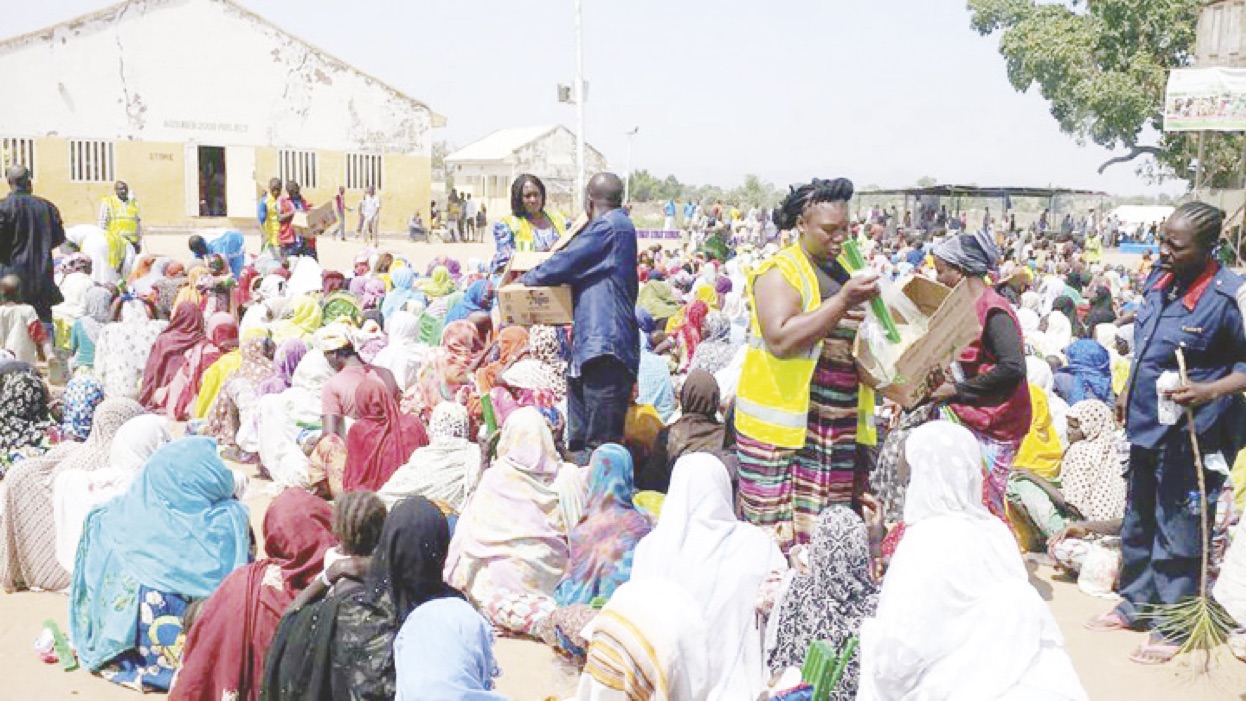
…Beg president to ensure their safety in ancestral communities
By Noah Ebije (Kaduna), Scholastica Hir (Makurdi), Olanrewaju Lawal (Birnin Kebbi), Lucky Ighomuaye (Benin)
Fifty-six years have passed, yet the memory of the harrowing experience of being an Internally Displaced Person (IDP) is still fresh in the mind of Mrs Udodinma Ibezim.
Today, Ibezim, whose first name means “peace is good” presides over a successful publishing enterprise in Lagos.

But back in 1967, her family became displaced from Kaduna in the heat of the crisis that engulfed the Northern parts of the country and quickly degenerated into the Nigeria-Biafra Civil War that lasted for 30 months and ended in 1970. Over two million people were said to have died in the war and an estimated 10 million internally displaced, according to a publication on www.reliefweb.int based on a report by the Global IDP Database of the Norwegian Refugee Council on its country profile on internal displacement in Nigeria.
With some parts of the country caught in the web of the worsening attacks of armed herdsmen and bandits, Ibezim, like most her compatriots who survived the civil war, is disturbed by the fate of IDPs in the various camps across the country.

In the Southeast, the Orlu Senatorial Zone of Imo State, questionable, inhumane and heavy-handed operations of the army worsened by the activities of unknown gunmen have forced many families to abandon their ancestral homes to flee to the capital city of Owerri, and several other semi-urban communities around it, to seek refuge as tenants. The pathetic situation in Imo State began in 2020 and has got worse over time.
As noted by Relief Web, “while the displacement of the magnitude that occurred during the civil war has not been repeated since approximately 500,000 people were forced to flee their homes after ethnic violence rocked the country in October 2001,” the majority of whom returned to their homes by mid-2002.
“Available figures suggested that towards July 2002, a total of at least 30,000 people remained internally displaced in Nigeria. This figure is mainly composed of a remnant of the June/July 2001 clashes involving Tivs in Nasarawa and Taraba states, as well as people still displaced after the October 2001 violence in Benue State involving Tivs and the Jukun/military.
“The exact extent of displacement is difficult to estimate because many internally displaced people seek shelter within social networks and relocate to other towns and communities to join other family and clan members.”
The incidence of internally displaced persons in the present circumstance, as noted earlier, is attributable to the marauding armed herdsmen and bandits rampaging and stacking whole populations in farming communities.
As the Federal and affected state governments continue to grapple with the menace of banditry and herdsmen attacks which fuel the displacement of people in more communities, swelling the population of IDPs, Sunday Sun went to some of the camps to find out how the IDPs are faring? The big question on their lips remained: “When will us be able to return to our ancestral homes?” Below are snapshots of some of the states, where IDPs want urgent help from the government.
KADUNA
Kaduna State has been enmeshed in an enormous humanitarian crisis caused by deadly violence inflicted on farming communities by the armed, marauding Fulani men. Today, Southern Kaduna accounts for over 15 IDP camps, populated by over 75,000 persons, for whom the camps are the only home they have for now.
The attacks dated back to 2015 when General Muhammadu Buhari and Nasir el-Rufai were elected as president and governor, respectively. The killings, maiming, raping and other atrocious, dastardly acts seemed to have been emboldened during the tenure of both Buhari and el-Rufai. By 2017, kidnapping and banditry in Kaduna had displaced several communities in Southern Kaduna.
In Birnin Gwari in the Kaduna Central zone, cattle rustling has continued to be a major problem, but in the Kaduna South zone, things have gone several steps higher especially as the victims are people, not cattle.
The displaced communities were left with no option, but to resort to living in the various IDP camps in the zone. The then National President of Southern Kaduna People’s Union (SOKAPU), Jonathan Asake, said that 15 of such IDP camps were spread across the Southern Kaduna Senatorial zone with an estimated 75,000 internally displaced persons.
This showed that each camp has a population of over 5,000 persons, who sleep in open spaces and battling with hunger and diseases. Some of the camps are Mercy IDP camp in Zonkwa, Zangon Kataf, Mariri camp in Lere LGA and Ladduga in Kachia LGA, Maraban Rido camp, Gonin Gora camp in Chikun LGA, among others.
The earnest and subsisting desire of the displaced persons is that the Federal Government would be decisive in restoring adequate and sustainable security in their communities and rebuilding their houses, to enable them to return to their ancestral homes to farm and continue with other daily activities.
There now appears to be a ray of home in this regard as the Kaduna State government has concluded arrangements in collaboration with the security agencies, especially Operation Safe Haven, to resettle Southern Kaduna communities displaced by bandits, back to their ancestral homes.
The government said that the resettlement would be done in batches. The Kaduna State governor, Senator Uba Sani, disclosed the collaborative move while briefing journalists shortly after holding a meeting of the State Security Council at Sir Kashim Ibrahim Government House, in the penultimate week.
Governor Sani said that the government was ready to provide all logistics necessary to resettle the displaced communities to their ancestral homes.
He said that the government will be assisting the displaced people to rebuild their destroyed communities where the need arises.
His words: “Fighting insecurity is the number one agenda of this administration because we believe, without resolving the security challenges, we might not be able to achieve all the development agenda of our government.
“We have invested a lot in the area of development, but I believe addressing the problem of insecurity is key. And as a government, we have promised to ensure that our people live in a secured environment.
“We have been able to achieve a lot and we will not relent, we will continue to fight the bandits, the insurgents and the criminals within Birnin Gwari and Southern Kaduna axis. The security reports from the security chiefs have shown that we are making progress, and we will continue to support them in terms of logistics and technology.”
On Southern Kaduna, Governor Sani said: “We are working together with Operation Safe Haven under the command of the GOC 3 Division, General Abubakar on the resettlement of displaced Southern Kaduna communities. This is because the security and safety of our people is a fundamental human right of the people, it is not something that the government needs to think twice before doing.”
BENUE
As of May 2023 when the immediate past administration led by Governor Samuel Ortom wound up, official figures of IDPs in Benue State stood at over 2 million. At that time, the state established eight official camps while other camps were not official.
But Sunday Sun learnt from the Executive Secretary, State Emergency Management Agency (SEMA), Sir James Iorpuu, after Governor Hyacinth Alia took office, that he saw the need to increase the number of camps in the state to enable him give better care to persons of concern.
This was also necessitated by the fact that more communities were being attacked and more people were being displaced.
According to Iorpuu, Benue currently has 14 IDP camps which have been in existence for six years.
The camps include Ichwa/NEPA, Abagena and Baka IDP camps located in Makurdi Local Government Area, Gbajimba I, Gbajimba II, Ortese, Daudu I, Daudu II in Guma LGA, Anyiin and Ugba camps in Logo LGA, as well as Naka and Agagbe in Gwer West LGA.
Currently, the International Organization for Migration (IOM) and the United Nations High Commissioner for Refugees (UNHCR) are working on biometric capturing of IDPs in Benue State. Until the exercise is completed and verifiable data on IDPs obtained, Iorpuu said that Benue State will continue to use the projected figure of one million and some fractions of the population.
The IDP situation arose as a fallout of a series of attacks carried out by terrorists and bandits masquerading as herdsmen in Benue communities.
About 18 out of the 23 LGAs of the state have been under attack by herdsmen and terrorists which started earlier, but gained momentum in 2018.
While over 6,000 persons have been killed in the attacks, according to the immediate past administration, over two million others have been displaced.
While both the federal and state governments are making frantic efforts to curtail the killings, Benue has witnessed relative peace even as the hostilities in the ancestral communities have continued.
Even in their helplessness, IDPs in Benue, like their Sokoto counterparts, have faced attacks while living in dehumanizing conditions in the camps.
It would be recalled that on April 7, this year, gunmen suspected to be herdsmen attacked an IDP camp in Mgban, Nyiev Council Ward of Guma LGA of the state, killing over 36 people, including aged persons, women and children.
Also last month, herdsmen, again, attacked an IDP camp at Nagi, Mabchohon Council Ward located along Naka-Agagbe road in Gwer West LGA of the state, killing three persons and injuring others.
Frustration has been the lot of the IDPs as they are demanding that the Federal Government fulfils the promise it made to resettle them in their ancestral homes.
For seven years, Festus Adzende has been living in the Abagena IDP camp. He is now the chairman of the camp. His pain and psychological weight of being an IDP are all too easy to feel as he said: “It has been very challenging staying in the camp. We have faced challenges of food, hygiene, shelter, and clothing, among others. The environment is not conducive, our younger ones have not been going to school. The government provides food, but it’s never enough.
“Several times, we have made efforts to check on our villages, but we usually narrowly escape being killed because the herdsmen are still there and when you insist on going, you can only come back by God’s grace.”
What does he want from the government, Sunday Sun asked, and he said: “Nothing much, even though the government gives me food, shelters me, it will not be okay for me. What they need to do for me is to return me to my ancestral home. I need to see my father’s home. I need to stay there.
“Even if you give me a lot of money now, that will not give me rest, but going back to my ancestral home will make me happy, it will give me peace. I’m a farmer and I need to produce my food and not be given food. When we were in the village, we produced rice, beans, yams, guinea corn, and millet and we were not hungry, but these days, we hardly know when the next meal will come or from where.”
Residing and coping in the camp have been rough and difficult for Adzende, who recalled that his parents were killed during the attacks on their village in Guma LGA.
In the wake of that tragic attack, he had to move into the camp with his siblings.
“This is where I have grown to maturity because when I came here I was young. I just want to go home and if the government can do this for me, I will be very happy,” he said in an emotion-laden voice, with tears rolling down his cheek.
Another inmate at Abagena, Denis Baki, said that life on the camp has been very miserable.
He has been living in the camp since 2018 with his whole family, comprising two wives and 13 children.
Baki who hails from Torkula village in Guma LGA said that they need security in their village to enable them to go back home.
He recalled that he used to fend for his family without hitches and expressed pain that he could no longer do so for the past seven years.
“We want to go back to our villages. We want the government to set up security bases in the communities because no matter what you do, without security, these people will continue to invade and kill us.”
Philomena Chiata, a mother of four, has been in camp for the last six years. Like the other IDPs in camp, she said point blank: “We want to go home. They used to give us food here, but we are many and it hardly goes around. We used to farm and feed ourselves. We lived peacefully and happily, but now, we sleep hungry, live in fear and our children do not know where they come from. We are tired, we want to go home and rest. The government should chase those killers away from our villages, give us an army post to guard us so that we can go and rest without fear.”
Meanwhile, the Federal Government has commenced the construction of resettlement homes for IDPs in Benue State. It is hoped that the issue of security will also be adequately addressed before they are finally returned home.
KEBBI
In Kebbi State, operatives of the Vigilante Group of Nigeria, VGN, have been confronting the bandits in their strongholds, determined to rout them and restore security to people in the beleaguered communities.
The efforts of the vigilantes have been paying off as recent reports indicated.
In collaboration with security agencies, VGN operatives have been successfully neutralizing bandits in the affected areas.
Sunday Sun learnt from the Director of Security in the state, Abdulrahman Usman, that recent successes resulted from a high level of vigilance of all the security agencies in collaboration with the VGN, to flush out the criminals from the affected areas.
Usman explained that the success story was due to credible intelligence information which led to the arrest of many bandits’ informants, who after being captured then led the VGN operatives to the bandits’ hideouts in the forest. In the ensuing gun battle, several of the bandits were killed.
Fortunately, Kebbi State has no operational IDP camps. Before the commencement of collaboration and expression of resolve to neutralise and defeat the bandits, they had been a menace to people in the communities who came under attacks in various towns and villages in parts of Zuru and Yauri Emirates, which were prune to bandits attacks as a result of sharing borders with Zamfara and Niger states, which happened to be their hiding places.
As a result of those attacks, those displaced took temporary shelter in schools in their areas. Prompt action by security agencies and vigilantes enabled the displaced people to return to their respective ancestral communities due to adequate security provided by the state government.
Usman while commending the VGN operatives spent the night in the forests until daybreak when they successfully overpowered the criminals during the exchange of gunfire, killing three of the bandits.
EDO
At Ohogua in Ovia North East Local Government Area of Edo State, Pastor Solomon Folorunsho is the coordinator of the only IDP camp in the state, and indeed the neighbouring states of Edo – Delta and Ondo states.
The camp is known as the Home For the Needy, and it started catering for IDPs in 2012.
“This is about the only IDP camp that I know. I don’t think that there is any other IDP camp in Edo State even in the neighbouring states, there is no IDP camp.
“This is the only one that I know that is functioning and which everyone can see.
“The IDPs came here in 2012 and from 2012, we have had over 8,000 inmates and more than 7,000 have relocated and reunited with their families and some have left to other parts of Nigeria, like Taraba, Abuja and Maiduguri and a few to Gwoza in Borno State, where there is relative peace while we still have over 3,000 around,” Folorunsho said.
He blamed acts of terrorism for the plight of the inmates, noting that the IDPs are nostalgic and are willing to go back to their ancestral homes, but saying that the government must assure them of their safety first.
“Terrorism, insurgency was what forced them out of their homes and places. Their houses were burnt, the parents of most of them were killed, their mothers taken away, their sisters abducted and forced into marriage, and the males slaughtered or captured and forced to join the terrorists. The ones that fled, some of them are the ones that are here while some of them don’t even have family to run to at all.
“The IDPs want the government to first of all clear out the terrorists from their places, from their local government and their state.
“When the terrorists are cleared, the next thing is for the government to get their facilities running again because they will need water, and all that and everything prepared for them to go back. Like the ones that are here, they want to go to school. You can see now, that everywhere is quiet because they are all in their classes and few of them who still have families would love to go back to their homes. Some of them are still afraid, they don’t know what will happen when they get back to their places.
“So, if the government can assure them of their safety, they love their homes, they talk about it all the time, but they want the government to assure them of their safety because even recently some of them that left here to Borno State, some of them were killed by Boko Haram.
“They sent us their pictures, between Gwoza and the neighbouring community and these things are not even in the news. So, these things tend to put fear in their minds that their places are not safe.
“So, if the new government can take out these terrorists, assure them of their safety, they will go back. As it is always said, home is home and there is no place like home, they will be willing to go home,” the IDP coordinator said.
He appealed to the government and well-meaning Nigerians to come to the help of those who are still in school so that they can complete their education.
“The IDP here, you see like I said, we give them quality education and that is why you see the results that are coming out.
“I want the government to intervene by providing school materials for those in nursery, primary and secondary schools; they need books. They need towels. Almost everyone in this camp doesn’t have towels and when they bath, they just put on their clothes because there are no towels to clean up their bodies.
“They also need mattresses. The ones that they have are worn out. They also need food items. Sometimes, they eat once a day and at times, they don’t even eat at all,” Folurunsho said with his emotion betraying his pain over the depth of lack in the camp.