Follow Us on Google
By Chinenye Anuforo
[email protected]
Nigeria entered 2025 determined to accelerate its digital transformation. From broadband expansion and telecom reforms to cloud infrastructure, startup regulation and data protection enforcement, the country’s ICT agenda was broader and more ambitious than at any time in the past decade.
But subscribers did not feel the impact as dropped calls, epileptic Internet services and undelivered SMS have lingered despite a 50 per cent hike in tariff.
Government officials spoke confidently about building digital public infrastructure, unlocking innovation and positioning Nigeria as West Africa’s technology hub.
Yet, as the year unfolded, progress across the ICT sector proved uneven. While parts of the industry posted record revenues and attracted fresh investments, others struggled with infrastructure failures, rising costs and policy execution gaps.
Candidly, 2025 stood out not as a year of seamless transformation but as a year that exposed the fragility and growing pains of Nigeria’s digital economy.
Telecom financial recovery without consumer relief
Telecommunications remained the backbone of Nigeria’s ICT ecosystem in 2025, carrying everything from mobile banking and e-commerce to streaming, education platforms and government services. The sector’s defining moment came in January, when the Nigerian Communications Commission (NCC) approved a 50 per cent tariff adjustment, ending an 11-year price freeze.
The regulator framed the move as a sustainability measure, arguing that years of rising operational costs, energy, diesel, security, foreign exchange exposure and equipment imports had eroded operators’ ability to maintain networks. Executives said the adjustment would stabilise finances and unlock long-delayed investment.
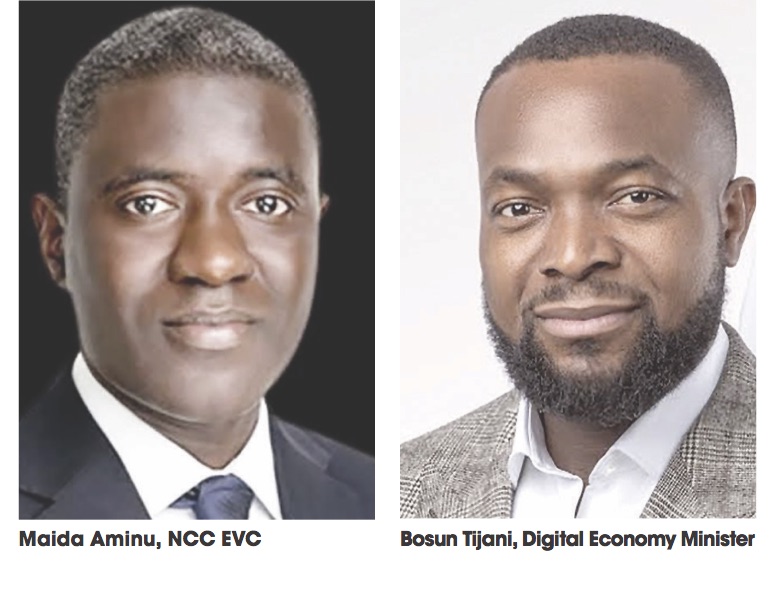
Specifically, the NCC Executive Vice Chairman Dr. Aminu Maida said the sector was at risk without intervention. “There had been a significant disconnect between operational costs and existing tariffs. This adjustment was necessary to stabilise the industry while ensuring that service delivery is not compromised”, he explained.
Financially, the impact was immediate. Major operators recorded sharp increases in Average Revenue Per User (ARPU), reversed losses and returned to profitability. For the first time in years, telecom companies had the balance-sheet strength to fund large-scale capital expenditure.
For consumers, however, the experience was far less positive. Higher tariffs landed in the middle of a cost-of-living crisis, triggering backlash from households, students and small businesses. While connectivity remained essential, many users complained that service quality did not improve in proportion to the higher bills, reinforcing public scepticism about whether telecom reforms were delivering inclusive benefits. A Lagos-based small business owner told Daily Sun that, “The Internet is no longer a luxury, it’s how we work. When prices go up but service stays the same, it feels like punishment.”
Broadband, fibre and expansion drive
Beyond tariffs, broadband expansion sat at the core of the country’s ICT strategy. The National Broadband Plan set a 70 per cent penetration target, while Project Bridge was introduced as a flagship initiative to dramatically expand the country’s fibre backbone through a public-private partnership model.
The plan was bold, tens of thousands of kilometres of open-access fibre, financed through a special-purpose vehicle with development finance support, designed to lower wholesale costs, stimulate ISP competition and extend connectivity to underserved areas.
Minister of Communications, Innovation and Digital Economy Bosun Tijani described broadband as fundamental to Nigeria’s economic future.
“You cannot talk about AI, digital government or innovation without broadband. Connectivity is the backbone of productivity in the modern economy”, Tijani said.
In execution, progress lagged ambition. By late 2025, broadband penetration remained below 50 per cent, well short of the stated target. Delays in right-of-way approvals, rising deployment costs, macroeconomic pressures and coordination challenges slowed fibre rollout. Development finance commitments and state-level agreements struggled to translate into rapid construction on the ground.
An Industry analyst and Chief Executive Officer of Jidaw Systems Limited, Mr. Jide Awe, who is familiar with the project noted: “The ambition was right, but fibre deployment is not just about money. It requires speed, alignment across states and solving last-mile economics. Those pieces didn’t move fast enough.”
The implications extended beyond connectivity metrics. Weak broadband constrained productivity across sectors, limiting remote education, telemedicine, e-commerce growth and digital government services. The shortfall highlighted a recurring theme of 2025: strong policy vision, but uneven delivery.
5G: Myth without meat
5G remained the headline, the promise rather than the lived reality. NCC data showed 5G subscriptions growing rapidly from a very small base, yet still accounting for only a fraction of total mobile connections. Fourth-generation (4G) networks continued to dominate usage, while legacy technologies persisted in many areas.
By late 2025, 5G subscription was at five million, concentrated largely in high-income urban clusters such as Lagos and Abuja. The figure showed the structural barriers holding back mass adoption: limited geographic coverage, high device costs and inconsistent service quality.
A regional telecom policy analyst at the SAMENA Council observed that Nigeria’s experience mirrored a broader continental pattern.
“5G is expanding, but it remains an urban, premium service. Until affordability and coverage improve together, it will not become mainstream.”
Affordability proved to be a critical constraint. Device availability, network consistency and rollout pace continued to restrict adoption. For many Nigerians, the cost of 5G-capable smartphones alone placed the technology out of reach, even before data pricing was considered.
Yet, despite its limited penetration, 5G retained symbolic and strategic importance throughout 2025. Policymakers and industry leaders increasingly framed it as a competitiveness marker, which Nigeria must eventually scale to unlock productivity gains in logistics, healthcare delivery, education, creative industries and cloud-enabled small and medium-sized enterprises.
“5G is not just faster internet. It’s the infrastructure layer for the next phase of economic productivity. Nigeria cannot afford to fall behind”, Awe said.
Network sharing and infrastructure protection: cutting costs, reducing downtime
One of the most pragmatic shifts in the sector in 2025 was a renewed focus on infrastructure efficiency and resilience.
In March, MTN Group and Airtel Africa announced an agreement to share mobile network infrastructure in Nigeria (and Uganda), explicitly framing the move as a way to reduce capital expenditure, accelerate rollout and expand coverage in areas where duplication had become economically unsustainable.
Commenting on the decision, industry executives described network sharing as a necessary evolution rather than a competitive retreat.
“The economics of telecoms have changed. Sharing infrastructure allows operators to invest smarter, not just bigger”, the Association of Licensed Telecommunications of Nigeria (ALTON) Chairman, Mr. Gbenga Adebayo had said.
The move was widely interpreted as a signal that the operators were adjusting to a higher-cost environment, one where sustainability required collaboration as much as competition.
At the policy level, infrastructure protection also moved into sharper focus. By October 2025, government officials and regulators were openly acknowledging that fibre vandalism and asset damage had become systemic threats to broadband expansion. The NCC repeatedly urged stronger protection of telecom infrastructure, stressing that investment alone could not deliver connectivity without security and enforcement.
NCC Maida, speaking at an industry forum, warned: “When infrastructure is destroyed faster than it is deployed, no amount of capital can close the connectivity gap.”
Fibre cuts and infrastructure sabotage: The silent ICT crisis
Perhaps the most disruptive force across the country ‘s ICT sector in 2025 was physical infrastructure failure. Despite telecom and digital infrastructure being designated Critical National Information Infrastructure, fibre cuts and vandalism surged nationwide.
These incidents did not only affect phone calls and mobile data. They disrupted payment systems, cloud access, banking platforms, enterprise networks and government services, revealing how deeply dependent the entire ICT ecosystem has become on fragile physical infrastructure.
Operators reported tens of thousands of fibre cuts by mid-year, many caused by road construction, theft or sabotage. The financial cost was enormous, but the opportunity cost was even greater. Capital earmarked for expansion and innovation was repeatedly diverted to emergency repairs, slowing progress across the ecosystem.
The ripple effects were felt by startups, SMEs and digital service providers whose platforms rely on stable connectivity. In many cases, outages translated directly into lost revenue, failed transactions and damaged consumer trust.
MTN Nigeria’s Chief Technology Officer, Yahaya Ibrahim, warned that vandalism was undermining investment outcomes.
“Spare parts and equipment originally meant for capacity expansion are now being used to fix damages. That directly delays network upgrades and slows overall progress”, Ibrahim said.
Regulators described the situation as a national emergency, while industry executives warned that without coordinated enforcement and real consequences for vandalism, billions of naira in investment would continue to be lost to repeated repairs.
Data centres and cloud
Amid these challenges, 2025 also marked a significant shift in the nation’s digital infrastructure layer. Data centres and cloud-adjacent investments moved from niche discussions to central pillars of ICT development.
Major operators and infrastructure companies launched or expanded large-scale data centre projects in Lagos, signalling confidence in Nigeria’s long-term demand for local hosting, cloud services and content delivery. These facilities were positioned to support fintechs, media platforms, enterprise software providers and government digital services while reducing latency and dependence on offshore data hosting.
For instance, MTN Nigeria launched the first phase of its $235 million data centre project in Lagos, positioning it as a serious move into commercial hosting and cloud-adjacent services. This phase was described as a multi-floor facility with significant IT load capacity and hundreds of racks, an investment meant to support local cloud demand and reduce reliance on offshore hosting.
The sector’s broader data centre ambitions also became more visible as Open Access Data Centres (OADC), disclosed large investment plans, including a hyperscale project in Lekki with timelines stretching into the coming years.
The business case is clear: as payments, streaming, enterprise software, government services, and AI workloads grow, the economy needs faster, cheaper local computers and stronger, more reliable power and connectivity to keep those facilities running.
Industry leaders argued that local data centres are no longer optional. “You cannot scale fintech, e-government or enterprise services on offshore infrastructure alone,” said Ike Nnamani, Chief Executive Officer of Digital Realities. “Latency, data sovereignty and resilience now matter”, he explained.
The growth of local data centres reflected a broader recognition that a country’s digital economy cannot scale sustainably without domestic compute capacity, reliable power and resilient connectivity. However, the same issues plaguing telecom networks, power instability, security risks and fibre damage also threatened these investments.
“Power instability and fibre damage don’t stop at base stations,” one operator noted. “They affect data centres too.”
Startups, fintech and the reality of selective capital
The startup ecosystem remained one of Africa’s most active in 2025, particularly in fintech, digital payments, logistics, health tech and enterprise software. The implementation of the Nigeria Startup Act continued, with efforts to formalise ecosystem participation through startup labelling and institutional support structures.
Yet the funding environment was far more cautious than in earlier boom years. Rising costs, macroeconomic uncertainty and global capital tightening meant investors became more selective. Startups were pushed to prioritise unit economics, infrastructure efficiency and clear paths to profitability.
For many founders, infrastructure reliability , power, connectivity, cloud access, emerged as a bigger constraint than access to capital itself, reinforcing how closely innovation outcomes are tied to core ICT infrastructure.
Data protection and digital trust
Another defining development of 2025 was the strengthening of Nigeria’s data protection regime. The Nigeria Data Protection Commission (NDPC), operating under the Nigeria Data Protection Act, intensified compliance expectations across sectors.
A major milestone was the General Application and Implementation Directive (GAID) 2025, which multiple legal and regulatory updates noted took effect in September 2025, signalling a new phase of implementation detail and compliance expectations.
Enforcement also became more explicit. Reports and professional updates in 2025 described NDPC compliance actions, including sector-wide notices and timelines for organisations to demonstrate compliance.
For the ICT market, this shift matters because Nigeria’s next growth wave, health tech, edtech, fintech, digital ID-linked services, depends on trust: how data is collected, stored, shared, and secured.
Rural inclusion and the unfinished agenda
Despite progress in urban centres, rural and peri-urban Nigeria remained on the margins of the ICT boom. Connectivity gaps persisted, outages lasted longer, and digital services were harder to access. Government-approved intervention programmes and rural connectivity initiatives advanced slowly, constrained by financing and execution bottlenecks.
For millions of Nigerians, participation in the digital economy remained aspirational rather than real , a reminder that ICT growth without inclusion risks deepening inequality.
An ICT sector at a turning point
By the end of 2025, Nigeria’s ICT sector stood at a critical juncture. Financial recovery in telecoms, growing data centre investments, and clearer digital policy frameworks pointed to long-term potential. At the same time, fibre cuts, power instability, missed broadband targets and uneven service quality exposed structural weaknesses that capital alone could not fix.
The lesson of 2025 was digital transformation is not only about innovation and investment, but about execution, coordination and resilience.
For Nigeria, the challenge ahead is clear. Building a truly national ICT ecosystem will require protecting infrastructure, accelerating fibre deployment, strengthening last-mile access, enforcing quality standards transparently, and ensuring that rising revenues translate into tangible improvements for citizens.
In 2025, Nigeria’s ICT sector showed both its promise and its limits. The coming years will determine which of the two defines its digital future.