Follow Us on Google
From Taiwo Oluwadare, Ibadan
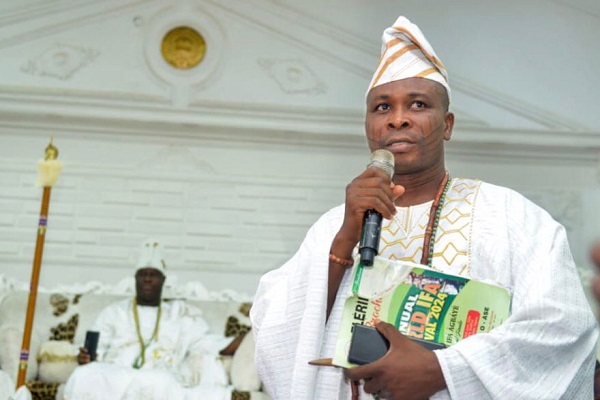
The Mogaji Onibudo of Ibadan and President of the International Council for Ifa Religion, Dr Fayemi Fatunde Fakayode, has debunked the long-held belief that the name Ibadan was derived from the words Eba and Odan. According to him, historical and linguistic evidence show that the ancient Yoruba city actually took its name from Iba and Odan, meaning “Pantry in the Meadow.”
Dr Fakayode made this clarification during the presentation of his paper titled “A Sociocultural Relevance of Osemeji Festival in the Modern Time” at the 2025 Osemeji Obamoro Conference, held on Wednesday at the House of Chiefs, Oyo State Secretariat, Ibadan.
The event was attended by representatives of the Oyo State government, traditional and religious leaders, and scholars from different fields.
Explaining his position, the Mogaji stated that the linguistic evolution of the city’s name supports Iba-Odan as the correct origin.
“If the two words were to be Eba and Odan, the linguistic transformation would have resulted in Ebadan after morphological change. Only Iba and Odan can transform to Ibadan,” he said.
Providing a historical context, Dr Fakayode narrated that Lagelu, the famed founder of Ibadan, was a Jagun (war general) from Ile-Ife who left the ancient city following a dispute with the then Ooni of Ife. Lagelu and his followers settled on a meadow between the grassland and the Egba forest, where they engaged in hunting.
“In Yoruba, a pantry or storehouse is called Ileba or Iba, while Odan means meadow. Hence, Iléba Òdàn or Ibà Òdàn translates to ‘Pantry in the Meadow,’ which later became Ibadan,” Fakayode explained.
Other News
He also dismissed the widespread notion that the colonialists’ mispronunciation of Ebadan led to the name Ibadan, arguing that English speakers were capable of pronouncing “Ẹ” sounds, as seen in words like “Elephant” and “Egg.”
“If the name were truly Ebadan, the whitemen would have pronounced it as such. They would not have pronounced Ede as Ide or Egba as Igba. This logic shows that Ibadan was never from Eba-Odan,” he insisted.
Fakayode called for a correction of the misconception in educational and historical references to ensure that future generations understand the true origin of the city’s name.
“We need to correct this henceforth so that our children and grandchildren can be properly educated about their heritage,” he urged.
Another paper presented at the conference, titled “The Roles of Ìṣẹṣẹ Practitioners in Economic Development,” was delivered by Surveyor Dasola Fadiran, a former Secretary of the Oyo State Branch of the Nigerian Institution of Surveyors (NIS).
Fadiran highlighted the economic significance of traditional religion and culture, emphasising the roles of art, herbal medicine, and cultural festivals in boosting tourism and generating revenue for Oyo State and Nigeria at large.