Follow Us on Google

- I did odd jobs to train myself
From BEN DUNO, Warri
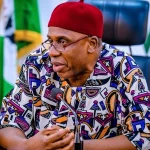
At 100 years of age, Ovie R.L. Ogbon, Ogoni- Oghoro 1, the Ohworode of Olomu Kingdom, an Urhobo community in Ughelli South Local Government area of Delta State, may be said to have seen it all. The mix of good and challenging experiences of life that ultimately translates to a glorious triumph for anyone who successfully took the gauntlet.
From a hopeless illiterate beginning, the Ogbon redirected his fate, going to primary school at age 20, doing odd jobs to sustain himself and later rising to become a respected educationist, a leader of thought in his community that paved way to the throne of his forebears.
The Ohworode, who celebrated his centenary birthday early this year, thus making him one of the oldest monarchs in Delta State and perhaps the entire nation, has been on the throne since March 5, 1988 when he succeeded a cousin to whom he had conceded the crown four years earlier, despite being the popular choice of his people.
A unique character of his reign is that Ogbon, a canon in the Anglican Communion, has kept to his Christian faith by not participating in communal ancestral rituals.
Although he was taken to court for allegedly shirking what was regarded as part of the obligations of his office, he won the case in 2011.
Hanging on the wall right inside his palace is an imposing life- size portrait of Jesus Christ diminishing the rest of the family portraits. There is also a massive rosary such as could only be found on the altar of a Catholic priest displayed right in front of the king’s throne signifying, perhaps, his orthodox belief.
Humble beginnings
The royal father in a chat with Saturday Sun, said, he was born on January 20, 1917 in Ogoni-Olomu, one of the over 16 communities in Olomu kingdom formerly known as Igwe-Ogoni. “I grew up in this place, I did all odd jobs young men usually do in African society in this place, we went to bush, clearing grass, tilling the ground, we also set traps for catching animals – grass cutters, rabbits, ‘ejoks’ and the rest of them. I started trading in tapioka hawking it from my village to a place called Ekuigbo in Ughelli, Ojekota, Ogor and afterwards to sell at Umuno market in Olomu kingdom. I worked as a labourer clearing farms for people in Ughelli, paid two shillings for a whole day. Before this, I also served as a baby sitter for two of my senior sisters- Atekem Moses Emiora at Worwor area and Mrs. Eitugbo Adaje at Ovie-Ogor”, the monarch recalled.
Before this, he had been a stark illiterate even as a teenager. However, the performance of a cousin who was in primary school, (now deceased), late Joshua Kwale, who was always summoned to read and write letters for elders in the family compound, where they all lived encouraged him to also get educated. “Joshua was going to primary school at Okpare and I was doing all those odd jobs at home. We ate together… What surprised me in those days was that letters were written and sent to Lagos, Ibadan and even overseas? This my junior cousin called Joshua would be invited to read these letters to our people and to reply the letters. He would carry his ink bottle and pen. So, I was surprised how somebody far away in Lagos would send a letter and someone would be interpreting it. I began to wonder why and how? His mother sent him to school, because she saw school children as a trader and was interested.
“At the age of 20, I decided to go to primary school. Two days to the time, Joshua, myself, Edward and George sat down to think of a name I should bear in school- many names were suggested like Albert, Nelson, Edward, Richard and so forth. I chose Richard. I did not know the meaning, but liked the sound of the name and my native name is Liegwe. My name became Richard Liegwe Ogbon,” the traditional ruler said.
He was enrolled at Okpare, a central school for the whole of Urhobo nation then and put in Infant 1 class between 1946 and 1937. He rose quickly getting double promotion at least twice, but had to fend for himself, as his parents were too old to pay his school fees, buy books, uniforms and other educational needs. He was employed as a house-boy to one Mr. Dein, a Catechist of Anglican Semes Church at Owor-Olomu.
He said: “By 1939 I could not help it and I had to stop school for a while and travelled to Burutu to be employed as a casual worker in the UAC. UAC was the hub of commerce in Burutu. During the Second World War, there was scarcity of coal for operating the ships, so we also cut mango wood in Forcados river.
“After a while, I gathered some money and came back to start school. By the grace of God in 1943 I completed my primary school education, coming first in the first school leaving certificate examination.”
Ogbon said his modest aim was to be able to write and read letters to people and not to be employed in the teaching and public service, which was the vogue then.
But, apparently impressed by his academic credentials, the Anglican Church offered him a job as a teacher early in 1944. He was the only one who did not apply for, but got the position among those interviewed.
Life as a teacher
He was posted to Odoworri in Bayelsa State, but had to quit because of mosquito infestation. He was later transferred to Egbo-Ogorie the same year, as one of the only three teachers in the local school. Between then and 1946, he moved rapidly to Oginibo from the school in Udu area, then to Ohworode and back to Oginibo to head the primary school, a 3rd grade school.
While teaching at 3rd grade school in Agbarha-Otor, he was also in-charge of the church affairs in the Agbarha Kingdom. From there, he gained admission in 1948 to St. Michael Teachers Training College, for a two-year course. He was posted to CMS School Burutu after finishing the training that he later supplemented with a grade 2 teacher’s course at St Mark’s College between1952 and 1953. He then taught at CMS Central School, Okpare between 1954 and 55. By that time, he had formed a town union, the Olomu Patriotic Movement, of which he was the President General.
Ogbon was sent to CMS Modern School Ewu as the Principal of the modern school from 1961 to August 1966. He also served in Burutu and Sapele during the civil war and was made an Inspector of Education under a scheme by the Ogbemudia administration to upgrade senior headmasters in the then Midwest.
“As Inspector of Education I worked in Ubiaja, Sapele, Igueben and Igobazuwa, the first pioneer Inspector of Education in Ovia Local Government area. By 1975/76, I was transferred to the headquarters at Benin and worked under the State Education Board and became Education Officer in 1980 before I retired voluntarily,” the monarch recounted.
Although he severally offered to step down as President General of Olomu Kingdom between1954 and 1988 when he served; the people would not hear of it, due to the stellar achievements of the union under him.
These included improving the network of motorable roads in the area through self effort, establishment of a postal agency to Okpare-Olomu and Oviri-Olomu, building of town halls and a secondary school in the headquarters of Olomu.
Battle for the throne
After his retirement, Ogbon returned home to stay at a house he had built at Ughelli. A battle for the throne of the kingdom was raging between the two ruling houses in Olomu. Owhorode was the head as equivalent of Ovie, the King and Otota (Prime Minister). Then, the kingship rotated between the two ruling houses (Oghworo and Oghwure). The Oghwure was the last to produce the king, Henshaw Mosheshe, the father of one Jeremiah the great Evangelist from Oghwure. So it was the turn of Oghworo. But, the former insisted it would produce the Ohworode again, triggering a legal battle.
Ogbon’s family had unanimously selected him to be the Ohworode, but, he conceded it to one of his cousins named Daniel Ariole, who begged him to allow him occupy the seat while he filled the position of Otota. “They told me three persons were voted for. One Joshua Okugbedi, Alfred Okorodudu and Richard Ogbon, the other two were present and I was not there, I was in Benin. Okorodudu scored 5 votes, Okugbedi 3, while I had 35 votes! For the peace of the land, I said let it be. My people refused, they said I was the one selected to be and I was giving the position out to another person, but I said he should be. He stayed there for about four years before he passed on and I succeeded him.”
Family
Ohworodo married in 1954 and together with his wife has 12 children including the first female Ambassador in Nigeria, Elizabeth Ogbon-Day, the eldest child, who died in 2012.
The king revealed that his father lived for about 120 years and was still strong and healthy before he died, ascribing his longevity to the grace of God. His words: “Longevity comes with divine grace. And it’s a special gift God chooses to release upon the lives of men that please Him, irrespective of religion, culture, race and status in the society. However, a man must consolidate this grace by being disciplined enough to bring moderation and contentment to his life style”.
He feels fulfilled, saying: “I have a name in this country for the Federal Government has honoured me with OON, I did not solicit for it and in the pipeline I am going to be awarded a Doctorate degree. I’m healthy, I sleep like a baby. I praise God.”
Advice to younger generation
He advises the youth to take care of their health and diet, keep God first in their lives, avoid meddling with women and stay off corruption, which, he said, attract curses. Said he: “When I retired in Benin I was sitting on top of money because in the Midwest, I was the only one that decide the salary of a teacher both in secondary and primary schools. ‘Your certificate attracts this grade of salary and that was the end.’ People wanted to bribe me, but I never took anything from people. If I had taken money from people, I would have been fabulously rich and possible I might have died. After three years of my retirement, I was going to court in Benin to testify in a case I had treated and I went there to give evidence, without fear. When you pay the money today, the person is happy, but when you take N3,000 forcefully from people, you are going to spend more than that, maybe within the next few days, your wife, yourself, children may fall sick, you must pay for it. You may have accident.”