Follow Us on Google
By Oluseye Ojo
On Thursday November 30, the Civil Society Legislative Advocacy Centre (CISLAC) convened a national seminar with the theme, ‘National Seminar on Targeted Judicial Reforms and Enhanced Judicial Integrity in Post-Election Litigation in Nigeria.’ The event was held at the Sheraton Hotels, Lagos.

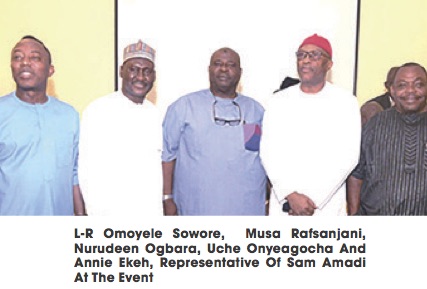
L-R Omoyele Sowore, Musa Rafsanjani, Nurudeen Ogbara, Uche Onyeagocha And Annie Ekeh, Representative Of Sam Amadi At The Event
Over the years, Nigeria has witnessed series of hitches in electoral outcomes. In many cases, candidates contesting elections have tended to gravitate towards the judiciary to obtain victory, making the judges to determine election winners rather than the electorate. The event was organised to deliberate on these and other related matters.
The event brought together various stakeholders. It was moderated by Professor Victor Adetula of the International Relations and Development Studies, University of Jos, Ebun-Olu Adegboruwa, SAN and a number of other political analysts and activists.
Welcoming the participants, Mallam Auwal Ibrahim Musa Rafsanjani, Executive Director, CISLAC stated: “We cannot continue to invest our energy in an election and some people will sit down and will be writing results for themselves. That is why the civil societies, the media and other stakeholders must come together and rise up against the trend,”
“We must be interested in seeing where the problem is, because we cannot continue to truncate the decision of the Nigerian people. If it is INEC that is the problem, we must find out. If the problem is the politicians or judiciary, we must find out who is responsible.
“We saw the judgment in Zamfara, Plateau and particularly in Kano State where tribunal judges delivered their judgment via Zoom. That happened because they knew what they did to the mandate of the people of Kano and reason they were afraid to deliver their ruling physically.
“We are indeed excited to bring under one roof, these very illustrious sons and daughters of our great country as we collectively strive to make it a better place. Some of you in the room today fought and struggled for the transition of Nigeria from military rule to the current democratic dispensation. While our democracy has hitherto been threatened by series of systemic challenges since 1999, we had anticipated to make appreciable progress than we currently have.
“Despite various legal reforms preceding the 2023 general and off-cycle elections, the conduct and outcomes of the elections have questioned the direction of Nigeria’s democracy. It is like going ten steps backward for every one step taken forward. We are not unaware of the undemocratic actions of the political class who are bent on capturing power at all cost for their personal aggrandizement and at the detriment of the collective good remains a growing challenge.
“Electoral violence is one problem that has been identified as a stumbling block to free, fair and credible elections in Nigeria. Politics at all levels is currently marred by violence, persecution and intimidation and exclusion of women from active participation in electoral politics.
“The emerging judicial corruption through the post-election litigation like tribunal activities and outcomes has called for adequate reform in our judicial system to make it more independent and efficient in the delivery of electoral justice through which the citizens’ choices prevail. Many Nigerians strongly believed that judiciary suffers from credibility as allegations of bribery activities to truncate justice and compromise electoral outcomes are playing out.
“We must recall the alleged attempts to truncate citizens’ electoral choices through the tribunal judgments in Kano, Kaduna, Plateau and Zamfara states which highlight a disastrous channel Nigeria’s democracy trends in recent times. The judiciary through tribunal judgments has reportedly employed the technicalities in upturning electoral victories, which in most occasions, rigs out the choices of the electorate.
“These are very disturbing trends that must be brought to an end in order not to make the role of the electorates irrelevant. Again, the case of Kano election tribunal is clear example of a deliberate effort still people’s mandate through connivance of both INEC and sponsored judiciary injustice. The conflicting double standard court judgement papers showed the desperation to undermine Kano election victory.
“Equally the recent elections in Kogi state, where original result sheets were reportedly filled in favour of the incumbent political party and in Imo state where the incumbent polled over 80% of total vote cast have sent shivers across the minds of Nigerians, signalling the dangerous extent of political compromise in Nigeria. As concerned citizens, it is imperative on everyone desiring the reflection of true democracy in our practice to be apprehensive of the current situation and seek channels for improvement.
“It is in light of this that CISLAC is championing this critical seminar bringing together highly valuable resources to speak on topics reflecting areas of challenges in our democratic journey and desire to free fair and credible elections to enable us to have patriotic, transparent and accountable leaders that will work and ensure good governance in Nigeria not political merchants.
“We are fully confident that reflections shared today can be compiled into a compendium of thoughts by vastly experienced Nigerians on electoral reforms and enhanced judicial integrity,” he said.
In his paper titled ‘Reforming Nigeria’s Electoral System for Mandate Protection: Opportunities, Challenges and the Way Forward, Professor Jibrin Ibrahim, Senior Fellow, Centre for Democracy and Development, said when election riggers face consequences, things will be better.
The professor noted that even in Niger Republic there is no post-election litigation “because votes are cast, they are counted, winners are announced and people move on”.
He recalled that the only time election was compromised in Republic of Niger was in 1999 when the then Military Head of State, Col. Ibrahim Bare Mainassara, who had decreed that no military officer should contest an election, changed his mind later and contested. He noted that when Mainassara knew he had lost the election, he ordered that the votes be recounted in tyhe army barracks, after which he was declared winner.
“The next day, his ADC took a machine gun and blasted his head,” said Prof Ibrahim. “That was to tell all political leaders that there are consequences for every action that threatens democracy.”
He took a swipe at the Chief Justice of Nigeria (CNJ), Olukayode Ariwoola, for regarding critics of the judiciary as a mob.
Professor Mohammed Kuna, Special Adviser to the Chairman of Independent National Electoral Commission (INEC), who represented the INEC boss at the event, spoke on “Electoral Reforms from Institutional Strengthening.” He listed four issues that must be addressed to get things right with elections in the country.
“By and large we have seen how reforms have become crucial in advancing democracy in Nigeria but there is limit to reforms because, there are elements who are impeding the legal process in order to make reforms meaningless. No matter the amount of reforms given to the electoral law, if the people impeding the legal process to satisfy themselves against the will of the people are not taken care of, it will not work.”
Noting that coups could be staged by the military or electorally, Prof Kuna expressed worries that some political elite who make electoral coups happen are not talked about.
He also talked about internal process and institutional reforms, which he acknowledged in some way as having improved. He noted, for instance, that cases of ballot snatching have drastically reduced.
“We need to begin to focus on other bodies who are also involved in ensuring credible election, including the security agencies and the political parties.”
Speaking on ‘Electoral Reform from Political Party Strengthening Perspective”, Professor Hassan Saliu, President, Nigerian Political Science Association (NPSA), noted that “Nigerian political parties are the bakers of the electoral challenges in the country. They make laws for themselves and still do not obey their own laws. If we can find a cure for our sickening political parties, then, our electoral challenges will be solved,” he said.
The professor bemoaned the control of political parties by state governors. He also wondered why all parties must have national spread. “It is in an effort to give a party a national spread that moneybags hijack them. Where also you impose heavy charges on contestants, moneybag is able to hijack the process.
The Resident Electoral Commissioner (REC), Benue State, Prof Sam Egwu,spoke on ‘RECs and Challenges of Election Management in Nigeria’, noted: “For RECs, there are pressures from the political parties. But they must be able to surmount the challenge of those pressures.”
Also speaking, Dr. Kole Shettima of MacArthur Foundation lamented: “If 2023 is bad the way it has been, I don’t know what 2027 will be. My fear is that 2027 is going to be bad because the indicator is exactly that.”
Mr. Ebun-Olu Adegoruwa SAN, spoke on the topic: ‘Politicisation of Election Disputes in Nigeria’s Courts: Key Provisions of the Electoral Act, and the Challenges of Technical Interpretation.’ He said the implication of the current electoral situation in Nigeria is that nobody can win election and go to sleep because his victory can be truncated at the level of judiciary. He opined that not all electoral matters should end up in court, even as he blamed technicalities for other disappointments seen from the courts.
He held that the court should not determine the choices of a political party. He said candidate the party brings should be its own and that whoever is chairman should be left for the party. He said judicial reforms should be done to avoid technicalities and that burden of proof in election case should be shifted from the candidate of the political party to INEC.
He recommended specific training for judicial officers in case of election petition to avoid technical justice.
On the Kano governorship issue, Adegboruwa said that it was obvious that NNPP won but noted that the court said the candidate was not a member of the party and that some ballot papers used for the votes cast were not stamped. “There should be no mention of pre-election issues in court because elections are already concluded. You cannot come and say the votes of the people should be upturned like it happened in Kano,” he submitted.
He said the judge and the judiciary in general must be free of inducement, threats, improper influences, restriction of any degree and manner, direct or indirect interference from any persons or groups and on whatever grounds.
Mrs Olajumoke Anifowoshe, former Attorney-General and Commissioner for Justice, Ondo State, spoke on ‘Experience Sharing: Women in Politics.’
Anifowoshe, a lawyer and daughter of late Chief Michael Adekunle Ajasin, former Governor of Ondo State, called on stakeholders to be be courageous and always speak truth to power. ‘Not being able to attain political height without going through a godfather makes Nigerian democratic experience very difficult,” she stated.
Former Presidential Candidate of the African Action Congress (AAC) and publisher, Sahara Reporters, Mr. Omoyele Sowore, said the Nigerian political situation is beyond mere reforms but requiring that every wisher for truly better Nigeria must be ready for change.
“The Nigerian situation has gone beyond reform. This is an unreformable system. Don’t let anybody deceive you. And there is no amount of conferences you can hold and seminars and workshops that can reform the electoral system in Nigeria. It’s impossible! Because, the system in the first place was not designed to hold elections; it was designed to select people into power from within the political class that has been holding this country to ransom since 1960 and beyond. Except we are ready, nothing will change.”
He also spoke about the judiciary: “We must understand that the judiciary in Nigeria has come to judgment this year. Before, the judiciary used to escape all the blames for the evils that they perpetrated in Nigeria because judges are usually not seen but heard. But now we have seen our judges more.
“If you look at it historically, at least from the contemporary history, in 1979 it was the judiciary that truncated the transition of power with their mathematical agenda – the 12 2/3. It was perpetrated in this Lagos. In 1993 that we were involved, it was the judiciary that truncated the freest and fairest election in this country and made sure that Abiola did not become President.
“A judicial officer said the election should not hold, another officer said the election was not legitimate, another judge pronounced that Abiola should stay in detention. The Supreme Court couldn’t meet. They claimed it was because Chief Gani Fawehinmi accused them of collecting Mercedes Benz from Babangida, which was true.
“In 2007, the judges met in this country and said ballot papers don’t need serial numbers. The judiciary has mortgaged and destroyed our democracy here.
“A judge sent me to jail, granted a bail condition that I could never meet. When we came back and asked for variation, he said, ‘You mean Sowore doesn’t have N100 million?’ Till today, they have not given me back my passport. I’m still undergoing trial for treason. The person they said I wanted to overthrow has gone back to his Katsina State. That is Buhari.
“When I reminded the judge, he was looking at he said, “Sebi you have lawyer” and I said “I’m a lawyer too by way of how many times I have been in and out of court. But the serious matter here is that,
Dr. Sam Amadi, former Chairman, Nigerian Electricity Regulatory Commission (NERC) delivered a paper entitled, ‘Addressing and Entrenching Threshold for Election Credibility in the Country.’
Amadi said: “By the way, is there anyone in this hall who doubts that the 2023 elections were worse than the 2019 elections? I doubt. But if there is such a person let me make one argument in proof of the claim. In 2019 there was little enthusiasm and confidence in the quality of legal and regulatory instrument guiding the conduct of the elections. In 2019, the commissioners did not give so much assurance that they would protect the integrity of the elections.
“In 2019, there was no provision for bimodal accreditation of voters and there was no provision for electronic transmission of election. Notwithstanding that the Electoral Act, 2022 built in these safeguards, and notwithstanding the many assurances of the electoral managers, we ended up with elections that have immensely discredited both INEC and the judiciary.
“So, where do we go from here? We have to decide whether we truly want to embark on a serious electoral reform or not. It seems clear to me that the Nigerian political elites do not want free and fair election. The reason for this lack of commitment is not far-fetched. Free and fair election will make it difficult for them to remain in power and could lead to the sort of accountability that will make it difficult for them to expropriate as much as they would.”
Uche Onyeagocha, a lawyer, former Member House of Representatives and former Secretary to the State Government in Imo State spoke on ‘Legislative Pathways for Effective Electoral & Judicial Reforms.’ Not a few would consider his positions as quite radical.
He noted: “There are things we need to do. One, all the clauses in our laws on who qualifies to run for an election should be completely removed, even the age barrier. The only requirement the person needs to contest is that you can vote, so you should have the right to be voted for. Every other person can now go ahead and say you are a criminal or you are not a criminal. If the populace chooses to vote for you when they know that you are a criminal, it’s their headache because, if you are a criminal, you should be actually be charged. This would serve the purpose of eliminating all these pre-election matters.
“Secondly, nomination into INEC should be made to be partisan. Every political party must have representation in INEC. Everybody should have equal access to INEC since the party in government is nominating people, all other parties should nominate their own people.
“The only difference is that, the person who should be Chairman of INEC should come from the minority political parties because he would not be in a position to rig himself in and he will not rig another person in. “Then finally the most sacrosanct item in an election should be the ballot paper. Anybody who tampers with the content of a ballot or ballot box is a criminal offence for which you will go to prison. At the end of every election, the contestation should start from recounting the votes. Let the court preside over the recounting. If there is no pre-election matter and they recount and you find out that the man has won, what are you arguing again? It’s all over. “But we don’t want to hear that any ballot paper was destroyed by water or rain or fire or stolen or missing. Don’t worry about those who say they will stuff the ballot boxes. Any ballot box that is stuffed, you won’t know when you overstuff or under stuff it. But where what is contained in the ballot box does not reflect in the result on the paper, that one is cancelled.
“These three things, once you adopt them, you take away all these excessive powers of INEC to rig elections, you take away all the excessive powers of security agencies and you take away all these excessive powers of the judiciary, everybody would move. You would see that at the end of every election, everybody would move on.
“Why do you have to insist that people should be 30 years before they can go to House of Representatives. What has 30 got to do with it? Why do you say that everybody should have O’ Level? People of my father and my mother’s time who went to Standard Six are by far much more brilliant. “It makes it simple: let’s stop making this thing difficult for ourselves. Let us start to amend our Electoral Act but just add these items and amend the Constitution, remove all the causes. In fact there should not be any clause on age for any position in Nigeria any more. Like EFCC and he must be 50 year, what has that got to do with it? There are 15-year-old criminals. Anybody who is up to the age of 18, in fact voting age should reduce to 16 because most kids today are finishing secondary school at the age of 16. Most kids at the age of 16 are far much more reasonable in choosing a voter than many elderly people because their future is at stake. The voting age should be brought down to 16.
“And if the people choose to elect a 19-year-old person to be President of Nigeria, so be it. If they choose to elect somebody who does not have tax clearance certificate, so be it. But at all times, if you don’t pay your tax, you go to prison. So if a man is contesting an election, and we find out he hasn’t paid his tax, it shouldn’t be a ground to stop him from running and it shouldn’t be a ground to stop people from voting for him. If people want to vote for him, let them vote for him. At the end of his tenure, then take him to court for evading tax and send him to prison. But don’t use it to disrupt the electoral process.”