Follow Us on Google
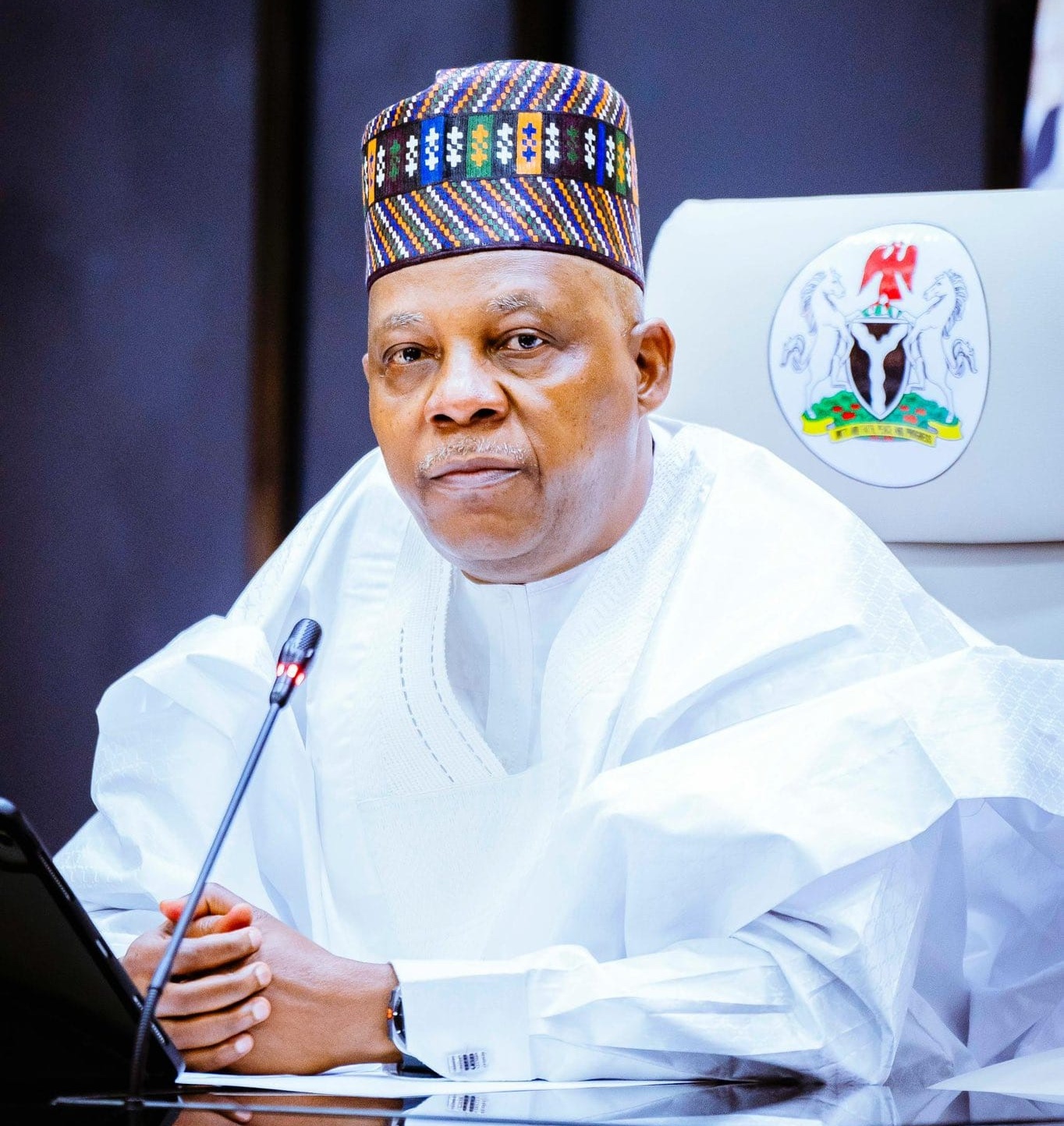
From Juliana Taiwo-Obalonye, Abuja
Vice President Kashim Shettima, yesterday, recounted an episode that occurred a few months after President Bola Tinubu took office, saying some visitors from Borno warned the President to stop wearing traditional outfits he gave him during the 2023 campaign, claiming that the garments had been used to charm him and would cause his death.
He said Tinubu dismissed the allegation and, in a deliberate show of defiance, wore the clothes for an entire week.
Shettima spoke in Abuja at the presentation of Gowon’s autobiography, “My Life of Duty and Allegiance” where he represented President Tinubu, who described the autobiography of the former Head of State as a vital national document that preserves Nigeria’s history and offers guidance for future generations.
The Vice President used the incident to buttress what he called a worrying rise in suspicion within Nigerian public life.
He linked the trend to an anecdote about Gowon that the Sultan of Sokoto shared: “the Sultan’s family used to send gallons of fura each week to Dodan Barracks in Lagos for General Gowon, a gesture Gowon accepted without mistrust.
“He noted that Gowon accepted the gesture without any suspicion, in a spirit of trust that he said has since been eroded,” Shettima said, adding the problem now is different: “Suspicion smears our relationships and it ought not to be. We are essentially one people tied to a common destiny.”
The VP recounted his personal role in acquiring Tinubu’s outfit during the 2023 campaign to help him connect with the northern people during the pre-primary outreach.
The incident, Shettima said, happened after the election. He recalled travelling to Beijing in October 2023 to represent Tinubu at the 3rd Belt and Road Initiative Forum — one of his early foreign assignments as Vice President. On his return, Tinubu called him in and relayed the visitors’ warning about the clothes.
“When I came back from China, where I had represented him at the Belt and Road Initiative Conference, he said: ‘Sit down. Your people came to me and said I should stop wearing those dresses you gave me. They said I must have been charmed, and that I am going to die and he will become the president.’”
Shettima said Tinubu rejected the allegation because it “did not add up.”
According to Shettima, the President told him, “Their story did not add up, because when you gave me those dresses, I was an aspirant. I wasn’t even the candidate. Neither were you the vice-presidential candidate.”
Still, Shettima added, Tinubu chose to wear the outfits for a week to make a point.
“For one week, to prove to them that he is not fetish, he wore those dresses. These are some of the gimmicks that are taking place in power circles in Nigeria nowadays.”
At the ceremony, former president, Dr. Goodluck Jonathan, the Sultan of Sokoto, Sa’ad Abubakar and other prominent Nigerian leaders called for national reconciliation and the preservation of institutional memory.
The gathering drew top government officials, traditional rulers, diplomats and elderstatesmen.
The dignitaries highlighted the importance of leaders documenting their experiences to prevent historical distortion and inspire future generations.
They also celebrated Gowon’s enduring legacy of unity, humility, and post-civil war reconciliation.
Tinubu said accounts from leaders who lived through defining moments are essential to deepening democratic stability. “A nation that misplaces its memory soon begins to quarrel with its own reflection. A society without memory becomes an orphan in time,” he said.
He told the gathering that Gowon’s reflections arrive at a critical juncture for Nigeria and West Africa, where insecurity, economic pressure and social fragmentation persist. He praised Gowon’s post‑civil war reconciliatory stance, particularly the “No victor, no vanquished” declaration, as a principle that “helped preserve Nigeria’s unity after the civil war.”
“The decisions of that period cannot be understood by those who examine them with the arrogance of comfort. Every generation that inherits peace must learn to speak gently about the choices made in the season of peril,” the President said, urging policies built on trust, inclusion and shared citizenship.
Tinubu also highlighted enduring institutions from Gowon’s era, notably the National Youth Service Corps (NYSC), saying the programme “has helped bridge ethnic, cultural and religious divides across generations.” He described Gowon’s life as “a rebuke to divisive narratives that attempt to reduce Nigeria’s diversity into rigid regional or religious stereotypes,” adding: “His story teaches us that the Nigerian project becomes stronger when a citizen refuses to become a weapon in the hands of sectarian entrepreneurs.”
On regional affairs, Tinubu commended Gowon’s role in establishing the Economic Community of West African States (ECOWAS), calling the regional bloc “one of the continent’s most important platforms for economic cooperation and collective security.” He appealed for renewed cooperation to confront terrorism, instability and economic disruption: “We need cooperation against insecurity. We need trade that empowers our young people. We need diplomacy that prevents conflict from becoming contagion.”
Earlier, Gowon said he wrote the autobiography out of the desire to tell his truth, not to join issues with anyone or sit in judgment over what was right or wrong.
The former military leader revealed that he decided to write his autobiography because of the countless times he has been declared dead and the negative stories making the rounds about him and his time in government.
“As I said, publishing my autobiography in the 60th year of my becoming head of state is mere coincidence.
“I had no timetable in mind. Over several years, several individuals tried their best to persuade me to write to end the growing spate of misinformation and disinformation on me in national conversations.
“More pressure was mounted when rumors of my death gained ground. Not once, but many times. I think up to four times so far.
I wonder how many more will be done. As you can attest today, these reports to paraphrase the writer, Mark Twain, were over-exaggerated.
“When I eventually decided to write, I was clear that I only needed to tell my truth, not join issues with anyone or sit in judgment over what might be considered right or wrong.
“I chose instead, I chose this path over my former stance to maintain silence, conscious you know of the need to preserve institutional memory through a truthful documentation of my experience. Speaking, speaking out also became necessary because my story and that of Nigeria were too intertwined.
“So I needed to mind the gap and avoid feeding negative narratives that could reopen all wounds,” he said.
Other News
He said speaking out became necessary because “my story and that of Nigeria became intertwined”.
Gowon added that the book reflects his modest attempt to document the opportunity he had to serve Nigeria.
On the 2027 general elections, he advised Nigerians against listening to “naysayers.”
The former head of state maintained that the nation, which did not fail under his watch, would never fail despite the country’s challenges.
The book reviewer, Bishop of Catholic Diocese of Sokoto, Matthew Kukah, noted that the book was a vivid account of Nigeria’s turbulent history through a civil war, and Gowon’s personal travails and life’s journey.
He explained that different sections of the book provide valuable insights to events during the General’s reign as head of state.
The Bishop, however, noted that no autobiography summaries history in totality as each account presents a particular point of view.
Kukah assured the gathering of God’s continuous favours and blessings for the country, noting that “God will continue to do great things for Nigeria.”
Jonathan, who chaired the event, described the autobiography as a “living testimony” from a leader who steered Nigeria through its most turbulent post-independence chapter.
He noted that Gowon’s magnanimity at the end of the Nigerian Civil War in 1970, famously encapsulated in his “No Victor, No Vanquished” declaration, laid the foundational blocks for national healing, reconstruction, and reintegration.
”As younger generations study our nation’s history, it is important that they hear directly from those who bore the burden of leadership during difficult times.
”Memoirs such as this help preserve institutional memory, deepen public understanding, and enrich the national conversation on governance and leadership,” Jonathan said.
He lamented that valuable chapters of Nigeria’s history are frequently lost because key actors fail to write accounts of their stewardship, revealing that he also intends to publish his personal reflections in due course.
”By sharing his story, General Gowon has rendered yet another important service to Nigeria and to the historical record of Africa.
“I believe this is a debt I also owe Nigerians and humanity. Someday, it will be my turn to present personal reflections at a programme like this,” he said.
Corroborating Jonathan’s stance, the Sultan of Sokoto, said that writing an autobiography while alive is crucial for safeguarding personal integrity.
”Launching your own biography while you are still alive is one of the most important things to do.
”It is not after someone’s death that people write lies and lies about the person when he is not alive to defend himself.
“We thank Allah, you are alive and you presented to us your own true words,” the Sultan said.
The royal father described Gowon as an honorary member of the Sultan Abubakar family, commending his lifelong commitment to humility, spirituality, and peace-building between Christians and Muslims.
In his goodwill message, the Emir of Kano, Muhammadu Sanusi II, noted that while public infrastructure and state policies inevitably change, a leader’s character remains permanently etched in public memory.
Recalling a personal childhood memory from Kaduna, Sanusi recounted how Gowon, as a sitting Head of State, would write affectionate, handwritten letters signed “Uncle Joe” to Yusuf Opam, the young son of his late friend, Col. Opam, who was killed in the 1960s.
”That is a window into the person that you’re dealing with.
“As head of state, Commander-in- Chief, he would write a handwritten letter to the son of his dead friend, so that the boy would continue to feel he had a father.”
The Emir hailed Gowon as a lasting role model for leadership integrity.
Reviewing the book, the Catholic Bishop of Sokoto Diocese, Most Rev. Matthew Kukah, captured the essence of the work as a masterclass in selfless stewardship.
”If this book achieves anything, let it be to show that public service is never a call to gain glory, but an aspiration to guardianship by those who lead with conscience and conviction,” he said.
While noting that no single autobiography can encapsulate the entirety of history, Kukah urged those who might disagree with the narrative to write their own accounts.
”Nobody tells all the truth because a point of view is a point for review. The author has written things as he saw them. And if you respond negatively to an autobiography, the answer is go and write your own,” he added.
Earlier, the Group Chief Executive of Hailsham Group and publisher of the memoir, Akogun Adesuyi, warned that nature abhors a vacuum in historical narratives.
”If you do not tell your story, the void will be filled with versions told by persons with vested interest to undermine the essence of all that you embody,” he said.
The event drew top government officials, including the Secretary to the Government of the Federation (SGF), Sen. George Akume, former heads of state, governors, ministers, and members of the diplomatic corps.