Follow Us on Google
By Fred Itua, Abuja
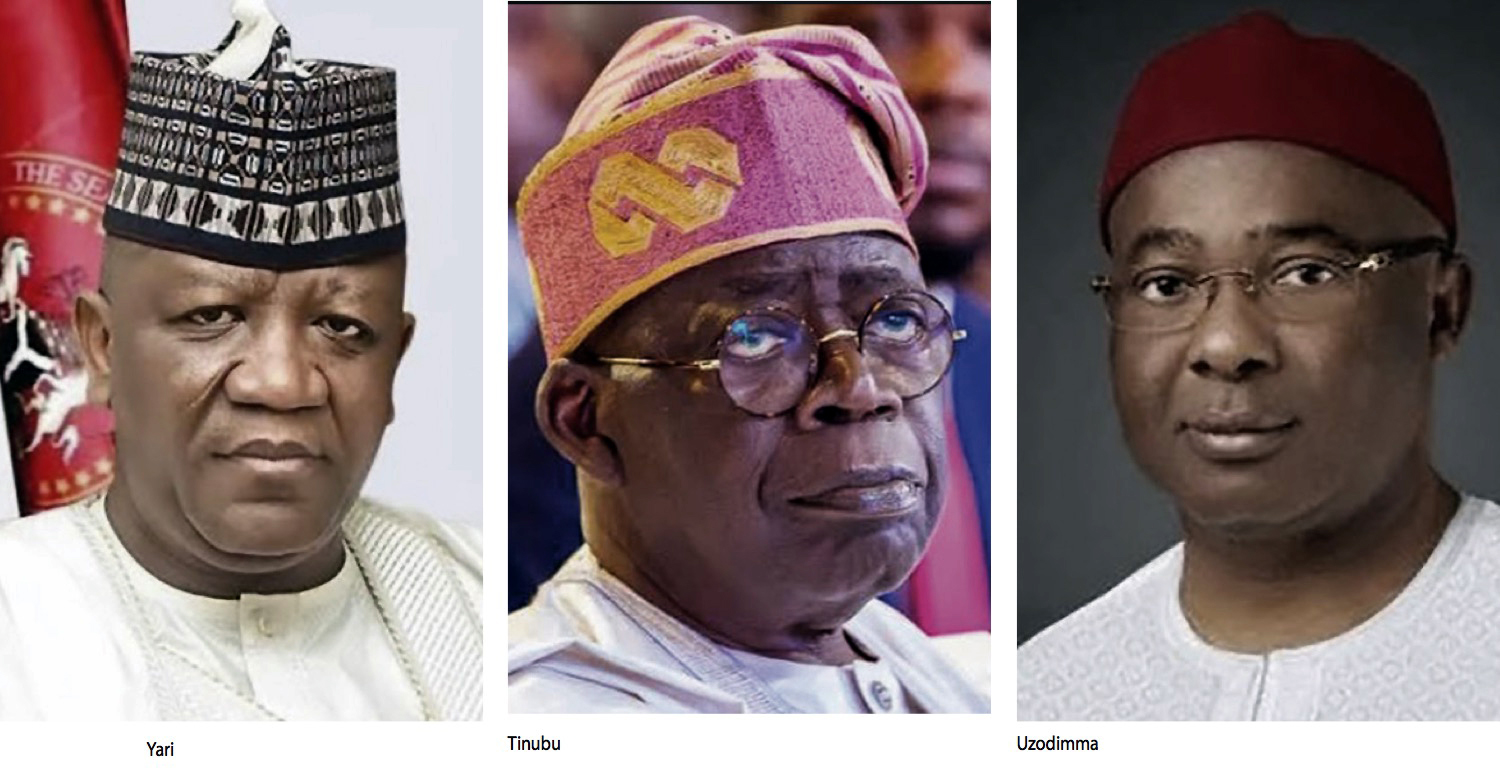
Beneath the choreography of endorsements, communiques and support-group rallies that trailed the race for the Directorship-General of President Bola Ahmed Tinubu’s 2027 Presidential Campaign Council lies a far more revealing story; a contest that pitted the APC’s most powerful governors against a president determined not to be hostage to them. That contest has now produced former Zamfara State governor and serving senator, Abdulaziz Yari, as the man confirmed to head Tinubu’s re-election machinery, with Imo State Governor and Progressive Governors’ Forum (PGF) chairman, Hope Uzodinma, named secretary of the campaign organisation, according to the official list of the council released by the Presidency on Saturday.
The emergence of both men, and the manner in which it happened, offers a window into how power actually moves inside the APC, and what the ruling party is gambling on as it heads into the toughest re-election test Tinubu has faced.
The narrowed field
For much of 2026, the race for the campaign Director-General (DG) position was genuinely open. At various points, at least four names circulated at the top of the list– Al-Makura, the former Nasarawa State governor and one of the founding fathers of the APC merger in 2013; Uba Sani, the sitting governor of Kaduna State; Hope Uzodinma, chairman of the Progressive Governors’ Forum; and Yari himself, a former national chairman of the Nigeria Governors’ Forum. At one point, the name of Nyesom Wike, the combative Minister of the Federal Capital Territory, was also dropped into the conversation by party insiders.
Each of the frontrunners came with a distinct constituency behind him. Al-Makura had the backing of an APC old guard nostalgic for founding-generation figures and was formally endorsed by the APC Integrity Group. Uba Sani carried the appeal of a sitting governor with fiscal muscle and a working relationship with the Kaduna political establishment.
Uzodinma had, on paper, the strongest institutional case. As chairman of the PGF, he already sat atop the informal college of APC governors, and his Renewed Hope Ambassadors platform had spent over a year showcasing the administration’s achievements nationwide, effectively auditioning him for a bigger campaign role. He had also chaired the APC’s national campaign council for the Osun governorship poll in July, giving him fresh, visible experience running a multi-committee campaign structure.
Yari’s case was different, and in the end, decisive. Sources close to the presidency had described a president who had privately settled on Yari weeks before the public jostling reached its peak, a disclosure that, insiders say, is what triggered a wave of political attacks on the Zamfara senator earlier in the year.
The account has now been vindicated. The official list released by the Special Adviser to the President on Information and Strategy, Bayo Onanuga, confirms Yari as the DG, with Tinubu and Shettima as chairman and vice chairman of the council, and APC National Chairman Nentawe Yilwatda also serving as vice chairman. Two factors are repeatedly cited by those close to the process for Yari’s emergence– loyalty and independence.
How Yari survived defeat
Yari’s stock with Tinubu rose sharply after his unsuccessful bid for the Senate presidency, a contest in which he could easily have turned bitter or drifted toward the disgruntled bloc that periodically needles the presidency from within the party. He did not. Instead, he doubled down on visible, organised loyalty, launching the Renewed Hope Network, mobilising roughly 1,500 APC-aligned support groups under its banner, and fronting grassroots structures such as the “YARI 774 for Asiwaju Initiative,” which set itself the target of delivering ten million votes for Tinubu across Nigeria’s 774 local government areas.
He also positioned himself publicly on the delicate question of zonal balance, telling Northern audiences bluntly that the region owed Tinubu a debt for engineering Muhammadu Buhari’s rise, and that the South West’s turn to complete two terms should not be contested. That message, delivered repeatedly at Northern stakeholder meetings, functioned as much as a service to Tinubu as a campaign speech.
A former national chairman of the Nigeria Governors’ Forum himself, Yari also carries something the presidency values highly– standing among his fellow former and sitting governors that does not depend on being one of the reigning power brokers of the moment. He is, in the language of party insiders, a “northern bridge” able to speak to Northern APC structures with authority while remaining, crucially, not currently in office and therefore not directly entangled in the resource politics that governs so much of the party’s internal bargaining.
The financial-dependence factor
The second reason cited for Yari’s emergence is less about optics and more about arithmetic. Multiple sources familiar with the deliberations told Daily Sun that Tinubu was determined to hand the DG role to someone who would not leave the campaign’s finances entirely at the mercy of the 31 APC governors, several of whom effectively financed and micromanaged the 2023 campaign structure in their states, extracting political concessions in return once the election was won. A campaign whose funding depends heavily on gubernatorial “goodwill” is, by definition, a campaign that gives governors leverage over appointments, resource allocation, and eventually, post-election patronage.
Yari, sources revealed, was seen as someone capable of running a campaign machinery with independent financial muscle, reducing the extent to which the president would need to negotiate resources through the very governors he would then need to manage in a second term. This is, in effect, an attempt by Tinubu to correct a structural problem from his first term; an APC in which governors, through their control of state structures, party primaries and now large blocs of the National Working Committee (NWC), effectively wrote their own script.
APC governors’ rebellion
Other News
That script has been long in the making. Since 2023, APC governors have consolidated an extraordinary degree of control over the party’s internal architecture. Multiple sources have described a pattern; governors dictated the outcomes of State Assembly primaries in their states, engineered the emergence of preferred National Assembly candidates from their zones, and in several states, personally handpicked the successors who will take over from them at the end of their tenures. That same bloc, sources revealed, was also instrumental in shaping the composition of the APC’s NWC, ensuring the party’s central machinery answers, in practice, to a governors’ consensus as much as to the presidency itself.
It is against this backdrop that many governors hoped to repeat the trick with the campaign DG position, effectively hijacking the selection process the way they had hijacked party primaries and legislative nominations before it. Uzodinma’s own interest in the DG role, sources said, was real and was actively lobbied for, before he stepped back, a retreat he has since publicly denied was ever a demotion.
Al-Makura’s continued candidacy, backed by the APC Integrity Group, similarly reflected a bloc of party elders unwilling to simply defer to the presidency’s preference without a fight. That Yari, not a sitting governor and not the PGF chairman, ultimately emerged as the man for the job, confirmed in the council list alongside more than 100 other appointees spanning finance, legal, media, security, youth, women and zonal directorates, is being read by APC insiders as a signal that the presidency was not prepared to let the governors’ bloc extend its winning streak into the one appointment that matters most for 2027– the person who will run the actual re-election operation.
Hope Uzodinma’s consolation
Uzodinma’s expected appointment as Secretary of the Campaign Organisation is not, however, a minor consolation prize dressed up as compromise. As PGF chairman, he retains institutional command over the governors’ bloc whose cooperation the campaign will still need in every one of the 31 APC-controlled states. Handing him the secretary’s role keeps him inside the tent, formally central to the campaign’s day-to-day machinery, while denying him the top job that would have made the DG position, in effect, an extension of gubernatorial power over the presidency’s own re-election bid.
There is also a religious and regional calculation at play in Uzodinma’s placement, one that party insiders said was explicitly discussed. As a Christian from the South East, his presence in a senior campaign role is intended to soften a structural imbalance that has become one of the most sensitive undercurrents of the entire 2027 project. The wider council list bears this out; alongside Uzodinma, the presidency has also brought in a broad council of elders, Bisi Akande, Segun Osoba, Rochas Okorocha, Abdullahi Adamu and Florence Ita-Giwa, and a deliberately mixed regional command structure in which Godswill Akpabio, Tajudeen Abbas and Mai Mala Buni serve as deputy Directors-General for the south and north respectively, working alongside Bamidele Opeyemi and Barau Jibril in the two zones.
The Muslim-Muslim question
The imbalance is stark on paper. Tinubu, a Muslim, is running with Vice President Kashim Shettima, also a Muslim, repeating the Muslim-Muslim ticket that proved politically costly, though not fatal, in 2023. With Yari, also a Muslim, now expected to head the campaign organisation charged with actually winning the election, the APC’s most visible campaign leadership, president, running mate and chief campaign strategist, would be entirely Muslim for a second consecutive cycle.
Christian groups and elders have already flagged concerns about this configuration in the broader run-up to 2027, with some publicly urging Tinubu to reconsider aspects of his ticket altogether. For a country almost evenly split between a Muslim-majority North and a Christian-majority South, and one with a long, uneasy history of managing religious balance at the highest levels of government, the optics of an all-Muslim campaign trio sit awkwardly against Nigeria’s unwritten but deeply felt conventions of representation.
Critics argue that placing a Christian in the secretary’s chair, however senior the position sounds, does not answer the deeper question of who is seen to be steering the ship; a Muslim president, a Muslim vice president, and now a Muslim campaign chief, all reporting into a Christian-minority secretary role that carries administrative weight but not the final word.
The APC’s likely counter-argument, according to party sources, will run along different lines that competence and loyalty, not religion, should determine campaign leadership; that the 2023 Muslim-Muslim ticket won despite the controversy it generated; and that Uzodinma’s role, along with a wider campaign council expected to include senior Christian political figures from the South East, South South and Middle Belt, will provide sufficient balance across the full structure even if the very top of it skews Muslim.
Whether that argument satisfies Christian constituencies uneasy about the optics, or whether it hardens perceptions that the APC’s core leadership circle has become religiously lopsided, is likely to remain one of the more combustible undercurrents of the 2027 campaign, one both supporters and critics of the arrangement will continue to argue over as the contest unfolds.
The electoral map
Beyond the optics, the practical test facing this campaign leadership is geographic. The APC’s core electoral problem is not the North, where its structural dominance remains largely intact, but the zones where Tinubu has historically struggled or lost outright; the South East, the South South, and strikingly, his own home turf of Lagos and the Federal Capital Territory, where he underperformed in the 2023 election despite decades of political dominance in Lagos specifically.
The South East remains the country’s most APC-resistant region, a legacy of longstanding grievances over political marginalisation and the fallout from the 2023 election, in which the region voted overwhelmingly for Peter Obi. The South South, an oil-producing bloc with its own history of feeling shortchanged by federal allocation formulas, presents a similar challenge, complicated further by internal APC rivalries in states like Rivers, where Wike’s continued influence inside the federal government sits uneasily with local political currents. Lagos and the FCT, ordinarily assumed to be safe APC territory given Tinubu’s own political base, delivered an uncomfortable result in 2023 that party strategists have not forgotten.
A campaign structure led by a Northern senator and anchored by a South Eastern governor as secretary is, in theory, built to project a coalition wide enough to make inroads into these no-go zones.
Uzodinma’s South Eastern identity gives the campaign a plausible face for outreach into a region that has otherwise shown little appetite for the APC. Whether personnel alone can dislodge deeply entrenched voting patterns rooted in economic grievance and post-2023 political memory, particularly in the South East and among younger, urban voters in Lagos, is a separate question entirely, one that months of grassroots mobilisation, and not simply the announcement of a campaign organogram, will ultimately answer.
The battle ahead
The emergence of Yari and Uzodinma tells a story less about two men and more about a presidency recalibrating its relationship with its own party. Tinubu appears to have concluded that a campaign machinery too dependent on gubernatorial financing and gubernatorial personnel is a campaign machinery that governors can eventually hold hostage, as they arguably have done with primaries, legislative nominations and even the NWC’s composition since 2023. By reaching for a loyal former governor with grassroots networks and financial independence from the sitting governors’ bloc, rather than simply elevating the PGF chairman to the very top, the presidency is attempting to keep the 2027 campaign answerable to Aso Rock rather than to the Government Houses of the states that make up the APC’s federating structure.
In time, Nigerians will know whether his arrangement will survive contact with the actual rigours of a national campaign, particularly if it fails to crack Southern resistance and Yari’s Northern bridge-building proves insufficient to paper over the religious optics of an all-Muslim leadership trio, will be one of the defining internal tensions to watch inside the APC as the countdown to the January 2027 polls continues. What is already clear is that the governors did not get everything they wanted this time, and that in itself may be the most significant outcome of the entire process.