Follow Us on Google
•Market fully deregulated –LPGAR
By Adewale Sanyaolu
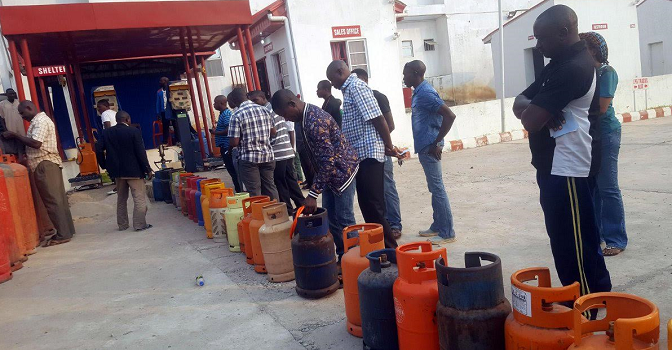
The current Liquefied Natural Gas (LPG) crisis, otherwise known as cooking gas, has been linked to the activities of middlemen, especially neighborhood retailers, findings by Daily Sun have revealed.
In the last two weeks, there has been an acute shortage of commodities leading to skyrocketing prices, a situation propelled by the activities of greedy businessmen within the value chain.
Over the weekend, Daily Sun uncovered the operations of cartels driving up cooking gas prices by hoarding supplies. These groups reportedly buy large quantities of LPG in 50kg cylinders from plants and resell to retailers at inflated prices.
Investigations revealed that the so-called marketers have no registered businesses or fixed outlets. Instead, they move from one gas plant to another, mopping up supplies at lower prices and reselling for quick profit.
An attendant at a major gas plant in the Fagba area of Iju Ishaga, Lagos, who identified himself simply as Lekan, said they were selling to consumers at N1,300 per kilogram at the height of the crisis, while bulk buyers purchased at N1,200.
“But at a point, we discovered that the number of bulk buyers outweigh that of end users, a development that forced us to reduce the volumes we were selling to them to enable us service our end user clients,”.
Further findings by Daily Sun revealed that between the middlemen and neighborhood retailers, there was a gain of N1800 for every 1kg of cooking sold to the end users.
While those middlemen without any significant investment bought at N1,200/kg, they, in turn, sold at N1,700/kg to neighborhood retailers, who later sold the same at N2,500/kg to end users, and in some cases, at N3,000/kg.
In other instances, some of these middlemen were working in active connivance with certain gas attendants, who gave them priority over end users in exchange for a percentage of their profit margin.
National President of the Liquefied Petroleum Gas Retailers Association (LPGAR), a branch of NUPENG, Mr. Ayobami Olarinoye, in a telephone interview with Daily Sun, said the allegation against retailers was simply an attempt to “call a dog a bad name in order to hang it.”
Olarinoye argued that the LPG market is a deregulated one, and as such, prices cannot be uniform. “We can only appeal to our members to be patriotic but cannot compel them to sell products at a fixed price because we all source products from different suppliers,” he said.
He added that retailers are the “weeping child” in the cooking gas value chain.
Olarinoye explained that at the peak of the crisis, some cooking gas plants refused to sell products to retailers, thereby compounding the problem.
He stated that retailers, under the law, are licensed as Category D operators and can only source products from gas plants.
“However, in cases where cooking gas plants refuse to sell to us but prefer to sell to end users because of additional profit, we are then forced to source products from third parties, which comes at a premium,” he said.
He maintained that, in the past, cooking gas plants were located in industrial areas where retailers traveled to refill their cylinders for resale to end users. But now, he lamented, many gas plants have moved into residential areas, competing directly with retailers and pushing some of them out of business.
He, however, called on LPG marketers (gas plant owners/operators) to see retailers as partners, not competitors.
“It was very unfair to read some comments credited to LPG marketers during the peak of the crisis labeling retailers as those responsible for the skyrocketing prices when, in fact, it was the marketers that were hiking prices. If I buy at N1,700/kg from gas plants, how much am I expected to sell in order to make a marginal profit?” he asked.
Other News
The LPGAR President called on the Federal Government to ensure sufficient product availability to prevent a recurrence of scarcity.
The federal government, last week, ordered the Nigerian Midstream and Downstream Petroleum Regulatory Authority (NMDPRA) to launch a full-scale crackdown on cooking gas marketers involved in racketeering and sabotage across the value chain.
To ensure compliance, the Minister mandated the NMDPRA to intensify monitoring of LPG depots nationwide to prevent product hoarding and other sharp practices capable of worsening the situation.
The directive followed the recent cooking gas scarcity and its attendant effect on prices, which have risen from N1,000 to as high as N3,000 per kilogram in some parts of the country.
A statement quoting the Minister of State for Petroleum Resources (Gas), Mr. Ekperikpe Ekpo, expressed concern over the recent increase in the price of Liquefied Petroleum Gas (LPG), popularly known as cooking gas. The Minister appealed for calm and understanding from Nigerians, assuring that the situation is temporary and will normalise soon.
Ekpo explained that the recent price surge was primarily caused by two factors: the industrial action by the Petroleum and Natural Gas Senior Staff Association of Nigeria (PENGASSAN) at the Dangote Refinery, which temporarily halted LPG loading, and the ongoing maintenance activities at the Nigeria LNG Train 4 facility, which reduced the volume of LPG available in the domestic market.
According to him, these disruptions led to a shortfall in supply and a consequent increase in prices due to a demand–supply imbalance.
The Minister, however, noted that operations at the Dangote Refinery have now resumed, with LPG loading for the domestic market already underway. Similarly, the Bonny River Terminal operated by Seplat Energy has commenced loading, while the Nigeria LNG is gradually restoring normal operations as maintenance nears completion.
With these developments, he said, supply to the domestic market is expected to stabilise by next week, leading to a gradual reduction in prices.
Ekpo also reiterated that the LPG market is deregulated and appealed to marketers, distributors, and all stakeholders along the LPG value chain to be patriotic in their dealings, desist from hoarding, and refrain from exploiting consumers for profit.
He reassured Nigerians that the Federal Government remains committed to ensuring sufficient and affordable gas supply to all households across the country.
The NMDPRA had, two weeks ago, disclosed that fewer than 3,000 cooking gas refilling plants are serving over 200 million Nigerians.
The revelation may not be unconnected with the current cooking gas scarcity being experienced in some parts of the country, as this affects gas penetration.
Authority Chief Executive (ACE) of NMDPRA, Mr. Farouk Ahmed stated this at the National Association of Energy Correspondents (NAEC) Energy Conference 2025, held in Lagos recently, themed, “Nigeria’s Energy Future: Exploring Opportunities and Addressing Risks for Sustainable Growth.”
Represented by the Head of Public Affairs, George Ene Ita, Ahmed said Nigeria urgently needs a diversified investment approach in its energy mix to drive economic expansion beyond the traditional reliance on fossil fuels.
He added that as the country invests in gas infrastructure, it must also diversify energy sources to reduce dependence on any single fuel.
“It is important to note that the number of LPG refilling plants in the country is less than 3,000, while the CNG compression stations are fewer than 50, for a country of over 200 million citizens,” he said.
He added that a constructive approach to developing other energy sources has the potential to sustain economic growth, create jobs, expand the country’s revenue base, and offer multiple revenue streams for the government to drive national development.