Follow Us on Google
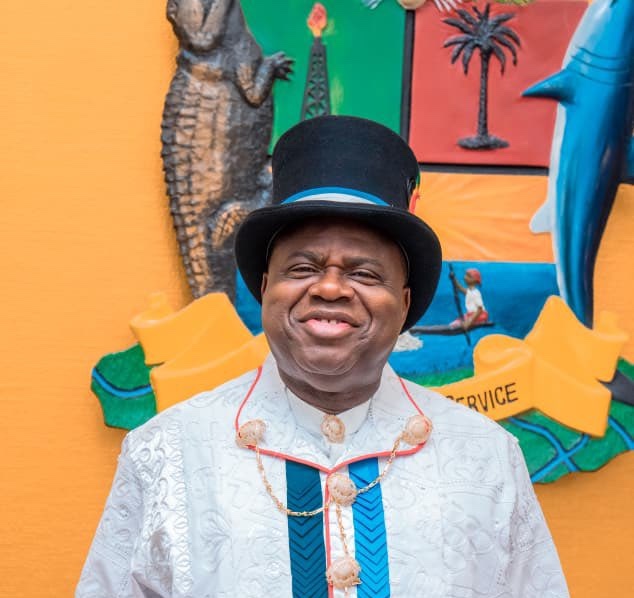
From Femi Folaranmi, Yenagoa
The exit of Senator Douye Diri, Bayelsa State Governor, from the People’s Democratic Party (PDP) has triggered mixed feelings in the state. His parting of ways with the PDP, Daily Sun gathered, has so far polarised discussions into two schools of thought. To be sure, the sentiments being expressed for and against the dumping of PDP cannot be divorced from the long affinity Bayelsa State has with the PDP.
For a state that has been ruled by the PDP since 1999, the parting of ways with the party, most Bayelsans have come to recognised as “Ijaw party’’ was a political shocker. The decision by Senator Douye Diri to severe relationship with the PDP has not only sent shockwaves across the state but has also altered the political landscape in ways that would definitely redefine the politics of the state.
Daily Sun recalls that since 1999, when Chief Diepreye Alamieyesigha emerged as governor on the PDP platform, Bayelsa State political elites have jealously guarded the state from falling into the hands of another political party. Previous attempts by the Alliance for Democracy (AD), All Nigeria Peoples Party (ANPP), and the Action Congress/ Action Congress of Nigeria (AC/ACN) to make significant political inroads and oust the PDP from Creek Haven, Bayelsa State Government House had been thwarted.
However, the real test of the extent of the political strength of the PDP came in 2015 when a breakaway faction of the PDP led by former governor, Timipre Sylva of the All Progressive Congress (APC) stretched the political contest in the state to a breaking point. Even with its federal might, APC was roundly rejected by the voters in 2015. But what the APC failed to achieve in 2015 was made possible in 2019 in a landslide victory against the PDP. It only took the court to miraculously hand the state back to the PDP. Now, from Monday, November 3, the APC flag will fly in the Bayelsa State Government House on a platter.
For political observers, Diri’s decision to leave the PDP and his move to the APC have thrown up two questions: what is the moral rationale behind abandoning the PDP that has given so much to Bayelsa State, and what are the implications of Diri’s exit from the PDP?
On the moral rationale behind Diri’s dumping of the PDP, the first school of thought is of the view that Diri’s action amounts to betrayal of the forces that threw him up as governorship candidate and which worked for him to emerge as governor first in 2019 and again in 2023. Obviously, leading the pack of this school of thought is former governor and Diri’s political benefactor, Senator Henry Seriake Dickson.
It was Dickson who used all the powers at his disposal to stop the emergence of Mr. Ndutimi Alaibe as the PDP governorship candidate in 2019, ostensibly as ‘’punishment’’ for abandoning the PDP and defecting to the APC in 2015. It is therefore understandable that in his reaction to Diri’s exit from PDP, Dickson expressed disappointment and wondered what could be the compelling reason for a second-term governor to want to defect from his party.
He explained that the PDP has a special history with the Ijaw people and Bayelsa, and hinted that Diri had betrayed the factors that propelled him to the Government House.
His words, “Our state, which has been in the PDP since 1999 till date, is now midway through being donated to the APC free of charge. I’ve told all those who have been bombarding me with questions that I am not moving. I am still in the PDP. My life and values about constancy, consistency, principles, honour, and loyalty to people and causes have not changed.
‘’It is unfortunate that my hand-picked successor, whose consideration was influenced mainly by the need to protect the values and ideals of the state and of the Ijaw Nation, sees things differently. The PDP has a special place in the history of Bayelsa, the Ijaw Nation, and the Niger Delta, and all so-called minorities and majority groups in Nigeria, as well as all faiths, because it is an inclusive platform.
‘’The PDP gave my people an opportunity to be a Vice President, an Acting President, and a President of the Federal Republic of Nigeria. And I branded it, since 2015, as Governor, the party of the Ijaw Nation, the same way I branded Bayelsa the Jerusalem of the Ijaw Nation. I believe that I, and other leaders and all products of the PDP, of Bayelsa and the Ijaw Nation, have a duty to show loyalty and steadfastness to the PDP to the very end,’’ he said
Another PDP member, Epbifiye Prince Simeon, also described Diri’s dumping of the PDP as acts of betrayal driven by personal interest rather than principle.
‘’The event unfolding before us is disregarding those of us who stood by the governor through every up and down. It clearly demonstrates the value—or lack thereof—that the governor and his associates place on the years of loyalty, sacrifice, and support we have given.
“Since they did not value our support, I am certain they will value our opposition going forward,” he stated.
Other News
However, the second school of thought holds that the current situation of the PDP has left Diri and others with no alternative but to seek political refuge elsewhere.
Senator Konbowei Benson (Bayelsa Central), in his letter of resignation from the PDP, said the party has lost the capacity to function as a political party and fallen into the wrong hands.
He said ‘’I have taken a protracted look at the leadership crisis and the division that has resulted from the competition for power within the PDP, especially at the national level. I have lost hope in the capacity of the PDP to play the role of a political party.’’
In tandem with Senator Benson, Senator Benson Agadaga (Bayelsa East), said internal issues within the PDP influenced his decision to leave.
“It is both astonishing and deeply disturbing that the once proud and largest political party in Africa has been torn into shreds due to internal wranglings and irreconcilable differences at both the state and national levels,” he said.
Explaining why he left the PDP, the governor said “Somebody had to take the decision (to leave the PDP) and I took it on behalf of the state. I took it in the best interest of the state. Some of you might not understand now but later, it will be clear to all. When we came in as a government, what we did at the beginning was to ensure that most of the uncompleted projects were completed and we introduced new ones. That alone is enough reason to thank God.
“The peace and security we are enjoying is another reason to thank God. Politics is for development and not to kill your brother. The gathering here is a testimony of the unity in the state,” Diri said.
While explaining the efforts he and others made to salvage the PDP, Diri noted that he would not denigrate his former party because it provided the platform for them to attain their current political height, but added that they had to leave the “sinking ship” when it became obvious that the party had been hijacked by undertakers who were determined to destroy it, saying that “we had no choice than to join the ruling party to protect the political future of the state.”
He further said that “After seeing that the undertakers wanted to bury the PDP, I never wanted my state to be buried alongside with PDP. So, knowing what was going on, after all my consultations with all the leaders, it was incumbent on me as governor to make a decision. I never wanted my state to be buried with the PDP. What was going on became incumbent on me to take a decision and majority of the state House of Assembly, including the Speaker, have come with me to the APC.”
“Long in the military regime, we requested a coastal road from Lagos to Calabar. Memorandum on the demands by the Ijaw ethnic nationality submitted to the Head of State. The major demand here was the construction of the coastal roads from Lagos to Calabar. I don’t care how much the coastal road will cost. Today, we have a President who has come to realise that this coastal road is important to the people of the coastal area, majority of whom are Ijaw people. Are we going to leave that type of man?
“There is only one way a governor will lose his office, by impeachment from the State House of Assembly. And in this situation, the Speaker of the State House of Assembly and the majority of the members are going with me.
“You know that Bayelsa is taken. I want to thank Mr. President for all that he had done for Bayelsa. Mr, President, you have shown this state love. I appreciate love as against hatred. The love you have shown to us, we will reciprocate. Bayelsa people will reciprocate.”
Beyond the rationale of Diri’s departure from the PDP is the implication of his newest political movement on the politics of the state. Political pundits have pointed out that by leaving PDP, Diri is finally ready to assert himself and ensure the survival of his political family outside the control of other political leaders. As he enters the halfway mark of his four-year tenure, he is already having his sights on his successor. Remaining in PDP would have left that decision not entirely in his hands, considering the fact that he was also handpicked by Dickson, whom many still believe wields a considerable influence in the party.
Another implication is the reconfiguration of Bayelsa politics. Diri’s exit from the PDP is without some troubling development. Unlike other governors who left PDP recently with their deputies, Diri’s deputy, Senator Lawrence Ewhrudjakpo, widely known as an associate of Dickson, has refused to leave the PDP. More worrisome is the suit filed at an Abuja High Court by Ewhrudjakpo seeking to stop the Bayelsa State House of Assembly from initiating any impeachment proceedings against him.
Ewhrudjakpo is not alone in refusing to follow Diri to leave the PDP. There are also federal lawmakers, three House of Assembly members, a local government chairman, and several other bigwigs. For political observers, this development is an indication that Diri was not in full control of the party before his departure. Undoubtedly, Diri would now have to contend with an opposition that would have his deputy and his predecessor as the arrowhead. Any attempt to do away with his deputy would not only heat up the polity but also distract his administration, which has been doing well in terms of developmental projects, political observers say.