Follow Us on Google

•Abuja landlords demand 2-year advance payment, tenants kick
From Idu Jude, Abuja
Potential tenants in the Federal Capital Territory (FCT), Abuja, now have to contend with a new economic reality: sourcing for two years rent and arbitrary rent increment for old tenants. Hitherto, most renters had to pay a year rent in advance and associated charges.
James Fadeyi, a rights lawyer, said arbitrary increment of house rent by FCT landlords remains an issue he has recorded little or no success. He attributed this to the absence of price control measure by government, despite many housing policies:
“I once had a case involving a landlord and tenant over an arbitrary increment of house rent without considering the income level of such tenant.
“The landlord increased the rent from 50 per cent to 200 per cent with little or no prior information. Landlords in the FCT have come out with a newly perfected policy of two years advance payment from tenants before occupying houses and shops, with the belief that many tenants no longer renew their rents immediately after the initial payment expires due to economic downturn.
“I would suggest that people should go to court and file new cases challenging this new twist targeted at Abuja residents. And I also believe that other parts of the country will soon be affected by this menace.
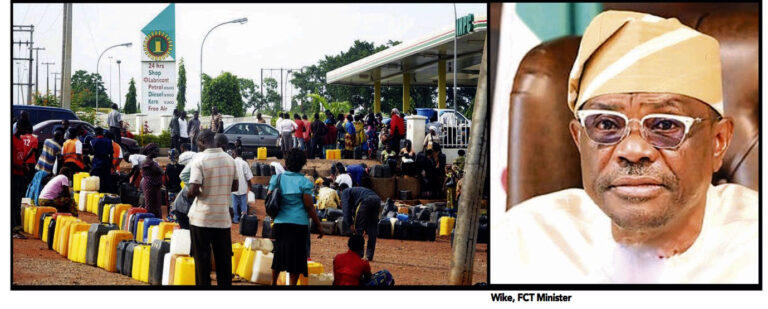
“I felt bad when many of the landlords alleged that the idea was motivated by payment of the new land rate policy being implemented by the Minister of FCT, Nyesom Wike.
“But, we also see people living in Abuja shanties paying the same, even when those who pay land rates are meant to be for those who built on government-regulated lands in highbrow areas, like Maitama, Garki, Wuse 2 and Asokoro districts. It is a bandwagon effect to the extent that some landlords, irrespective of the location, implement same.”
Nmalagu David, a civil servant, said: “FCT landlords should be considerate because they are most fortunate to be able to afford these buildings, which means they are a little bit better than the tenants. Again, government should apply price control measures by building low-cost houses as well as other housing projects.
“The failure of Federal Government housing projects is being exploited by some unscrupulous landlords and targeted at ripping tenants and potential tenants. Look at the policies of government and the way the elite buy government properties for themselves and make the poor people pay for them, too.
“The privatisation policy brought by President Olusegun Obasanjo saw almost all properties bought by political allies. Others were bought by already rich. Today, the masses suffer to live in those buildings.”
Dr Rufus Ebegba expressed serious concerns: “Tell me why people should be classified in payment of electricity tariff? Why should people be in bands A, B, and C? We know all these have been happening but the people were not made to know about what they consume. It has been a situation where people ignorantly pay above what they consume.
“And in the case of payment of house rent, it shouldn’t be as if all hands are equal and businesses flourish in every part of the FCT. Of course, some places are meant for business while others are for residential. If we begin to charge people without considering all these, it becomes anti-human.”
Dr. Maxwell Babanja suggested that the court should look into the inhuman treatment of tenants in the FCT: “There are many things that are not defined to the common man in Nigeria. How possibly can a country exist like this? As a civil servant, I can’t afford to make two years advance payments before packing into a rented apartment. This is because my salary is not structured like that.
“Salary is statutory and spending should also blend with the way it comes in. Government should begin to tilt its reasoning towards that in order not to force people to get involved in corrupt practices to make ends meet or to pay house rent. Truth be told, if government is serious about price control of goods, it will trickle down to all sectors of the economy, house rent inclusive. But for now, everyone wakes up at any time and pronounces any price.”
Chidi Ugwu, a Journalist holds the opinion that the National Assembly should make laws to straighten landlords and tenancy agreements to avoid arbitrary house rent increases: “Tenants must insist on producing the tenancy agreements and assessing the quality of the building before making payments.
“To me if I fail to agree with you and other prospective tenants reason the same way, then the landlords will have no choice than to sit up or else their houses remain unoccupied. And I can tell you that looking around Abuja there are many empty houses being occupied by lizards and other reptiles.”
Mazi Uchegbu Linus, a landlord resident in Jikwoyi Phase 11, said: “When I listen to some people blame the landlords, I feel like not talking because it will amount to exacerbating energy on irrelevant things. It is obvious that thousands of them hold opinion where it hurts them.
“As a landlord and a member of the Jikwoyi Landlords Association, it is better to let you know some of the new policies being implemented by the FCT Minister regarding land rates. We, the landlords, spend a lot on maintaining these structures. With the high cost of building materials, we also encounter horrible characters among the tenants.
“They deliberately refuse to pay their house rents as when due, but choose to hire a lawyer whenever they are asked to leave the property. Many tenants prefer well-built houses for comfort but see the price tag as a misnomer.
“A two-year advance payment is quite appropriate. That is to enable landlords to have substantial amounts to cover expenses. Another reason is to stop recalcitrant tenants who refuse to renew their lease houses but head to court at every little apprehension. How can a man say he has no money but he is able to hire a lawyer?”
Kahdijat Umar runs a restaurant in Garki 2 Distric. She told Daily Sun: “Looking for shops for rent with two years advance payment is another subtle plan to get rid of poor people in the FCT. What seems to be the second round of Abuja cleansing now turns to those who can only afford houses the steep two years advance payment.
“It got to a level early this year, my landlord came around to quit every tenant unknown to us that he had a plan to execute the new policy. Those who wished to stay around were made to sign a new tenancy agreement to pay two years in advance.
“When we sought to know the reason for the turn of events, he claimed that that was always the only way to get money from those who could not possibly renew their rent next year.”
Amaka Linus, a civil servant and owner of a supermarket: “What determines my stay in Abuja is the income my business generates. It is obvious that if nothing is done quickly to address the ugly trend, many businesses will fold up due to lack of capital to run the business after paying for rent.
“My business needs to be nurtured. What this means is that I don’t have to spend the capital to avoid crippling the business. Of course, the survival of any business starts with good capital and turnovers. But, two years advance payment of shop rent can cause a dent in my pocket.”
Yohana Yusuf: “You see as a Gbagyi man, I know that some people did not buy property to earn a living but to use that to rob us of our rights as indigenous people of this city. Tell me how someone could buy lands with N400,000 but wish to kill others over house rent? You can also notice that the materials used in building those houses are substandard and the houses are out of fashion, the house rents keep on increasing by the day.
“I can tell you for free that a great number of these new shops springing up here and there will remain empty due to lack of patronage. This is because people have no money to pay two years in advance, including a five per cent agent fee. One of the shops built in Wuye District has not been occupied. Not even one tenant has tried to get one of the shops due to this problem.”
Maxwell Nwoko, a serving youth corps member. He sees nothing wrong in landlords placing such demands on their houses since such are for commercial purposes: “There are ways many countries of the world checkmate excesses of the Shylock landlords. That is by building affordable low-cost housing estates for low-income workers. By so doing, they can assess it through mortgage plans. Even shops can as well be gotten through the same way.”
A civil servant with the Federal Capital Territory Administration (FCTA), who doesn’t want his name mentioned, insisted that the FCT administration has failed in taking control of the price of house and shop rents despite disparities in residential standards.
“This is not what is obtainable in so many smart cities across the globe and even in some parts of Africa. I find it difficult to believe that we are heading to become one of the smart cities in Africa or that we are even close to becoming a giant of Africa.
“The same thing happens in electricity tariff regulations. We have a situation where the masses are classified to be on the same band ‘A’ and B’ alongside the first and middle class. And sometimes you ask yourself if things are being done justifiably in this country.
“As an FCTA staff, there is nothing close to regulating the price of house and shop rents within the FCT. What we have is similar things to transportation fares. It is all about garbage in and out. The major things that affect the masses directly are never the concern of the government. What they come after are people’s buildings to demolish but not to put regulations and policies that would make both the rich and poor feel okay.”
Source said people should know their rights, and as far as the Federal Capital Territory (FCT) is concerned, every Nigerian is welcome to be a resident of the capital city.
“What I mean is that people should seek redress in the court. The court should also let the landlords know that their business cannot flourish without the tenants occupying the buildings.
“They should approach the court and charge the authority for the failure to put house and shop price regulations. I think this should be determined by a court of competent jurisdiction.”