Follow Us on Google
- Traditional ruler advocates action to confront ocean encroachment
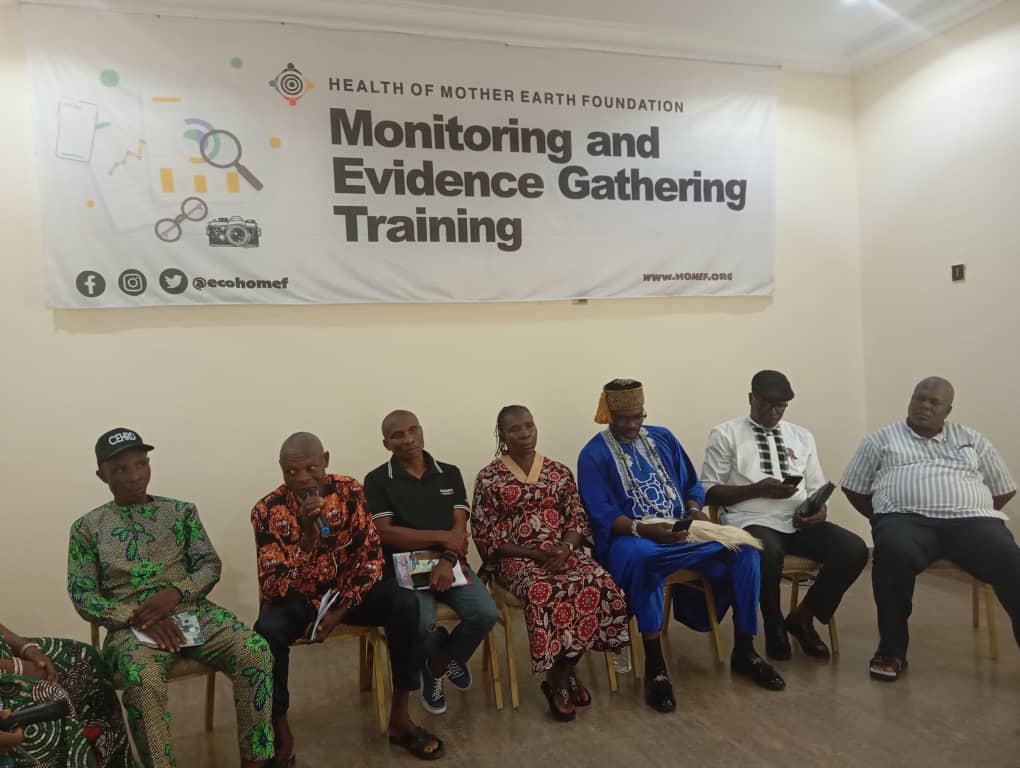
The Health of Mother Earth Foundation (HOMEF) has concluded a training workshop for the Niger Delta oil communities on environmental monitoring.
The capacity building programme drew participants across the Niger Delta region from Cross River, Akwa Ibom, Rivers, Bayelsa, and Delta states.
Mr Stanley Egholo, Fossil Politics Lead at HOMEF, noted that the challenges posed by oil pollution and climate change have yh made environmental monitoring imminent.
He regretted that oil-bearing communities often lose cases instituted to seek environmental justice due to a lack of credible scientific evidence.
He urged the participants to take an interest in defending their environments and gather empirical evidence whenever there is oil pollution.
Mr Onyekachi Okoro, Executive Director, Media Awareness and Justice Initiative, who served as a resource person, said that empirical data reinforces and strengthens advocacy for environmental justice.
Okoro took through the rudiments of Understanding Environmental Monitoring – Air, Water, and Land.
According to him, recent technological advancements have made so many digital tools available for monitoring the environment.
Speaking at the panel segment, Chief Alagoa Morris, a renowned environmentalist, highlighted the challenges to environmental monitoring and gave tips on how to overcome them.
He urged participants to refrain from exaggerating pollution incidents, as credible facts were sacrosanct in environmental activism and would always survive validity tests.
Other News
Morris encouraged participants to work with residents of pollution-impacted communities and avoid taking sides in community conflicts.
Meanwhile, the traditional ruler of Ayetoro, a coastal community in Ondo State, has advocated unity amongst coastline settlements across the Niger Delta to confront ocean encroachments.
Oba Oluwambe Ojagbohunmi, the Ogeloyinbo of Ayetoro, made the call at Coastal Communities Exchanges organised by Health of Mother Earth Foundation (HOMEF) in Yenagoa.
Ojagbohunmi noted that rising sea levels and associated coastal erosion posed an existential threat to the culture and identity of Ayetoro people, adding that the community remains the ancestral land of his subjects.
“Before this time, the tidal currents used to add sand to our land more than it takes. But over the past 25 years, the ocean has been seriously encroaching on our land at alarming rates.
“We are left with no option but to stay because we do not want to lose our identity and culture, which is woven into the ancestral land occupied by the Ayetoro people,” he said.
The royal father spoke on the theme Sea encroachment, Coastal Erosion and Livelihood Losses: Building Community Resilience against Climate Change.
He noted that the ocean is a living entity with self-cleansing mechanisms that often results to returning foreign bodies and debris thrown into the rivers from the mainland to coastal communities.
He called for adaptation in livelihood practices and cited his examples of having to resort to rearing fish species that survive in a mixture of fresh and salt waters following the inflow of salt water into areas hitherto known to be of freshwater habitats.