Follow Us on Google
…N11m/unit too costly for food growers –Experts
By Chinyere Anyanwu
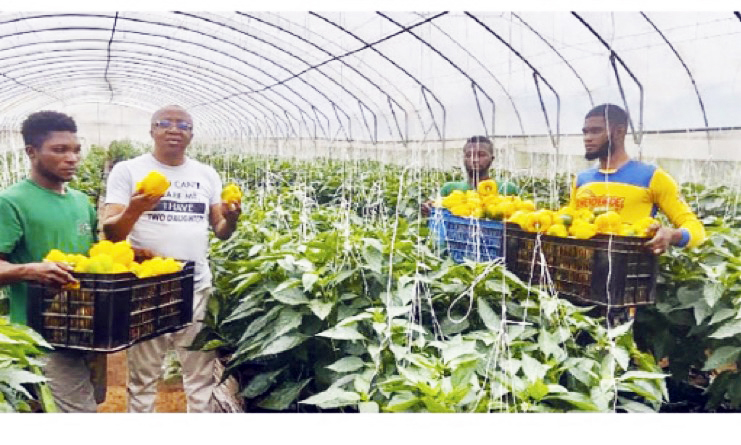
Greenhouse farming, a method of growing crops inside protected structures where temperature, water, pests and nutrients can be better controlled, is gaining ground in Nigeria as farmers seek to overcome climate and seasonal challenges.
The technology can support year-round vegetable production and reduce post-harvest losses. However, agric experts say the high cost of setting up and running greenhouses remains a major barrier for many Nigerian farmers.
Annually, it is estimated that Nigeria loses between N3.5 trillion and N5 trillion to post-harvest losses with the vegetables value chain being the hardest hit.
These post-harvest losses result mainly from lack of adequate cold-chain infrastructure and modern refrigeration facilities, bad road networks and inefficient logistics leading to delays, and unreliable electricity access required to power cold storage facilities.
This, in effect, occasions seasonal shortages and high prices of vegetables such as tomatoes, onions and peppers, leaving consumers, farmers and the country’s economy at a huge disadvantage.
To tackle these issues, greenhouse farmers agree that in addition to becoming commercially viable, greenhouse farming is the game-changer that would bring required solutions to the challenges confronting the vegetable value chain.
The Managing Director/Chief Executive Officer of Goldridge Bioagro Ltd, an agribusiness company based in the Ikorodu area of Lagos, Mr. Greg Nwamadi, stated that greenhouse farming can revolutionise the cultivation of vegetables in Nigeria because the problems of pests, weather, nutrition and water are better managed in a greenhouse through the use of drip irrigation and other management protocols.
Nwamadi said, “there’s no doubt that greenhouse farming can revolutionise the cultivation of vegetables in Nigeria.”
According to him, “a well-equipped greenhouse, supported by enabling technology systems like sensors, cooling pads, among other devices, will give a farmer peace of mind. Greenhouses are suitable for urban farming, which is also the nucleus of population growth.”
Speaking on the commercial viability of greenhouses, the Goldridge Bioagro CEO said, “with emerging technologies, greenhouse farmers are assured of increased yield and improved quality. Urban lifestyle promotes the consumption of fruits and vegetables. This factor makes investments in greenhouse farming worthwhile for farmers.”
On the affordability of greenhouses, Nwamadi noted that they are capital intensive and are, therefore, not an all-comers venture. He explained that, “running a well-equipped greenhouse farm business is expensive. Today, owning a 500sqm greenhouse can cost anything from N11 million, depending on the source or origin. For a good commercial production, you will need much more than one unit.
You will also need value adding equipment – cold storage, dehydrator and processor. These help mitigate against post-harvest losses. Most farmers in Nigeria may not be able to invest in this method of farming.”
Despite the huge cost of investing in greenhouses, Nwamadi stated that greenhouse farming should be encouraged on a large scale considering the impact it will create in the country’s food system, in the economy and farmers’ livelihood.
He said, “whenever the government is talking about support for farmers, they rarely consider those who have invested in greenhouse farming. I will advocate tailored support for greenhouse farmers. Banks, unfortunately, classify us as high risk, putting us in the same mold with open field farmers. This is not right. Greenhouse farmers invest so much to start and should be able to attract funding to scale.”
He further pointed out the problem of manpower deficiency in the greenhouse value chain and the need for proper knowledge of how a greenhouse operates.
He said, “we have more online-trained greenhouse farm hands than those with practical experience.
These charlatans cause more harm than good in the sector. Greenhouse farming and contemporary technology-enabled farming methods should shape agricultural training in universities and similar institutions.”
The Managing Director, Kaspharyn Solutions Nig. Ltd., Ayodele Farinde, a greenhouse farmer of over 10 years, is convinced that greenhouse farming is already revolutionising vegetable production in Nigeria, Africa and beyond.
“At Kaspharyn Solutions, we have been into the business of greenhouse farming and greenhouse construction for over 10 years and we can say the sector has experienced significant progress,” Farinde said.
According to him, “over the years, experiences have shown that climate change is very real. Climate change effects like unpredictable rainfall, long droughts like we witnessed recently during the August break, high temperature, high incidence of pests and diseases, are affecting open field vegetable production and the only solution to this is greenhouse farming – protected cultivation, especially for high value vegetables.”
The Kaspharyn Solutions boss stated that one of the benefits of greenhouse farming is the opportunity it affords practitioners to produce all year round.
He noted that greenhouse farming is already a commercially viable venture because it ensures sustainability of production. “Any vegetable farmer now must consider greenhouse farming if you want to be sustainable because climate change is real. Any farmer going into vegetable production without irrigation is playing. If you want to nurse your tomato, you need a nursery. That is why most vegetable farmers now have protected structures.”
In addition, he stated that greenhouse farming has become a commercially viable answer to Nigeria’s seasonal vegetable production as it ensures input seedling and vegetable availability all year round. No seasonality.
Speaking on the high cost of greenhouses and the financial capacity of farmers to invest in them, Farinde offered viable alternatives. He said, “if a farmer cannot afford the galvanised greenhouse, they can go for the wooden one. Most farmers think the greenhouse technology has to be imported but it can be fabricated locally. At Kaspharyn Solutions, we fabricate both galvanised and wooden greenhouses of different sizes and designs. So if a farmer cannot afford the big one, they can start with the small one. If they cannot afford the galvanised steel one they can start with the wooden one.”
On how to encourage the growth of greenhouse farming in the country, Farinde insists that adequate training to acquire required knowledge in that field is critical.
“I believe the best way to encourage greenhouse farming is to start with knowledge. Many people go into farming, especially greenhouse farming, without knowledge. This aspect of agriculture is knowledge-intensive, unlike other conventional agricultural production methods. It’s not cassava or yam farming; it requires a lot of knowledge of nutrient management, knowledge of pesticides management, knowledge of hydroponics, and even the market. So, there’s a need for the farmer to acquire knowledge through the right source. Identify the real greenhouse farmers, attend their training and seminars, and learn from what they are doing. You can also work with experts in greenhouse farming.”
On a final note, the Kaspharyn Solutions boss said, “greenhouse farming is commercially viable. Whether you are a greenhouse farmer or open field farmer, we all need protected cultivation to ensure sustainable production.”
For Prince Babatunde Raji, a former civil servant turned farmer, greenhouse vegetable farming is a commercially beneficial venture if the funds to invest into such mode of farming are readily available.
He stated that since greenhouses are very expensive, either the government or high networth investors can empower intending greenhouse farmers to start off or support those already engaged in it to scale.
Citing his own experience, Raji advised against vegetable farmers taking bank loans to invest in greenhouses because, according to him, these high interest loans, as are available to Nigerian farmers, will not translate to profitable ventures.