Follow Us on Google
By Chinyere Anyanwu [email protected]
Unknown to many urbanites and suburbanites in Nigeria, greenhouse farming has become a more reliable route out of the lingering food insufficiency nightmare as it allows families to grow healthy crops in very small spaces through vertical farming techniques. It equally creates a controlled environment where temperature, humidity, and light can be regulated, leading to optimal growth conditions for plants as they are totally insulated from the devastating impacts of climate change.
It also reduces the exposure of plants to pests and diseases, minimising the need for chemical pesticides, among other benefits that ultimately lead to higher crop yield.
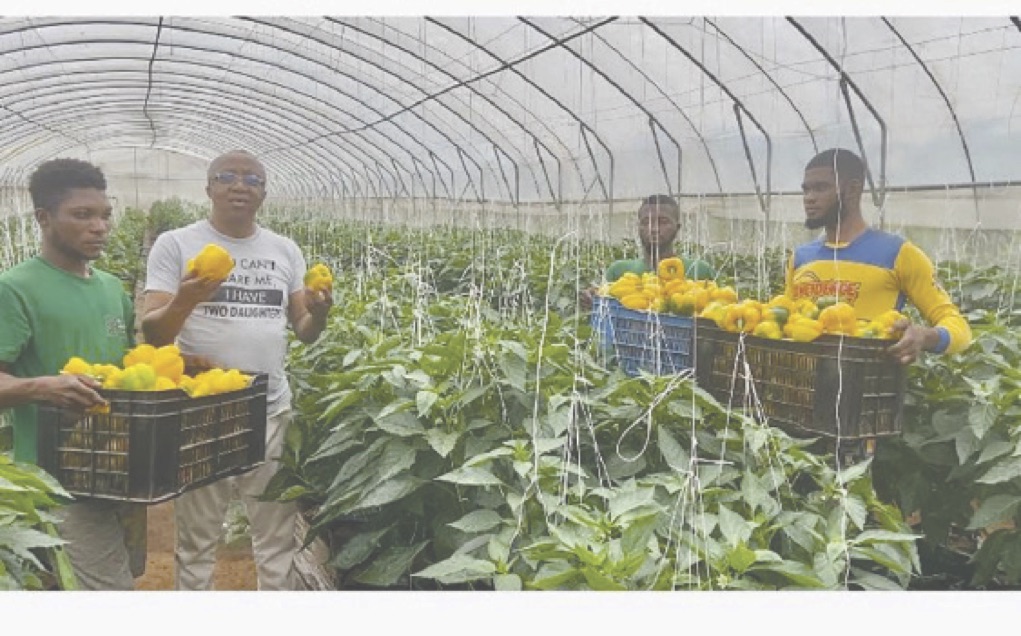
This is the crusade of Mr. Greg Nwamadi, the Managing Director and Chief Executive Officer of Goldridge Bioagro Ltd, an agribusiness company headquartered in Lagos with operations in South Africa.
He wants many Nigerians to go into greenhouse farming rather than folding their arms and lamenting over the plummeting food production challenge accentuated by insecurity, climate change, decrepit infrastructure and more.
In this interview with Daily Sun, he discusses investment opportunities in agriculture, the benefits of greenhouse farming, and the necessity for government support to create a favorable environment for agricultural operators.
Setting up
Goldridge Bioagro Ltd. was incorporated and started operations in 2021. The story of Bioagro in growing vegetables started during COVID-19, when nobody could go out, and getting food became a big issue. I love vegetables and invested in growing profiles for vegetables. I turned my house into a garden and from those profiles, we were growing tomatoes, bell peppers and other kinds of vegetables, which were very helpful during that period. It did well that we were even selling to friends. So, immediately after COVID, we decided to take it to another level by importing and setting up a greenhouse farm. That’s how the company came about.
The major objective for the company was to utilise technology to provide agricultural solutions and food security. With the imported greenhouses, we grow bell pepper, celery and habanero. We process our products into flour and spices. Both the fresh and processed products are sold locally but we have plans to export.
Experience in commodity export
I have been involved in agricultural commodity export for years. When I left the university, I came to Lagos and found myself working for an investment company, Shawmann Investment Ltd. I was part of the team which organised export promotion seminars to promote the export of Nigerian manufactured products. On leaving Shawmann, I worked as head of Corporate Affairs for First Commerce Ltd., an export company predominantly into agricultural commodities. First Commerce exposed me to the export of cocoa, coffee, rubber and cashew nuts. One of the things I have found out is that in exporting agricultural raw materials we shortchange ourselves, as a country and even as practitioners. The need for value addition cannot be overemphasised. In Bioagro, we will grow, process and export.
Role of technology in agriculture
Technology is changing everything and the agricultural sector is not exempted from the disruption technology is bringing. For some years now, there has been a continuous threat of lack of food while insecurity has become the norm in our country. Like or hate this fact, the north feeds Nigeria. My experience in the sector has shown me that if we need to have a consistent supply of food, then we need to rejig our food supply system. And the only thing that can help us achieve this is for the south to effectively be self-sufficient in food production. This makes it imperative for the region to adopt the use of technology in growing food.
Today, we have a soilless farming system, a hydroponic system and a vertical system for urban farming. It may not substantially replace the use of large acreage to grow food, however, it can bridge the gap. For instance, urban farming today is a trend that is flourishing globally. So, rather than people being scared of going to the hinterland to farm, and risk herders’ clash, insecurity, kidnap, and the rest of them, there are hydroponic systems and greenhouse systems that can be utilised in growing food within urban areas. When people subscribe to this individually or in groups, it would have a huge impact on the volume of output that can be available even within cities to mitigate food shortage.
Take, for instance, there are greenhouse farms that can fit into a plot of land, some into two plots or more in the city. If in a city like Lagos you have 1,000 greenhouses growing tomatoes, peppers and leafy greens and they are well run, Lagos will not be in any threat like what we hear sometimes that farmers from the north say they won’t bring food here again. And the beautiful thing is that with systems like drip irrigation and sensors to help control expectations, an investor can enjoy an easier experience with technology. So, when we talk about farming today, we are no longer thinking from the perspective of the hoe and machete. You don’t need to do that anymore to grow crops. There is a great future for urban farming and I believe that more and more people will sign up for it.
Post-harvest losses and ways out
Post-harvest loss is one of the biggest challenges of farmers because when they grow perishable things like vegetables, they need to do a lot more investments to preserve them, like getting a cold room and dehydrating equipment. But how long can you keep them in cold rooms? Markets are very important and value addition is very important to penetrate markets. Bioagro pursued value addition to expand its market opportunities. We invested to set up a processing facility, producing super foods for healthy living. These are nutraceuticals as people are downplaying the use of pharmaceuticals, for food as medicine. That’s the way it should be.
When the chips are down, if you watch what you eat, you stand a greater chance of averting some of life threatening illnesses that affect people more.
So, the company focuses on healthier alternatives. We have a mix of unripe plantain and millet flour, which is very good for sugar control and cardiovascular health. We have mixed spice blend from bell peppers, celery, ginger and tumeric. The flavours are not just unique but healthy. In our processing facility we use dehydrators to prolong the shelf life of vegetables.
It is important for government to support farmers to reduce post-harvest losses through engagement in processing and value addition. Once in a while we hear conversations of government talking about setting up clusters where people can go and process their farm produce but it’s an issue of how real, efficient and sufficient these are. Nigeria is a country with so many smallholder farmers, people who farm on one plot, two plots, one acre, two acres; they are in the majority. If there is a facility close by for the farmers themselves to process or add value to their produce, I doubt if most of the farmers will want to embrace it. For a subsistence farmer, what’s in his mind at the point of harvest is cashing out because he needs the money for survival. Value addition takes a longer time for payback and most of them might not want to wait.
I think if there is a system where the government or big organisations off-take from them and pay them well, it would pay them off better. For those in the grains value chain, they might easily find off-takers but for people like us who are in the vegetables value chain, who is going to off-take from us? But we pray we can access capital and put in place structures to stand in that kind of gap where we can off-take from small farmers. That’s why if you go to Mile 12 Market which is a major aggregator for farmers, you will see farmers from Niger, Taraba, Plateau, all over the country, bringing produce to Mile 12 Market. People see the transactions and sales that happen there but you need to go there to see the volume of wastage of food going on there.
If you want five trailers of veggies from Mile 12 you can get them but you have to pay cash. Then you also need a system where you can process them to preserve them. This is a cash intensive process, and a conversation the government must have with farmers if they want to move this country forward in food sufficiency. If you go to the market and see all kinds of unhealthy imported tomato paste, meanwhile, you go to Mile 12 Market and you see fresh produce wasting. Whereas the imported brands are mostly made from concentrates which are not healthy, investment in processing fresh produce locally will be more valuable to the economy. So when are we going to have infrastructure to convert our agricultural produce into what is consumable?
Government’s role in repositioning agric sector
Every government since the inception of democracy in Nigeria has talked so well about focusing on agriculture but by the time the government goes we really struggle to see the footprints of what they did. When you evaluate the impact of these things, you can’t see how they have contributed meaningfully to the development of the agricultural sector.
The last administration of Buhari did a lot of interventions using CBN (Central Bank of Nigeria) and when you hear the sums that were spent on these intervention funds you will almost say to yourself without doubt that there’s truly an agricultural revolution and that there will be food sufficiency and affordable food but when you come on the ground and look, you wonder. You cannot marry the amount said to have been spent with the reality on ground. And it’s so discouraging. For those of us who are in the industry, sometimes I ask some friends, “did you access the money?” Because sometimes you hear some of these monies and you see that most SMEs who have put structures on ground to do things, structures that can scale productivity and employment, we are all only hearing in the news but we don’t get to access these funds.
However, the fact remains that the government has a lot to do. The policies should be friendly, especially policies that affect SMEs because they are the ones that make a remarkable change. And then the government should make capital available for businesses to venture into areas that would address the shortcomings we are talking about. Businesses are the ones that will invest in factories that will off-take produce from farmers. There must be a way for the government to do much more in this area.
Impact of greenhouse farming
Greenhouse farming is not so popular now but it is gradually picking up. Some time last year, there was conversation to form an association of greenhouse farmers and we are following it up. The promoters still have a lot of work to do to reach out to practitioners. The entry level might be a bit high because of the cost of setting up a good greenhouse farm. When we started, we invested almost $45,000 and it was like nothing. But I still believe it will be the game changer for the agricultural experience for people who ordinarily look down on agricultural ventures because with that, we can bring some measure of control.
Greenhouse is simply growing crops in a controlled environment where you can control the water, the sunlight, the nutrients you give, so it helps you try as much as possible to achieve your projection. However, it doesn’t mean it does not have its own risks. If one little thing goes wrong, it could affect all the projections you have made. It is coming up; more and more people will venture into greenhouse farming in the next few years and I see it as the way to go. I see so much hope in urban farming, utilising greenhouses. In fact, we’ll soon be seeing people taking over warehouses and turning them into urban farms.
Getting youths involved in greenhouse farming to tackle unemployment
Greenhouse farming will help tackle youth unemployment because young people have a strong connection with technology. Take, for instance, the potato value chain; today Nigeria grows a lot of potato. Where are the young men who will be trained to do value addition for potato? So also for other crops like cassava, grains, vegetables, etc. Do you know there are snacks you can make from rice? Our food culture will change tremendously when we educate and equip our populace to become innovative and also help them with capital to venture into agribusiness. Is it not funny that we are here importing all kinds of food-based products from Europe, Asia, America, etc., that we can do here. We have the raw materials here but the missing link is relevant education, skills and finance. The result will be that agriculture will become the mainstay of the economy.
Challenges of greenhouse farming
Greenhouse farming, like I said, is an evolving area in agriculture in Nigeria. The first challenge we had when we started ours was manpower. Most of the agronomists we engaged were trained in universities that did not even have greenhouses. So, most of what they knew was just theoretical.
Some of them only knew about the shade net systems which were nets and woods they knocked together in their schools and were growing things in them, and that is not the typical greenhouse methodology. We suffered initially because the agronomists we hired were learning at our own expense, so we were losing a whole lot in projections.
It has challenged us to work with institutions to improve greenhouse farming skills. So, we cannot have our training institutions training people with outmoded systems and expect them to compete with the practice in other parts of the world. That was the first challenge we had.
Then there was also the problem of climate change. Sometimes when we hear so much said about global warming and climate change, some of us don’t know the impact on our ordinary lives. In the last 12 months, the humidity rate has been unpredictable but high. That is where technology is good.
Anybody in Lagos would have noticed that the heat for a while has been mindless even in the night. Plants are like human beings. Sometimes, if they weather through it in the day, they look forward to relaxing in the night but the nights are also very hot. For instance, if you go to the greenhouse in the afternoon when it’s hot they will cower because of the heat but at night they blossom, but sometimes you see that even in the night, the weather is still hot. With the right technology, temperature and other factors can be regulated. So anyone thinking about investing in greenhouse farming must have all these in mind. You don’t just think you will install a greenhouse structure and you are set to go. No, you have to be mindful of the systems that will make it function optimally.
Like I said earlier, capital is critical. How I wish it will be possible to be accessing fund with longer tenure, ideally nothing less than five years. If you access funds that way, it doesn’t put you under pressure. The structure itself is an asset so banks should begin to collatarise that as an asset because each of the greenhouses we use today is worth almost N10 million.
What the government needs to do to attract the private sector to agriculture
Other News
The government should make available accessible funding. If you say you have provided funding for the private sector to invest in agriculture and they are difficult to access, what is the use? At the end of the day, you allow banks to use these kinds of funds for other things that are not the original mandate of the government. So, I think they need to look at that. For instance, most commercial banks no longer want to provide guarantees for the Bank of Industry (BoI). Before, you could rely on BoI to get single digit credit, which is okay for a business person, especially those in agribusiness. But BoI will tell you that part of their criteria is that you must have a guarantee from your commercial bank and commercial banks don’t want to do that. So, here you are, you need funding; you have to deal with managing credit from your commercial bank, and also deal with managing funds from BoI. It makes the process complex. If they simplify these processes, it will be better.
Let’s have policies that support those practicing in the industry to access these funds and use them so that the government can measure the impact. And at the end of the day, you cannot measure the impact. If the government is serious about developing the agricultural sector, it should make sure that funds get to the real people who are in the sector.
Leveraging agriculture to grow the economy
Agriculture will grow the economy faster than oil. Agriculture has the best potential to grow the Nigerian economy. Nigeria has a population of over 200 million people who must eat. If you want to know what the impact of the food system represents, go and check the data on import. Check how much we are spending on importation and the things we import. The challenge has always been that activity in the agricultural sector has not migrated from traditional farming system to value addition. There are dozens of products you can get from potato; dozens of products you can get from cocoa; dozens of products you can get from cashew nut and dozens of products you can get from yam, etc. let’s shift to industrialization and production. If we improve the value chains of the agricultural industry, train the young people to play in it, provide them with capital, monitor them properly, it will revolutionise our economy.
Netherlands is a small country but go and see what it is doing in agriculture using technology. Their agricultural export towers our oil export. Check the data.
If the Nigerian agricultural sector picks up today and the value chain activities become enviable, a whole lot of international agencies, companies, countries that are dependent on the rather deplorable state of the industry here will cry; they will be out of business. These European and Asian companies flooding our market with all kinds of things will be out of business or invest in Nigeria to manufacture and create employment opportunities.