Follow Us on Google
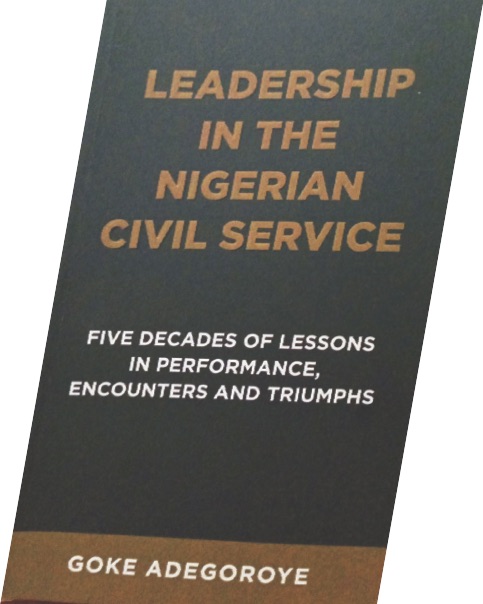
Title: Leadership in the Nigerian Civil Service
Author: Goke Adegoroye
Publisher: Kachifo Ltd, Lagos
Year: 2025
Pagination: 420
Reviewer: Henry Akubuiro
Leadership, says Goke Adegoroye, in the introductory section of his book, Leadership in the Nigerian Civil Service: Five Decades of Lessons in Performance, Encounters and Triumphs, is the single important determinant in management and governance. Among others, it reflects vision, courage, and the capacity to steer an organisation towards achieving its goals. Adegoroye is in the best position to write this wonderful book, having seen it all in a civil service voyage that spanned decades, where he rose to various leadership positions.
He has been privileged to serve in diverse roles across the public sector: from the academia to environmental management, from the Presidency to being the inaugural Director General and, later, Permanent Secretary of the Bureau of Public Service Reforms (BPSR). He has also served in the Manpower Development Office (MDO) in the office of the Head of the Civil Service of the Federation (OHCSF) and ministries of education, tourism, culture and national orientation, interior, as well as the Federal Capital Territory Administration (FCTA), where he retired eventually. As a reformer, the author experienced both trials and triumphs.
Leadership in the Nigerian Civil Service … takes us into the author’s leadership portfolio from the 1970s to the present. It covers the author’s service to the nation, which began in 1975 as Graduate Assistant at the University of Ife (renamed Obafemi Awolowo University), his environmental work in the 1980s and 1990s, public administration leadership in the 2000s, and post-retirement advocacy. It offers valuable lessons for up-and-coming civil servants, those already there, policymakers, civil service leaders desirous of precedents and everybody interested in bureaucratic operations.
The author tells us that he writes “as a scientist using the civil service ecosystem as my laboratory” and also in protest “against the entrenched culture of sycophancy in the service,” and he also writes with objectivity. There must be reasons for these affirmations. Writing on the Foreword, Bukar Usman, former Permanent Secretary in the Presidency, says this memoir is “Dr Adegoroye’s attempt to distill the lessons from his career and leadership experience so that others might learn”, adding, what strikes him most is the strong emphasis placed on integrity as a cornerstone for addressing the challenges of Nigerian civil service. Little wonder, he says that every Nigerian patriot should engage with the book “not only to understand the ideals that should underpin our public service but to recognise the extent to which Dr Adegoroye has gone in his advocacy, research, and meticulous documentation in and out of office.”
Adegoroye’s leadership acumen came to the fore early in life, years before his civil service days, becoming a deputy senior prefect at Chris Church. He shares pleasant memories with the legendary literary scholar, poet and playwright, Prof. Niyi Osundare, his senior in school, who left a lasting impression on him and whom he looks up to; and another student, Chief Wole Olanipekun (SAN), who looked up to him. At school, he held different positions: school prefect, school librarian, chapel prefect, house captain, deputy senior prefect, dining hall prefect, president of Dramatic Society and the Literary and Debating Society. No doubt, his accomplished school days were characterised with blue ribbons.
In the second chapter entitled “Midwife of Change and Reform”, the author leaves nobody in doubt that he has got the midas touch as a reformer, saddled with the responsibility of making a big impression as the founding Director General of the Bureau of Public Service Reform (BPSR). The author is grateful for the roles played by Dr. Selina Adjebeng Assem and Mrs. Comfort Owolabi in his transition from science and academics to public service.
His early successes in the civil service owed partly his cognate experience in academia, environmental management at Federal Environmental Protection Agency (FEPA), and an advisor to the Secretary to the Government of the Federation on substantive issues of policy design, implementation, and coordination. As the Director General of BPSR, he masterminded Generic Guidelines for the Reform of MDAs and the review and revision of the Public Service Rules and Financial Regulations. He also created the Nigerian Public Service Integrity at Work CD/DVD as a training manual for ethics and integrity. His administration installed the Integrated Payroll and Personnel Information System (IPPIS), and Financial Prudence.
The book chronicles the intrigues of the civil service and how the leaders here cleverly neutralise opposition. Having worked under Yayale Ahmed, who adopted divide and rule tactics, according to people, which also influenced him to an extent, the author says leaders have found a way to control the workforce. For him, Yayale Ahmed is the best Head of the Civil Service of the Federation since 1999. He praised him for being brilliant and shrewd at the same time.
Adegoroye prides himself for driving integrity in governance. This is echoed in the third chapter. He bemoans certain misconducts among some compromised Customs officers, teachers, medical doctors, and police officers exploiting clients and citizens. He believes it is the duty of leadership to change the rot in the system. An example is how the author stuck to his principles and avoided being a metaphor for corruption. Adegoroye is dissatisfied that retired permanent secretaries and directors are being appointed to company boards. He laments that “corruption in the Nigerian civil service has worsened across generations” (p. 105).
He, however, says “most civil servants do not want to be corrupt. The system was not designed to foster corruption. The civil service, by its very nature, is rooted in discipline, trust, and professionalism. What we witness today is a betrayal of its foundational values” (p.109). But he refused to toe the line of some civil servants, which is why he was garlanded with the Head of the Civil Service of the Federation Award for Integrity and Courage in Public Service.
The book explores favouritism in appointments to top positions in Nigerian Civil Service in the fifth chapter, where he alleges, on page 166, that states like Bauchi, Kaduna, Borno, Niger, Kano among others, dominated the director and permanent secretary positions, in reflection of the state of origin of the nation’s top leadership at the time” (p. 166). Though screening was introduced to checkmate the ugly development, he says nepotism still holds sway.
The impact of those mentored by Adegoroye cannot be underestimated. In the seventh chapter, he mentioned a number of people he mentored and supported. They include but not limited to Dr. Tunji Olaopa, who, under his mentorship, became a permanent secretary from his being a deputy director working under him. Olaopa also rose to the Chairman of the FCSC. There is also Tijjani Umar, who became a permanent secretary in the State House, Abuja. The book also includes David Gende, Dr. Antonia Ekpa and Toyin Adenopo as his mentees who have excelled.
While treating crucial issues and lessons in leadership in the eight chapter, Adegoroye highlights that the lack of understanding in applying the Tenure Policy has led to the exploitation of the provisions of 60 Years of Age and 35 Years of Service rule for retirement. He recommends that the flaws in the Tenure Policy should be addressed, including revisiting the 8-year tenure for directors and permanent secretaries, who play different roles.
The general reader, who isn’t a civil servant, would find the ninth chapter germane to contemporary discourse with the subject of “National Crisis Management: A Case Study of Response to Covid-19”. Readers are advised to purchase this book to digest this important topic. In the tenth chapter, the author interrogates public perception of leadership effectiveness in the federal civil service from 1999 to 2024. With the aid of diagrams and statistics, the author furnishes us with details to savour. The concluding chapter, “Charting the Way Forward for Leadership Effectiveness” invites all of us to get hold of copies of this amazing memoir to digest its rich contents. I am impressed with the lucidity of Adegoroye’s prose, which makes reading enticing. He also has eyes for details and dates, which is why the reader is made to remain wedded to the book from start to finish.