Follow Us on Google
With the rising global concern over food shortages, declining agricultural productivity, and the urgent need for sustainable farming solutions, an expert in agricultural biotechnology and biological sciences, Philip Appiah may have finally found a pathway toward contributing meaningfully to global food security through science, research, and innovation.
The Ghanaian-born scientist, who currently works with Bayer Crop Science as a contractor, has continued to gain recognition for his contributions to agricultural research and seed technology in the United States, where he combines laboratory precision with field-based scientific applications.
Speaking at the sidelines of an agricultural research engagement where he discussed modern crop development and laboratory innovation, Appiah disclosed that scientific research remains one of the most powerful tools available to humanity in the fight against hunger and food insecurity.
According to him, the world’s growing population and changing climate conditions have placed enormous pressure on agricultural systems, making it necessary for scientists and researchers to develop smarter, faster, and more sustainable food production methods.
“Food security is one of the biggest conversations of our generation,” he said.
“As scientists, we have a responsibility to contribute solutions that improve crop productivity, preserve quality, and support farmers across different regions of the world.”
Other News
Appiah explained that his work at Bayer involves processing and analyzing thousands of seed samples weekly, including corn, soybean, and cotton, while ensuring genetic traceability, laboratory accuracy, and research integrity.
He noted that precision and consistency remain critical in agricultural biotechnology because even small data discrepancies can affect long-term crop research and production outcomes.
“In agricultural research, accuracy is everything,” he explained.
“Every sample, every dataset, and every process matters because the ultimate goal is to produce stronger crops capable of feeding more people under increasingly difficult environmental conditions.”
The biologist further revealed that his academic and professional journey from Kumasi in Ghana to research laboratories in the United States has strengthened his understanding of the global nature of food challenges and the importance of international scientific collaboration.
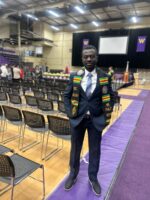
After relocating first to Canada and later to the United States, Appiah completed a Master’s degree in Biology at Western Illinois University in December 2025.
During that period, he interned as a Field Associate with Bayer Crop Science in Illinois, contributing to research projects focused on increasing crop production and improving agricultural sustainability.
Beyond the laboratory, Appiah said he remains committed to using science, research, and innovation to support global agricultural development, particularly in Africa and other regions vulnerable to food shortages.
“Science should not only remain in laboratories,” he said. “It must translate into practical solutions that improve lives, strengthen food systems, and create hope for future generations.”