Follow Us on Google
From Sola Ojo, Abuja
As rising global tensions in the Middle East continue to push up the cost of crude oil, Nigerians are once again grappling with the ripple effects, most notably, the steady increase in the price of Premium Motor Spirit (PMS), commonly known as petrol.
Across the country, transportation fares have surged, placing an additional strain on already strained household incomes.
For many workers, the daily commute has become a significant financial burden.
Yet, in Kaduna State, a different story is unfolding, one of cautious relief and an innovative government intervention that is helping thousands of workers stay mobile despite the economic headwinds.
In July 2025, following the Federal Government’s removal of fuel subsidy, the administration of Governor Uba Sani introduced a fleet of 100 Compressed Natural Gas (CNG)-powered buses as part of measures to cushion the impact on residents.
What began as a temporary relief programme has evolved into a lifeline for civil servants and informal sector workers across the state capital.
Originally designed to run for just six weeks, the initiative has since been extended indefinitely after recording significant success.
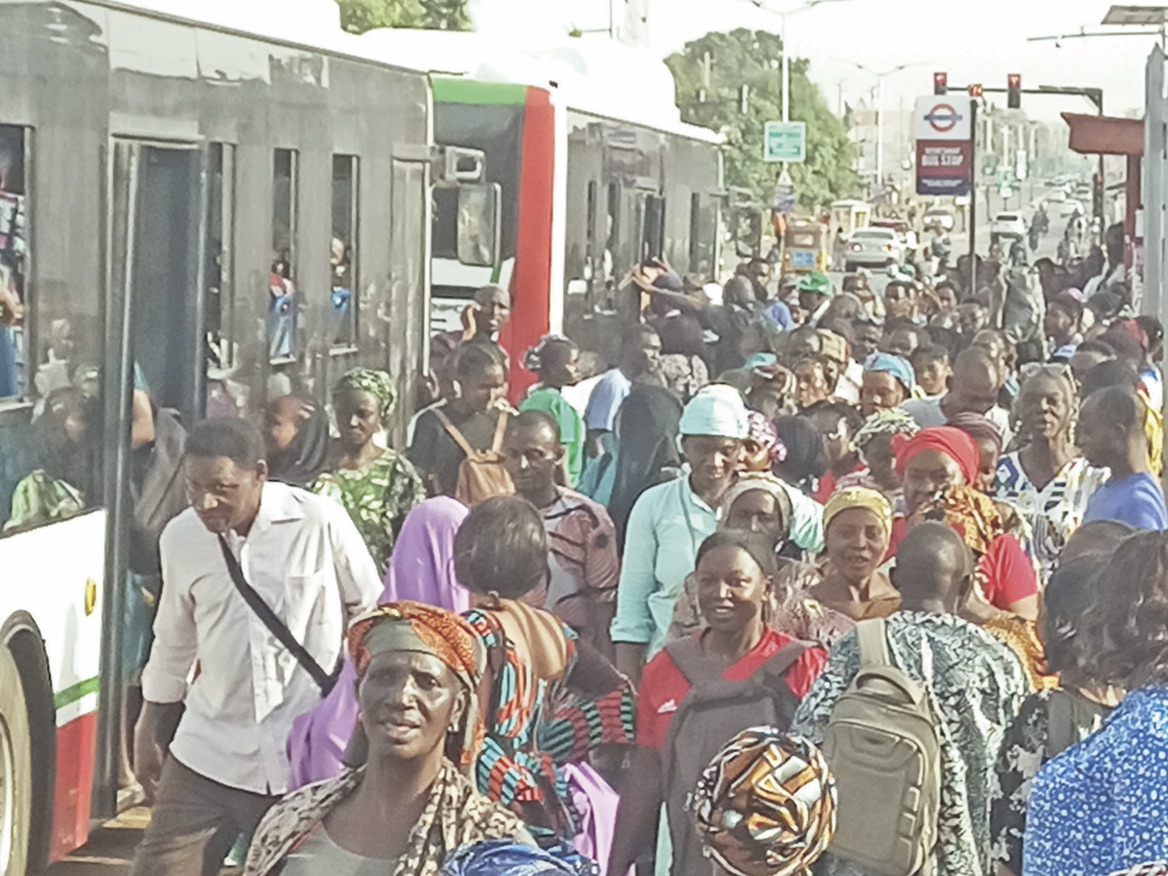
Today, these buses crisscross the Kaduna metropolis daily, providing free transportation to thousands of commuters without discrimination. But for persons with disabilities, the rush may expose them to unintended exclusion.
From Mararaban Rido to Nissi Village, from the Kaduna Refining and Petrochemical Company axis to Janruwa, Karji, Kaduna State University, the State Secretariat, Kawo, and Rigachikun, the buses serve a wide network of routes, connecting residential communities with key economic and administrative hubs since they started in July 2025.
By September 2025, the scheme had expanded significantly, with the buses operating from over 200 newly constructed, modern bus stops strategically located across the city.
Each bus, designed to carry about 60 passengers, now often transports more than 100 commuters per trip, a testament to both the popularity of the programme and the high demand for affordable transportation.
The buses typically run two trips in the morning and two in the evening, aligning with standard working hours. For many workers, this has eliminated the daily anxiety of how to afford transport to and from work.
A public commentator, Mr Ashidi Mamman, described the initiative as transformative.
“This has saved people a lot of money and at the same time increased productivity.
“Some workers who used to come to work only a few times a week because of transport costs can now plan better and attend work every day,” he said.
For many households, the financial relief has been substantial. Mr Mamman estimated that an average commuter saves between N1, 000 and N2,500 daily using the free bus service.
“Over weeks and months, these savings add up significantly especially in a challenging economic climate. When you multiply that by the number of people benefiting daily since last year, you’re talking about billions of naira saved.
“So if possible, the number of the vehicles should increase and send to other parts of the states so others can benefit as well.
“I also want to appeal to the managers that special attention be given persons with disabilities,” he added.
Official figures support this claim. According to the Kaduna State Commissioner for Information, Ahmed Maiyaki, the buses transported over 1.4 million passengers free of charge within just five months -from July to November 2025 alone.
“This translated into savings of about N1.39 billion for residents, money that would have otherwise been spent on transportation,” he noted.
For civil servants in particular, the impact has been profound. Before the intervention, transportation costs consumed a large portion of their salaries, sometimes leaving little for other essential needs.
“In some cases, whatever they earned went back into commuting expenses. This affected productivity, as some workers found it difficult to report to work regularly,” Maiyaki said.
With the burden of transport costs lifted, many workers are now more consistent and punctual.
For instance, government offices, once affected by irregular attendance, are reportedly experiencing improved staff presence and efficiency.
Other News
Beyond the civil service, the informal sector is also reaping benefits, traders, artisans, and small business owners who rely on daily movement across the city now have greater flexibility and reduced operating costs.
The scheme, therefore, is not just a social protection idea, it is also an economic enabler, supporting livelihoods and boosting overall productivity within the state.
While commuters celebrate the programme, those tasked with running it face their own set of challenges.
A driver, who spoke on condition of anonymity because he is not authorised to speak to the media, said the buses have remained in good condition despite heavy usage.
“Apart from CNG refilling and normal servicing, the buses are still very solid,” attributing their durability partly to the relatively good road network in the areas they serve.
However, he highlighted concerns about passenger behaviour and overcrowding.
“You know how Nigerians can be when it comes to opportunities like this.
“By the time we reach the final bus stop, there is often dirt everywhere, including water sachets, sugarcane waste, and so on,” he said.
He also noted that some passengers are unruly, speaking disrespectfully to drivers and officials, while overcrowding remains a persistent issue.
“We are finding it difficult to control the number of passengers, even with security personnel onboard.
“We don’t have serious issues of theft because passengers are usually careful with their valuables knowing full well that people come to enter the bus for different intentions,” he added.
The issue of overcrowding showed the acceptance, popularity and strain of the programme. With each bus carrying far beyond its intended capacity, questions arise about sustainability, safety, and the long-term viability of the initiative.
As states across Nigeria grapple with the fallout of subsidy removal and rising fuel costs, Kaduna’s approach may be considered because by investing in alternative energy (CNG) and prioritising mass transit, the state has created a buffer against external economic shocks.
The use of CNG buses is particularly noteworthy. Compared to petrol and diesel, CNG is generally cheaper and more environmentally friendly, making it a sustainable option for public transportation in the long run.
This model, if properly managed, could be replicated in other urban centres facing similar challenges.
Despite its successes, the programme is not without uncertainties.
Funding, maintenance, and operational logistics will all play a role in determining how long the initiative can be sustained at its current scale.
There is also the question of whether the service will remain entirely free or transition into a subsidised model over time.
Transport experts suggested that expanding the fleet or increasing the number of daily trips could help ease the pressure.
A member of the National Union of Road Transport Workers identified as Baban Yaara advocated introducing a minimal fare system to regulate demand while still keeping transport affordable.
“As a commercial bus driver, the CNG is somehow affecting our work. You know for example, my bus has a capacity of 10 passengers.
“So with more than 60 passengers entering each of those CNG buses, it reduces our passengers.
“Maybe if a small amount is introduced, it will help us and at the same time help the state government to maintain these buses. Otherwise, the sustainability may be threatened,” he said.
For now, though, Kaduna residents are grateful. In a period marked by economic hardship and rising living costs, the free CNG bus scheme offers a rare example of a policy that directly improves the daily lives of ordinary people.
As one commuter put it while boarding a bus at Kawo, “at least, getting to work is no longer a problem, and in today’s Nigeria, that is no small relief.”