Follow Us on Google
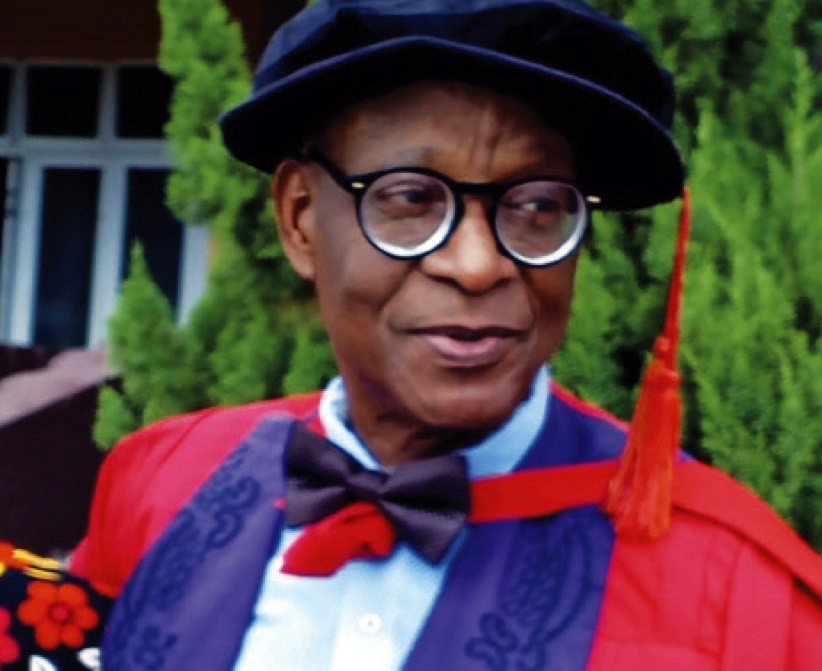
• At UNIBEN’s 366th Inaugural Lecture, Prof Odigie reflects on 46 years of surgical excellence, groundbreaking research and the future of healthcare in Nigeria
By Beifoh Osewele
For almost half a century, Professor Vincent Isibor Odigie has lived where life and death meet—not on a football field, but inside the operating theatre.
Yet when the veteran surgeon mounted the podium to deliver the University of Benin’s 366th Inaugural Lecture, he chose football—not scalpels, anatomy or operating rooms—to tell the story of his remarkable career.
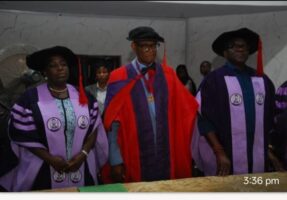
The lecture, titled “A Surgeon’s 46th Year of Surgical Soccering in a Changing Field of Play,” turned out to be far more than a discourse on medicine. It became a moving reflection on destiny, mentorship, teamwork, scientific discovery, humility and the urgent reforms Nigeria’s healthcare system desperately needs.



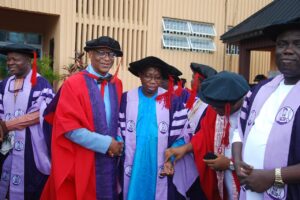
Inside the Akin Deko Auditorium sat members of the University of Benin community led by the Vice-Chancellor, Prof. Edoba B. Omoregie, SAN. Family members, former students, colleagues, friends and admirers had travelled from different parts of the country. Among them were sons and daughters of Ukpoke-Uhiele in Ekpoma, Esan West Local Government Area of Edo State, who came to honour one of their most distinguished sons.
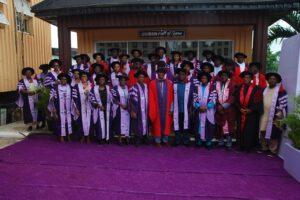


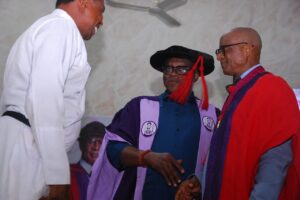
Throughout the lecture, Odigie repeatedly returned to one central message: “Surgery is a team game.”
From architecture to medicine
Looking at the accomplished professor today, few would imagine that medicine was never part of his childhood dream.

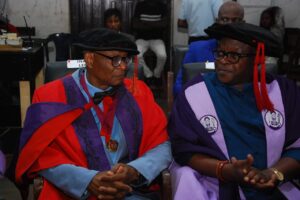

“As a teenager,” he recalled, “my dream was to become an architect. I applied to study Architecture. I never thought of Medicine.”
The audience listened attentively.
Unknown to him, however, his elder brother, then a university lecturer in Engineering, quietly altered his admission papers.
Professor Odigie would not discover the switch until three years later.
“I looked at my file,” he recounted with a smile. “I saw where they crossed out Architecture and wrote Medicine.”
Curious and slightly disturbed, he confronted his brother.
“I said, ‘Brother, I saw your writing in my file. You changed my course.'”
His brother’s response was simple.
“‘I am already in Engineering. What are you coming there to do? You are a young man. Just go ahead.'”
Professor Odigie laughed as he remembered what followed.
“And I obediently obeyed.”
The auditorium burst into laughter.
That unexpected decision changed not only his own future but also the lives of thousands of patients who would later pass through his hands.
Today, Vincent Odigie, professor of general surgery is one of Nigeria’s leading endocrine and gastrointestinal surgeons, a Fellow of the Medical College of Surgeons, the West African College of Surgeons, the International College of Surgeons and the American College of Surgeons.
Looking back, he expressed no regrets.
“Today,” he said quietly, “I have no regrets.”
Surgical soccering
The title of the lecture immediately caught the audience’s attention.
Why “soccering”?
Professor Odigie explained that the expression was deliberately chosen.
“The term soccering in surgery was aptly chosen by me,” he said. “I use it in the present participle and gerund of operating on live patients.”
Then he contrasted football with surgery.
“In football, the scorer of a goal and the assist are recognised. In surgery, only the surgeon is generally recognised, which I think is not appropriate.”
He paused and intoned: “Every successful operation has many assists.”
That philosophy became the thread that ran through the entire lecture.
Doctors may perform operations, but successful outcomes depend on anaesthetists, theatre nurses, laboratory scientists, radiologists, medical records officers, librarians, researchers, junior doctors and many others. No surgeon succeeds alone.
Before proceeding further, Professor Odigie offered perhaps the most heartfelt section of the lecture.
“I dedicate this inaugural lecture to God Almighty,” he declared, “the author and finisher of my faith, who managed my trajectory in life.”
He continued by dedicating the lecture to his patients, siblings, cousins, classmates, friends across northern and southern Nigeria, his wife, children, daughter-in-law and grandchildren.
“The boundless grace of God,” he said, “has been sufficient and will continue to be sufficient on my sojourn as a teacher, a surgeon, a mentor and caregiver for 46 years. I stand in awe therefore and return all praise and glory to God.”
He then turned to those who had worked with him throughout his career.
“I want to use this opportunity to thank all my colleagues, mentees, nurses, anaesthesiologists, laboratory scientists, medical records personnel, librarians and all those with whom I operated and researched together. God bless you all.”
A generation trained for every emergency
Professor Odigie belongs to a unique generation of Nigerian surgeons.
He recalled that after graduating in 1980, the Federal Government deliberately trained specialists who could respond to virtually every surgical emergency in the country.
“In 1980,” he said, “I was trained to become a specialist general surgeon—to play any position in surgery and score goals from any side.”
Unlike today’s era of narrow subspecialisation, surgeons of his generation handled virtually everything.
General surgery. Trauma. Orthopaedics.
Paediatric surgery. Urology. Emergency abdominal operations. Whatever arrived in the emergency room became their responsibility.
“We were trained,” he said, “to meet the unmet needs of doctors in Nigeria.”
Those experiences, he noted, shaped his professional outlook and prepared him for the challenges that would define his career over the next 46 years.
Heart of a lion
Perhaps the most memorable section of the lecture came when Professor Odigie abandoned statistics and began speaking directly to young doctors.
“A surgeon,” he declared, “must develop the heart of a lion.”
Then he explained why.
“When the lion picks on any prey, it is to devour that animal.”
But courage alone, he warned, is not enough. “You should acquire the eyes and wings and dexterity of an eagle.”
Like an eagle soaring patiently before descending with deadly precision, surgeons must combine courage with vision, patience and extraordinary skill.
Then came another lesson.
“If you can make a patient better,” he said quietly, “don’t make him worse.”
The audience responded with prolonged applause.
Professor Odigie urged young doctors never to lose their humanity.
“Develop compassion for the sick,” he advised. “Hear their pains. Love them like a woman loves her lover. And try to improve their health status.”
Finally, he reminded them that technical competence must always be accompanied by character.
“Above all,” he said, “be disciplined. Have the milk of human kindness and the humility and integrity to speak truthfully to your patients, your colleagues, your students and your authorities.”
Debunking dangerous myths
Professor Odigie devoted considerable time to correcting widespread misconceptions about hernia.
“Hernia,” he declared emphatically, “is not a sexually transmitted disease.”
The audience laughed.
Then came another statement that drew even louder laughter.
“‘Over-knacking’ or ‘under-knacking’ cannot cause hernia.”
The humour, however, masked a serious warning.
“There are no drugs for treating hernia,” he said. “The only drug for treating hernia is good surgery.”
Drawing from decades of clinical research, he explained that although increased abdominal pressure had traditionally been blamed, abnormalities in collagen formation are now recognised as an important cause of the disease.
He also described how surgical practice has evolved dramatically.
Years ago, patients often arrived with enormous untreated hernias, sometimes transported in wheelbarrows because they could no longer walk.
Today, advances such as mesh repair and laparoscopic surgery have transformed outcomes.
Nevertheless, he warned against dangerous delays.
“The patient starts vomiting,” he explained. “He cannot pass stool. The intestine loses its blood supply. Then the bowel becomes gangrenous.”
His prescription was simple.
Seek medical help early—not traditional myths.
Breast cancer: Nobody is too defended to be afflicted
If hernia exposed the dangers of medical myths, breast cancer revealed something even more troubling to Professor Odigie.
“It is not simply cancer that is killing our women,” he observed. “Fear, poverty and late presentation are equally deadly.”
Drawing from years of clinical research, he explained that one of the greatest misconceptions among Nigerian women is that every breast lump is cancerous.
“We reviewed over 400 breast tumours,” he told the audience. “Out of 428 breast lumps, 71 per cent were benign. They were not cancerous.”
He paused deliberately before delivering what was perhaps the most important public health message of the afternoon.
“So, if you have a lump in your breast, please do not think it is cancer. See a doctor.”
The packed auditorium fell silent.
Professor Odigie explained that many women delay seeking medical attention because they assume a breast lump automatically means a death sentence. Others dismiss the lump altogether until it is too late.
“Both assumptions,” he warned, “can be fatal.”
One of the presentation slides projected on the giant screen showed the photograph of a young woman wearing a necklace bearing the inscription: “I am too defended to be afflicted.”
Professor Odigie gently challenged the slogan.
“Nobody is too defended to be afflicted,” he said. “Cancer does not know whether you are rich or poor. It does not know whether you are educated or uneducated. It does not know your social status.”
“The only thing,” he stressed, “is to identify it early and get it treated.”
His appeal was especially significant in a country where breast cancer remains the commonest cancer affecting women.
The cost of coming late
Throughout his lecture, one phrase kept recurring.
“Come early.”
His research, he explained, consistently showed that early diagnosis dramatically improves survival.
“When patients present early,” he said, “their chances of surviving for five years and even ten years are very high.”
But once the disease spreads, survival falls sharply.
The statistics represented far more than numbers. Each percentage point, he reminded the audience, represented a wife, a mother, a daughter or a sister whose life might have been saved through earlier diagnosis.
“Early presentation,” he said again, “saves lives.”
Beyond the operating table
Professor Odigie’s concern extended beyond removing tumours.
He wanted to understand what happened to women after surgery.
His findings were sobering.
“The breast,” he explained, “is an organ of duty to a woman. It is an organ of bond between mother and child.”
Following women after mastectomy, his research team documented changes in self-esteem, family relationships and marital intimacy.
Some marriages survived the trauma.
Others did not.
Turning to husbands in the audience, he offered practical advice that blended humour with compassion.
“When you are in your quiet time,” he said, smiling, “don’t only play with the breast. Examine it.”
The audience responded with laughter.
Then his tone became serious.
“When the doctor decides that the breast has to be removed,” he pleaded, “the husband should not go outside to get another wife.”
Instead, he urged spouses to stand by their wives during one of the most difficult periods of their lives.
“Cancer,” he reminded them, “is a family challenge.”
The telephone that changed cancer care
Long before telemedicine became fashionable, Professor Odigie had already recognised its enormous potential.
The challenge confronting him was simple.
Many cancer patients never returned after surgery. Some lived too far away.
Others lacked transport fare. Many simply disappeared. Rather than blame them, he asked a different question.
“What if the hospital could reach the patient?” His answer was revolutionary for its time.
“I suggested that if you give a cancer patient your phone number,” he recalled, “you can follow that patient effectively.”
Using ordinary mobile telephones, doctors could monitor patients, answer questions, identify complications early and encourage them to continue treatment.
The innovation attracted international recognition. His research was presented before the African Organisation for Research and Training in Cancer (AORTIC), where it received wide acclaim. Later, both the World Health Organisation (WHO) and the Union for International Cancer Control (UICC) incorporated mobile telephone numbers into standard cancer patient records.
Looking back, Professor Odigie smiled.
“Now,” he said, “mobile phone number is compulsory.”
A warning every Nigerian should remember
If there was one message Professor Odigie wished every Nigerian would take home, it concerned blood in the stool.
Too often, he said, both patients and healthcare providers assume it is merely piles.
That assumption, he warned, has claimed countless lives.
“I studied colorectal cancer for twenty-four years,” he said.
Then, speaking slowly for emphasis, he declared: “Anybody who comes with rectal bleeding… put your finger into the rectum. Examine the patient.”
The hall fell completely silent.
Nearly 70 per cent of rectal cancers, he explained, can be detected through a simple digital rectal examination.
“Never diagnose piles in adults,” he warned, “without doing a digital rectal examination.”
It was one of the strongest clinical lessons of the afternoon.
The patient who swallowed his secret
Every surgeon carries unforgettable cases.
Professor Odigie shared one that sounded almost unbelievable.
A young man had complained of persistent chest pain for years.
Repeated treatments failed.
Eventually, surgery revealed the astonishing truth.
Buried deep inside his chest was a denture he had swallowed seven years earlier.
When the patient recovered, Professor Odigie showed him the object.
The embarrassed man finally confessed.
During his bachelor party years earlier, he became intoxicated, accidentally swallowed the denture, secretly replaced it and told nobody—not even his fiancée.
For seven years, doctors treated him for ulcers while the denture slowly eroded through his oesophagus into his lung.
The professor used the story to teach an important lesson.
“If the story does not tally with your clinical sense,” he advised, “handle the patient with caution.”
Medicine, he reminded young doctors, requires both scientific knowledge and careful listening.
When errors occur
After nearly five decades in the operating theatre, Professor Odigie has performed thousands of surgeries, trained generations of doctors and pioneered innovations that have influenced surgical practice within and beyond Nigeria.
Yet, standing before the University of Benin community, he chose not to celebrate only his successes. He confronted one of the most painful realities of surgical practice—medical errors.
Projecting the image of a surgical gauze inadvertently left inside a patient’s abdomen, he remarked quietly: “This is the only thing you hear in the news.”
The audience shifted uneasily.
“The heavens are moved when errors are made,” he continued.
The condition, known medically as gossypiboma, remains one of the most dreaded complications in surgery.
But Professor Odigie urged the audience to look beyond assigning blame to a single individual. “It isn’t just the surgeon that should be blamed,” he said. “It is everybody who was involved in the surgery—the surgeon, the nurse, the anaesthetist, the assistant, the attendant. Somebody did not do his own work.”
The statement echoed the philosophy that had framed his lecture from the very beginning. And that if success belongs to the team, failure also belongs to the team.
Throughout the afternoon, he demonstrated a rare willingness to discuss mistakes openly—not to excuse them, but to ensure they are never repeated.
For the younger generation of doctors, it was a masterclass in professional humility.
Diseases are changing
Medicine, Professor Odigie observed, is constantly evolving. “The surgery we practise today,” he said, “is not the surgery we practised decades ago.”
Diseases change, patients change and scientific knowledge changes.
Drawing on years of research, he explained that gastrointestinal perforations, once attributed mainly to peptic ulcer disease, are now increasingly linked to the indiscriminate use of painkillers.
“People take drugs like Feldin, Cataflam and Indocid for ordinary body pains,” he noted.
“They take the drugs for relief, but by morning they may have perforated their bowel.”
His warning against self-medication resonated strongly with the audience.
Innovation born from local realities
One of the most fascinating moments of the lecture came when Professor Odigie spoke about life after colorectal cancer surgery. According to him, patients who lose the anus require a colostomy through which body waste is discharged.
Imported colostomy bags were available, but they were not designed for African realities.
With characteristic frankness, he smiled and said: “They cannot hold the African stool.”
The auditorium erupted in laughter.
Instead of accepting the limitation, his team developed an indigenous alternative—the Zaria Kolobelta Bag—designed specifically for local conditions.
The innovation later gained national recognition among notable inventions from Nigerian universities.
For Professor Odigie, innovation begins by understanding the everyday realities of patients rather than merely importing foreign solutions.
Poverty is the greatest barrier
As the lecture drew to a close, the veteran surgeon shifted from clinical medicine to healthcare policy. He argued passionately that many Nigerians do not die because treatment is unavailable. They die because they cannot afford it.
“Late presentation,” he declared, “is not as a result of ignorance. It is as a result of poverty.”
Those words lingered in the hall.
For decades, healthcare experts have made similar observations, but hearing them from a surgeon with forty-six years of experience gave them added weight.
He called for stronger universal health insurance capable of protecting ordinary Nigerians from catastrophic medical expenses.
An Uber ambulance for Nigeria
Perhaps the proposal that generated the greatest interest was his vision for emergency healthcare. Borrowing from the convenience of ride-hailing technology, Professor Odigie imagined a future where emergency medical services would be available at the touch of a button.
“A sick patient should be able to call an Uber ambulance,” he said, “and the National Health Insurance Scheme should pay.”
It was a simple idea with profound implications.
Emergency care, he argued, should never depend on whether a patient has cash in hand. Lives should not be lost while families struggle to raise transport fares or negotiate hospital deposits.
Technology, he insisted, must become an integral part of Nigeria’s healthcare delivery system.
Universities should manufacture medicines
Professor Odigie also challenged Nigerian universities to expand their role beyond training health professionals.
“There should be a drug manufacturing unit in every university,” he recommended.
Such facilities, he argued, would encourage research, promote local pharmaceutical production, reduce dependence on imported medicines and strengthen the nation’s healthcare system.
It was another reminder that universities should not merely generate knowledge but also produce practical solutions to national challenges.
46 years of “surgical soccering”
As the applause subsided and the audience rose to its feet, one message remained unmistakably clear.
The professor had not merely delivered an inaugural lecture. He had shared the distilled wisdom of a lifetime spent in service to humanity.
From the unexpected decision that redirected him from architecture to medicine, to pioneering research in cancer care, telemedicine, colorectal surgery and indigenous medical innovation, his career has been defined by scholarship, compassion and an unwavering commitment to excellence.
His lecture challenged young doctors to cultivate “the heart of a lion,” “the eyes and dexterity of an eagle,” and, above all, “the milk of human kindness.”
It called on Nigerians to reject dangerous myths, embrace early diagnosis, support cancer patients with empathy, and build a healthcare system that is affordable, technology-driven and accessible to all.
For Professor Odigie, surgery has never been about fame or personal glory. It has always been about teamwork.
As he reminded his audience, football celebrates the player who scores the goal. Surgery should also celebrate those who make the goal possible.
After 46 years of what he fondly calls “surgical soccering,” Professor Odigie’s greatest victories are not measured by the number of operations he has performed or the honours he has received. They are measured in lives saved, cancers detected early, students mentored, innovations pioneered and families given another chance to hope.
Those, perhaps, are the goals that matter most.
———–