Follow Us on Google

By Chinelo Obogo
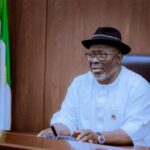
Rivers State Governor Siminalayi Fubara has condemned what he described as “the culture of impunity, corruption, and political godfatherism” plaguing Nigerian politics.
Speaking at the Freedom Online 6th Annual Lecture held in Lagos, Fubara, who was represented by a former Deputy Governor of Rivers State, Mr Tele Ikuru, addressed the theme: “Nigeria’s Socio-Political Challenges: Whose Fault? Leaders or the Led?” He said both leaders and citizens have a shared responsibility in addressing Nigeria’s persistent governance and development issues.
In his remarks, Fubara highlighted how, over the past 18 months, his administration established “a resource allocation and management process that is both transparent and judicious” in Rivers State. He said the state has transformed its public procurement system to be “more accountable, competitive, and seamless.”
He also criticised Nigeria’s weak institutions that fail to provide the necessary checks and balances on executive power and pointed to the Independent National Electoral Commission (INEC) for what he described as its selective enforcement of constitutional provisions regarding political defections.
Other News
“Institutions are supposed to act as checks and balances, but Nigeria’s weak institutions have further exacerbated governance challenges. The judiciary, legislature, security agencies, and electoral bodies often operate under political influence, undermining their effectiveness. For instance, the Independent National Electoral Commission (INEC) has failed to uphold the law concerning political defections. According to the constitution, lawmakers who defect from the party on whose platform they were elected should lose their seats. However, INEC has been selective in enforcing this rule, raising questions about its neutrality. When institutions fail to do what is necessary, the rule of law is weakened, and democracy suffers,” he said.
The governor also condemned political “godfatherism,” where leaders rise to power through the patronage of influential political figures rather than on merit, which he said “perpetuates a cycle of unaccountable governance across the country.”
Addressing voter behaviour, Fubara noted that electoral challenges are worsened by widespread voter apathy, particularly in states like Rivers, where accusations of voter suppression are common. He criticised citizens for often supporting politicians based on ethnic or party loyalty rather than demonstrated competence.
“Leaders emerge from the same society they govern. If the people demand accountability, credible leaders are more likely to emerge. If citizens remain passive, bad governance will continue,” he said.