Follow Us on Google
By Chukwuma Umeorah
The true measurement of one’s wealth is in the collective prosperity of his people. That principle finds expression in the life and trajectory of Festus Uzoma Mbisiogu, a businessman whose rise from a humble agrarian background in Ideato South, Imo State, has translated into sustained human capital investments and community development across his home region.

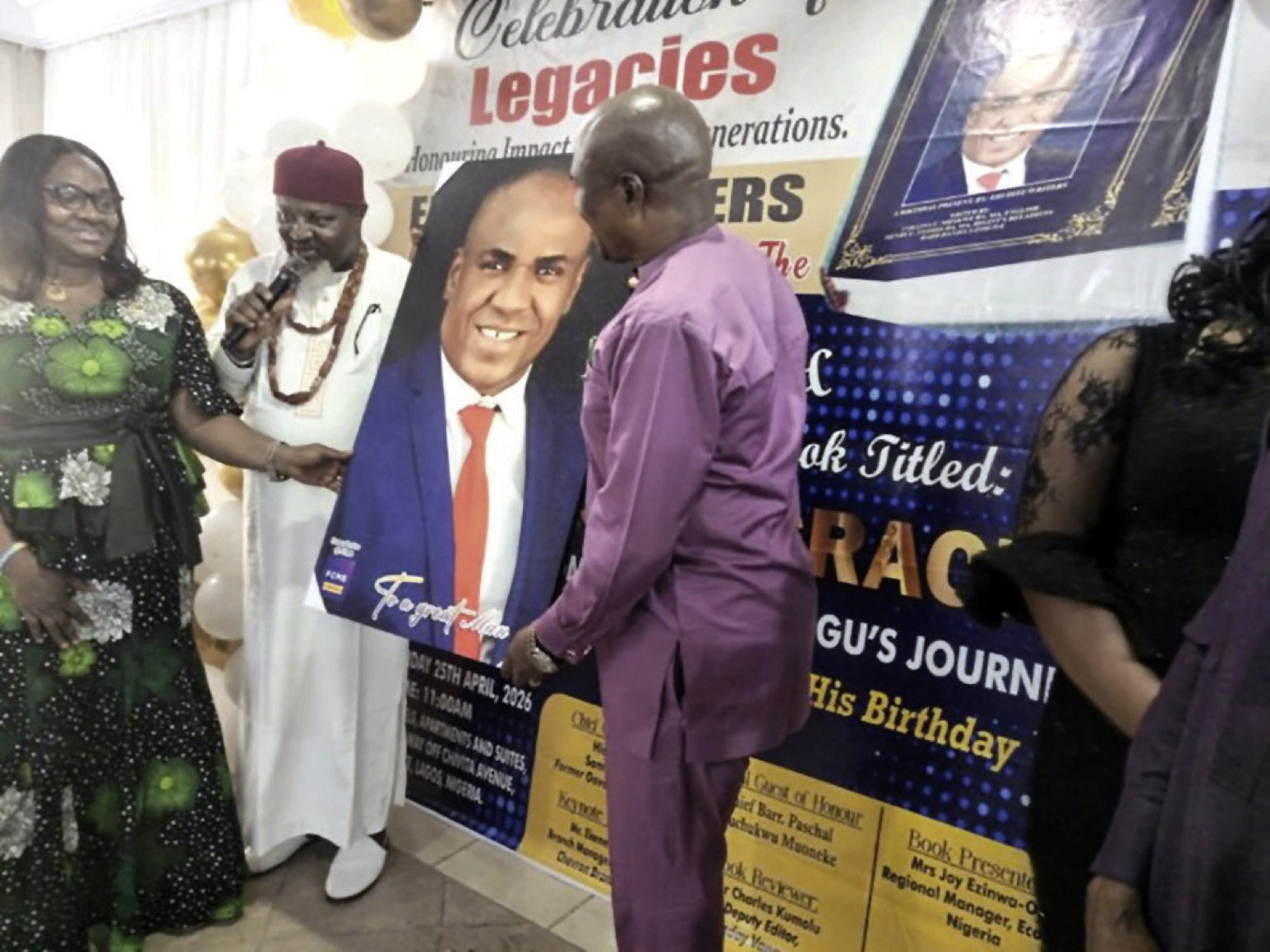
Mbisiogu has made it a priority to support his people in every way within his capacity, ranging from healthcare and education to community infrastructure. From boreholes and hospital support to scholarships and skills development initiatives, many of these interventions – carried out without public fanfare – have begun to alter living conditions in parts of Ideato, according to beneficiaries, community leaders and associates who spoke at a recent book launch in Lagos, documenting his journey.

It is often said that the best way to honour a man is to document his impact when he is alive. Given the scale of Mbisiogu’s contributions, it is little surprise that Erudite Writers, a publishing outfit, chose to celebrate him while he is still alive. The book, From Grass to Grace: Portrait of Uzoma Festus Mbisiogu’s Journey, authored by Ogudu Henry and Collins Chukwuma Mbakwe, founders of Erudite Writers, presents a detailed account of his progression from childhood struggles to business success and philanthropy, positioning his life as both record and reference point for younger generations.

At the launch, the authors framed the project as an attempt to document verifiable impact rather than celebrate wealth for its own sake. Ogudu set the tone in his address.
“We gather today not merely to mark a birthday, but to honour a man whose journey embodies an eternal truth: the wind of fortune does not lift men to the ladder of success. Rather, it is forged by the fire of hard work, tempered by resilience, and crowned by unwavering commitment.”
Born on April 15, 1973, in Umuchima, Ideato South Local Government Area, Mbisiogu grew up in what he has described as one of the poorest households in his village. His parents were subsistence farmers, and life revolved around limited resources, communal obligations and survival discipline.
Rather than romanticise poverty, Deputy Editor at Vanguard Newspapers, Charles Kumolu, in his review of the book, anchors this contextual approach as one of its strongest attributes
“From Grass to Grace is a deeply reflective and culturally grounded narrative that chronicles the life of Uzoma Festus Mbisiogu. More than a biography, the work stands as a moral and philosophical exploration of how adversity can cultivate strength, character, and vision.”
He further notes that the narrative is deliberately grounded in its environment. “From the very opening, the author demonstrates a deliberate and thoughtful approach, situating Mbisiogu’s story within the socio cultural landscape of Umuchima. This is not a casual backdrop, rather, it is a carefully constructed foundation that allows readers to understand the environmental, economic, and communal forces that shaped the subject’s early life.”
The book places strong emphasis on the formative role of Mbisiogu’s parents. His father is portrayed as a man whose authority was rooted in discipline and moral integrity, while his mother provided emotional balance and quiet resilience.
Kumolu highlights this dimension as central to understanding the subject’s value system. “His father emerges as a figure of integrity and wisdom, a man whose wealth was measured not in material possessions but in character and moral authority. His mother is presented as a pillar of emotional strength and quiet resilience.”
These influences, the narrative suggests, shaped an early understanding that success must ultimately serve a wider social purpose.
Childhood experiences are also used as interpretive tools rather than dramatic embellishments. A storm incident in November 1985, alongside other rural experiences, is framed as part of a gradual formation of discipline and awareness.
“Moments such as the storm incident of November 1985 are deliberately framed as formative experiences that instilled discipline, caution, and resilience,” Kumolu observed.
Other News
Mbisiogu later left Umuchima for Lagos in search of opportunity, advancing his education with a Bachelor’s degree in Business Administration from the University of Lagos and a Master’s degree from Guangdong University of Foreign Studies in China.
His business expansion spans logistics, shipping, freight forwarding and manufacturing. Through the Blue Diamond Group, which includes Blue Diamond Logistics and Shanghai Engineering Works Limited – his operations extend across Nigeria, China, Dubai and other international markets.
However, the book is careful to underline that this expansion came with structural and operational challenges – currency volatility, regulatory complexities and cross-border logistics demands.
These realities, according to the authors, reinforce the resilience required to sustain international enterprise from a Nigerian base.
The most defining element of Mbisiogu’s story, however, is not accumulation but redistribution. His philanthropic gestures have earned him a place in hearts of the people and in the sight of God. In Umuchima and surrounding communities, he has funded boreholes to improve access to clean water, including installations at strategic communal points. He has also supported hospital development, including the building and equipping of a medical facility, alongside more recent interventions such as a health centre, doctors’ quarters, solar street lighting and electricity infrastructure.
Through the Uzotex Charity Foundation, funded for over a decade, he has supported scholarships, medical bills, houses for widows and vocational training initiatives.
Community accounts consistently describe these interventions as quiet, consistent and need-based rather than publicity-driven. At the book launch, beneficiaries echoed a similar pattern – educational support, emergency healthcare assistance and livelihood support delivered without public announcement.
This reality aligns with a widely referenced principle in the book. “What you do speaks so loudly that I cannot hear what you say.”
For the authors, Ogudu and Mbakwe, the project is not only celebratory but archival in nature. “At Erudite Writers, we are guardians of legacy, not merchants of praise. We do not just write books. We craft legacies.”
They explained that the decision to document Mbisiogu’s journey followed verification through community engagement, stakeholder interaction and independent confirmation of impact in Ideato South. The authors added that the project later evolved into an educational initiative, with plans for an annual reading and quiz competition targeted at schools across the region.
For Kumolu, the significance of the book lies in its interpretive depth rather than its subject alone. It moves beyond biography into moral inquiry. He further describes it as “a repository of life lessons” and “a moral and philosophical exploration of how adversity can cultivate strength, character, and vision.”
The narrative, he argues, succeeds because it does not isolate Mbisiogu’s success from his environment. Instead, it links personal transformation to structural realities of rural life, education, family discipline and cultural grounding.
Overwhelmed with joy, Mbisiogu expressed surprise at the depth of documentation of his life, describing the moment as overwhelming. He went on to acknowledge the organisers and attendees of the event, noting their sacrifices in honouring him.
“Today is Saturday, you are supposed to be at the comfort of your home, resting, but you are here to celebrate me. May God Almighty celebrate you in the morning, in Jesus’ name.”
Explaining his initial hesitation about being the subject of such a publication, he said: “At first, I nearly declined because I was trying to avoid promoting myself or exalting myself.”
Mbisiogu, who is also a God-fearing and family-oriented man, framed much of his life experiences and philanthropic decisions as part of what he described as a divinely guided path. “I strongly believe that before the foundation of the Earth, that I have a script being written for me, from my creator.”
He linked several of his interventions, including community water projects and welfare initiatives – to personal experiences and losses within his family, noting that such moments shaped his sense of responsibility to his community.
“What I’m trying to say is this. I want to appreciate God for giving me the grace to respond to some of the scripts He wrote for me. Because it’s not by my power, neither by my might.”
Encouraging attendees to reflect on purpose and impact, he said individuals must identify their own calling beyond wealth or position. “Try your best to discover your own calling in life. It could be service to humanity. It could be advice you give to people. You don’t need to have money before you can now render your own service to humanity.”
He concluded by urging a collective commitment to societal impact: “If we all put our hands together, we are going to make this world a better place.”