Follow Us on Google
By Ahmed Abdullahi
President Bola Ahmed Tinubu’s appointment of Nyesom Ezenwo Wike as Minister of the Federal Capital Territory in August 2023 provoked one of the fiercest debates of his early presidency. Nearly three years later, however, the conversation has shifted from the politics of that appointment to the realities of infrastructure renewal, urban planning reforms and the enduring question of whether visible performance can ultimately reshape public perception.
As the first light of day breaks over Abuja, the city awakens with a renewed sense of purpose. Construction workers gather beside freshly paved roads, motorists ease through corridors once defined by frustrating gridlock, and the distant hum of heavy machinery echoes across neighbourhoods where abandoned projects have sprung back to life. For many residents, change is no longer something announced from government podiums; it is something encountered on the journey to work each morning.
Cities rarely tell their stories through speeches alone. They speak through their streets, bridges, parks and skylines. Some bear the scars of neglect, reflecting years of abandoned ambitions and inconsistent leadership. Others project confidence through purposeful planning, visible renewal and steady progress. In many respects, a city’s physical landscape becomes the clearest expression of the quality of its governance.
Abuja, Nigeria’s purpose-built capital, appears to be entering such a defining chapter. Across the Federal Capital Territory, several strategic roads have been completed at records time, many others, including those abandoned for years are nearing completion, dormant construction sites have returned to life and public spaces are undergoing visible renewal. The transformation is still unfolding, but it has become increasingly difficult to ignore. Whether viewed with admiration or cautious scepticism, the capital has become one of the most closely watched and talked about symbols of the Tinubu administration’s Renewed Hope Agenda.
Ironically, the man now closely associated with that transformation began his journey under a cloud of intense controversies.
When President Bola Ahmed Tinubu, GCFR, announced Nyesom Ezenwo Wike, CON, as Minister of the Federal Capital Territory in August 2023, reactions were immediate and sharply divided. Political opponents, religious and ethnic champions questioned the wisdom of the appointment. Civil society organisations urged caution. Commentators wondered whether a politician celebrated for his forceful leadership style in Rivers State possessed the temperament required to administer Nigeria’s uniquely sensitive capital.
Abuja is unlike any other city in the federation. It houses the Presidency, the National Assembly, the Supreme Court, foreign diplomatic missions and numerous international organisations. More importantly, it was conceived as neutral ground—a capital designed to symbolise national unity above ethnic, religious and regional identities. Whoever administers it occupies one of the country’s most consequential public offices.
Among the earliest critics was Senator Ireti Kingibe, who questioned both the appointment and aspects of Wike’s governing style. Religious organisations appealed for greater sensitivity in managing a city built on the ideals of inclusion and national cohesion. Others interpreted the decision through the lingering political tensions in Rivers State, predicting that Abuja might become another arena for partisan confrontation. Long before the new minister settled into office, expectations had already collided with suspicion.
Beneath the political exchanges lay a deeper constitutional conversation. For decades, leadership of the Federal Capital Territory had followed an unwritten regional pattern that many Nigerians gradually came to regard as convention. Although the Constitution reserves the office for no ethnic group or geopolitical zone, successive appointments had created the perception that the position naturally belonged to one part of the country.
Since the Federal Capital Territory was created on February 3, 1976, the only Minister from the Southern part of Nigeria was Mobolaji Ajose-Adeogun. He was referred to as a Commissioner then, and since he left office in 1979, successive Ministers of the Federal Capital Territory had been from the North.
Tinubu’s decision quietly challenged that long-established assumption.
In doing so, the President reaffirmed the founding philosophy of Abuja itself. The Federal Capital Territory belongs to every Nigerian, regardless of origin, faith or political affiliation. Its administration should therefore be guided by competence, capacity and constitutional responsibility rather than inherited political expectations. It was a bold departure from convention, but one whose ultimate justification would depend entirely on results.
That was the challenge confronting Wike from his first day in office. Symbolism alone would not convince sceptics. Political endorsements would not silence critics. Abuja had accumulated too many abandoned projects, too many planning violations and too many disappointed expectations. Ultimately, only performance could answer the questions surrounding one of the most debated appointments of the Tinubu presidency.
The challenge before the new minister was as daunting as it was visible. Abuja remained one of Africa’s most ambitious planned capitals, yet parts of the city reflected years of interrupted projects, mounting infrastructure pressure and uneven urban development. As the population expanded, expectations grew that the nation’s capital should better reflect Nigeria’s economic potential and democratic aspirations.
The problems extended beyond unfinished roads and increasing traffic. Urban development experts had repeatedly warned that inconsistent implementation of the Abuja Master Plan was gradually undermining the city’s orderly growth. Illegal developments, unauthorised land use and weak enforcement had begun altering the carefully designed character of the capital, raising concerns about its long-term sustainability.
For residents, these were not merely planning issues; they affected daily life. Lengthy traffic delays, poor connectivity to emerging districts and overstretched public infrastructure became familiar frustrations. Businesses faced rising transportation costs, while commuters spent valuable hours navigating roads that struggled to keep pace with Abuja’s rapid expansion.
Against this backdrop, Wike’s administration moved quickly to restore momentum. Rather than beginning with ambitious policy declarations, it focused on reviving projects that had stalled for years. Contractors returned to abandoned sites, construction activities resumed across key corridors and project supervision became more rigorous. The emphasis was clear: visible execution would define the administration’s early months.
One of the first indicators of that renewed momentum was the accelerated completion of strategic road projects across the Federal Capital Territory. Work advanced on sections of the Inner Southern Expressway, the Outer Southern Expressway and several important link roads connecting developing districts. Beyond reducing travel time, these projects were intended to stimulate economic activity and improve access to growing residential communities.
To mark President Tinubu’s first year anniversary, Wike took nine days to commission projects, it was 19 days during the second year anniversary and for the third anniversary, he took 31 days.
he impacts of these projects were not confined to Abuja’s City Centre. Attention increasingly shifted towards satellite towns whose residents had long argued that development in the capital was unevenly distributed. Road rehabilitation and new connections improved access to several communities, reinforcing the message that the benefits of public investment should extend beyond the city’s administrative and commercial core.
As at today, a total of 221km of roads have been completed with 96km ongoing across the satellite towns, making 317km.
Speaking during the inauguration of some of these projects, President Bola Ahmed Tinubu, represented by Vice President Kashim Shettima, described the interventions as part of a broader commitment to inclusive development. Roads, he observed, do more than connect destinations; they connect people to opportunity, commerce and essential public services. That philosophy increasingly shaped the administration’s approach to infrastructure delivery.
Attention also returned to public transportation. The Abuja Rail Mass Transit system, whose promise had long outpaced its performance, received renewed focus as government sought to improve urban mobility. While the rail project predated Wike’s appointment, renewed commitment to its operation reflected a growing recognition that modern capitals cannot rely solely on road transport if they hope to meet future demands.
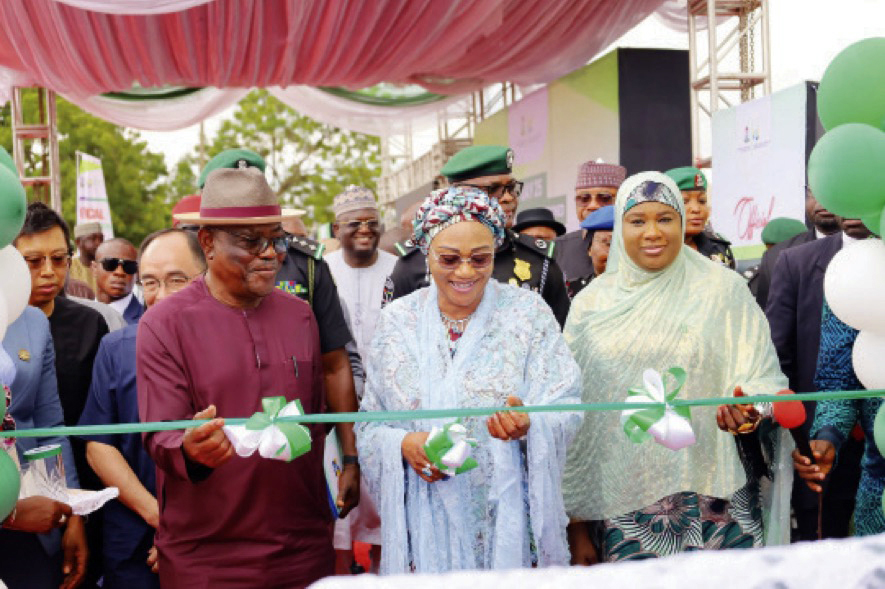
Urban renewal was equally evident in the transformation of the Abuja City Gate and its surrounding environment. Once regarded primarily as a ceremonial entrance into the nation’s capital, the area has been redesigned into an attractive recreational and environmental space. Landscaped gardens, improved walkways and enhanced public facilities have given one of Abuja’s most recognisable landmarks a renewed identity.
During the inauguration of the project, First Lady Senator Oluremi Tinubu described the redevelopment as a meaningful contribution to the Renewed Hope Initiative’s Green Nigeria Challenge. Her remarks highlighted an important dimension of urban development: successful cities are measured not only by highways and bridges but also by the quality of the public spaces where people live, relax and interact.
Also, water is being provided with greater vigour. The Greater Abuja Water Project was part of the projects commissioned last year, while water projects in Karu and Bwari were commissioned as part of this year’s 31 days of projects commissioning.
The Greater Abuja Water Supply Project, which was awarded in 2017 at a total cost of $470 million takes care of loops 1, 2, 5, and 6.
Apart from these, over 100 schools have also been reconstructed or renovated. As at the first quarter of this year, 60 to 70 per cent of the school renovations had been completed.
By and large, gradually, public attention has now shifted. The fierce political debate that had greeted Wike’s appointment did not disappear, but it increasingly competed with another reality. Across the capital, residents can see projects progressing, roads reopening and neglected spaces receiving new attention. The conversation is no longer centred solely on the politics of his appointment; it is being increasingly shaped by the visible pace of delivery.
If infrastructure became the administration’s most visible achievement, enforcement soon became its most contentious test. Building roads and renewing public spaces attracted broad approval, but restoring planning discipline, ensuring compliance, especially in the area of payment of Ground Rent and other applicable fees on properties across the Federal Capital Territory proved far more complex. It was here that Wike’s leadership style generated the sharpest debate and the strongest opinions.
For years, professionals in urban planning had warned that Abuja was slowly drifting away from the vision contained in its original Master Plan. Unauthorised developments, indiscriminate land use and weak regulatory enforcement had altered parts of the city’s carefully designed layout. What was intended to be a model capital increasingly faced the pressures of uncontrolled urban expansion.
Determined to reverse that trend, the administration intensified development control activities and strengthened compliance with planning regulations. Officials insisted that the objective was not simply to remove illegal structures but to protect the long-term integrity of a city designed to serve generations of Nigerians. In their view, delaying enforcement would only make future corrective measures more difficult and costly.
The policy, however, was never going to be universally popular. Demolition exercises affecting illegal structures, alongside the revocation of some land allocations, generated criticism from property owners, civil society organisations and sections of the political opposition. Many accepted the need for order but questioned the manner of implementation, calling for greater consultation, transparency and fairness where livelihoods were affected.
Supporters offered a different perspective. They argued that successive administrations had tolerated widespread violations for too long, creating a culture in which planning regulations were routinely ignored. From that standpoint, decisive enforcement was not an act of hostility but a necessary step towards restoring credibility to institutions responsible for managing the nation’s capital.
The debate mirrors experiences in many planned capitals around the world. Cities such as Brasília, Canberra and Islamabad have all struggled to balance rapid growth with strict planning standards. Wherever governments attempt to reclaim public spaces or enforce development laws, resistance is almost inevitable. Abuja’s experience therefore reflects a broader challenge confronting modern cities rather than an isolated political dispute.
President Bola Ahmed Tinubu consistently defended the administration’s approach, maintaining that difficult decisions are sometimes unavoidable when governments seek lasting reforms. For supporters, the emphasis on enforcement demonstrated a willingness to confront long-standing problems that previous administrations had often deferred. For critics, it underscored the need for stronger institutional safeguards and greater public engagement.
Ultimately, the debate should not be reduced to a choice between development and accountability. Effective governance demands both. Cities flourish when planning laws are respected, but public confidence grows only when enforcement is transparent, consistent and anchored in the rule of law. Striking that balance remains one of the defining responsibilities of every administration entrusted with Abuja’s future.
Even as those debates continued, the physical landscape of the capital kept changing. Roads previously trapped in endless delays gradually opened to traffic. Construction activity became more visible, neglected public spaces received renewed attention and regulatory agencies appeared more active than they had been in years. For many residents, these were practical changes that could be experienced rather than merely discussed.
By this stage, the national conversation had begun to evolve. The controversy surrounding Wike’s appointment had not disappeared, but it no longer stood alone. It now existed alongside a growing body of visible projects that were delivered promptly and measurable interventions. Whether one viewed his methods with approval or reservation, the discussion had become less about political prediction and increasingly about governance in practice.
If Abuja’s recent experience offers any enduring lesson, it is that leadership is rarely judged by first impressions alone. Political appointments may ignite passionate debate, but time has a way of shifting attention from personalities to performance. In the end, citizens are more interested in how government improves their daily lives than in the controversies that accompany its decisions.
That helps explain why the conversation around Wike has evolved. The questions that dominated the early months of his appointment have not disappeared, but they now share space with discussions about roads, public spaces, planning reforms and the changing face of the Federal Capital Territory. The narrative has become broader and, perhaps, more balanced.
None of this suggests that criticism has become irrelevant. Questions about transparency, consultation and accountability remain legitimate in every democracy. Equally, governments must continue to demonstrate that decisive leadership can coexist with respect for due process and the rule of law. Sustainable development demands both public confidence and institutional credibility.
For President Bola Ahmed Tinubu, appointing Wike represented a deliberate break from convention. For Wike, it became an opportunity to demonstrate that performance could gradually reshape public opinion. Whether history ultimately ranks his tenure among the most consequential in the administration of Abuja will be left to future generations and the test of time.
One conclusion, however, already appears difficult to dispute. The debate surrounding Wike’s appointment has matured beyond politics alone. Today, it is increasingly measured against the physical transformation taking place across the nation’s capital. Cities, after all, are remembered less for the controversies that surround those who govern them than for the legacy they leave behind. In that respect, Abuja’s story is still unfolding, but its conversation has undoubtedly changed.
• Abdullahi, a public affairs analyst lives in Abuja