Follow Us on Google
From Okwe Obi, Abuja
There is no doubt that Nigeria’s healthcare sector is replete with plethora of hiccups like poor medical facilities, brain drain, industrial actions by medical doctors and health workers, and poor budgetary allocation, leading to poor services and unavoidable deaths. In fact, the lingering problems have given wings to capital flight through medical tourism.
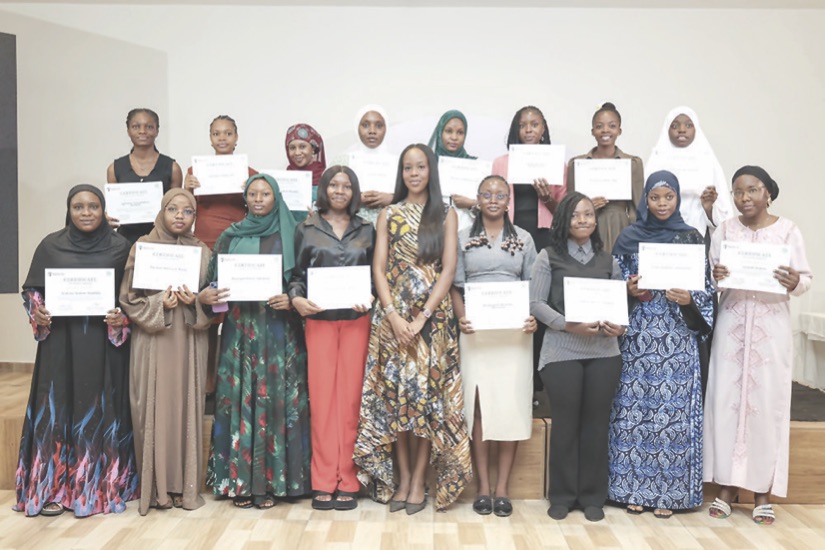
Piqued by the existential snags, the Built for Her Foundation, recently took up the gauntlet to salvage the crisis by granting scholarships to 30 female medical students drawn from the six geopolitical zones of the country, who are in their 400 levels.
The beneficiaries were drawn from the Ahmadu Bello University, Zaria, University of Jos, Lagos State University University of Calabar, University of Nigeria, Nsukka and Obafemi Awolowo University, Ile-Ife among others.
Its founder, Dr. Teniola Saraki, said the intervention stemmed from the gloomy picture of medical negligence in the country, especially as it affects women and girls.
Saraki also cited a scalding report on the rot in the health sector from the McKinney Institute, which stated that Nigeria records one maternal death every seven minutes, adding that in 2023, about 75,000 mothers lost their lives, which accounted for 29 per cent of all maternal deaths worldwide.
She claimed that one in every 100 Nigerian women risks dying from pregnancy or childbirth-related causes.
According to her, women’s health autonomy also remains a challenge as 71.2 per cent of married women lack autonomy in making decisions about their sexual and reproductive health, which means that only 29 percent have full control over their healthcare choices.
She said the scholarship which is in partnership with the Nigerian Medical Schools Students Association, was geared towards simmering the statistics.
The daughter of the former Senator President, Bukola Saraki, disclosed that she tapped only women because of their representation in the scheme of things.
“The foundation first came about due to the scholarship which we are announcing today.
“It is a national scholarship in partnership with the Nigerian Medical Schools Students Association, and it gives 30 beneficiaries from across all six geopolitical zones in their 400 level tuition fees.
“But apart from that, we want to form a connection with the female medical students throughout their time in medical school and also their time as doctors, because female representation in the physician workforce is low.
“It is below 50%, and so we are really trying to include women in the healthcare workforce, because more women in the healthcare workforce has multiple benefits in terms of healthcare utilization, policy, care in the actual hospitals, and understanding the needs of women.
“And so the scholarship is mainly based on including women in the healthcare workforce,” she explained..
She clarified that the work for the foundation “is based upon the five pillars of closing the gender health gap set out by McKinsey, and that includes women, studying women, caring for women, and investing women.”
On the selection, Saraki said her organisation sent applications to all medical schools in partnership with the Nigerian Medical Schools Students Association, adding that the universities forwarded their transcripts and proof that they were enrolled in the institutions.
“From there, we picked the highest achieving students, five per geopolitical zone.
“So the criteria was you had to be a female medical student enrolled in university, you had to be in the 400 level, and you obviously had to have outstanding achievement in university, and we picked the five top-scoring students,” she said.
The tuition cost, she said, varied per student, as it is based on the tuition fees pending for them.
She assured female medical students that the intervention would be an annual event to encourage them to take their studies seriously.
To close the gender health gap she said it “requires everyone involved, requires all hands in. I think the message is that women’s health matters. Gender equity can’t be reached without addressing women’s health.
“Women’s health is needed for women to thrive. It affects how they learn, how they work, how they care for others, how they lead, how they create. Women’s health is really foundational to gender equity and everything.”
Beyond the foundation’s intervention, the Coordinating Minister of Health and Social Welfare, Prof. Muhammad Ali Pate, claimed that maternal deaths had reduced drastically.
Represented by his Chief of Staff, Dr. Mayowa Alade, Ali Pate corroborated Saraki’s fear on the rise of maternal and child mortality rates.
“Through the NHSRII, we are beginning to see a downward trend in maternal deaths in our health facilities (17% reduction in maternal deaths in health facilities in the MAMII LGAs),” he added.
National President, Medical Women’s Association of Nigeria (MWAN), Dr Zainab Kwaru Mohammed-Idris, said the focus on women was not to sideline the men, but bridge existing gaps between both genders in the medical field.
Also, Mohammed-Idris observed that female medical doctors are not just service providers, but designers of better health and related systems, advocates for equity and accountability and drivers of sustainable reforms.
She said without female medical doctors there would be reduction in workforce capacity, weaker patient-centered care and slower progress on women’s health goals.
On her part, the former First Lady of Kwara State Toyin Saraki, lauded the Built for Her Foundation for translating vision into structured action and for placing women’s health firmly within broader conversations on development, equity, and national progress.
She expressed optimism that the foundation would catalyse sustained collaboration across sectors, contribute to shared global and local learning on closing the gender health gap, and support Nigeria’s continued progress toward achieving the Sustainable Development Goals.
Chairman of the Nigerian Medical Association (NMA), FCT chapter, Dr Emeka Ayogu, said the milk of human kindness was timely, as it would encourage more women to pursue medicine.
Furthermore, the 48th president of the Nigerian Medical Students Association (NiMSA), Ahmadu Delmi Sardauna, said the initiative would inspire female students and strengthen the country’s health workforce, professionally.
In her response, one of the beneficiaries, and fourth-year medical student of Ahmadu Bello University, Zaria, Hindat Abdulwahab, said the foundation did not only funded education, but ignited a movement for women to champion healthcare innovation, leadership, and excellence.
Abdulwahab said: “Since receiving this scholarship, I have been ecstatic. It reminds me that someone sees me. It says I may not know what it took for you to get here but I see you and I am proud of you.”