Follow Us on Google
From Abel Leonard, Lafia
Smallholder farmers across rural communities in Nasarawa State have lauded the Sasakawa Africa Association (SAA) for improving their productivity and livelihoods through various agricultural interventions.
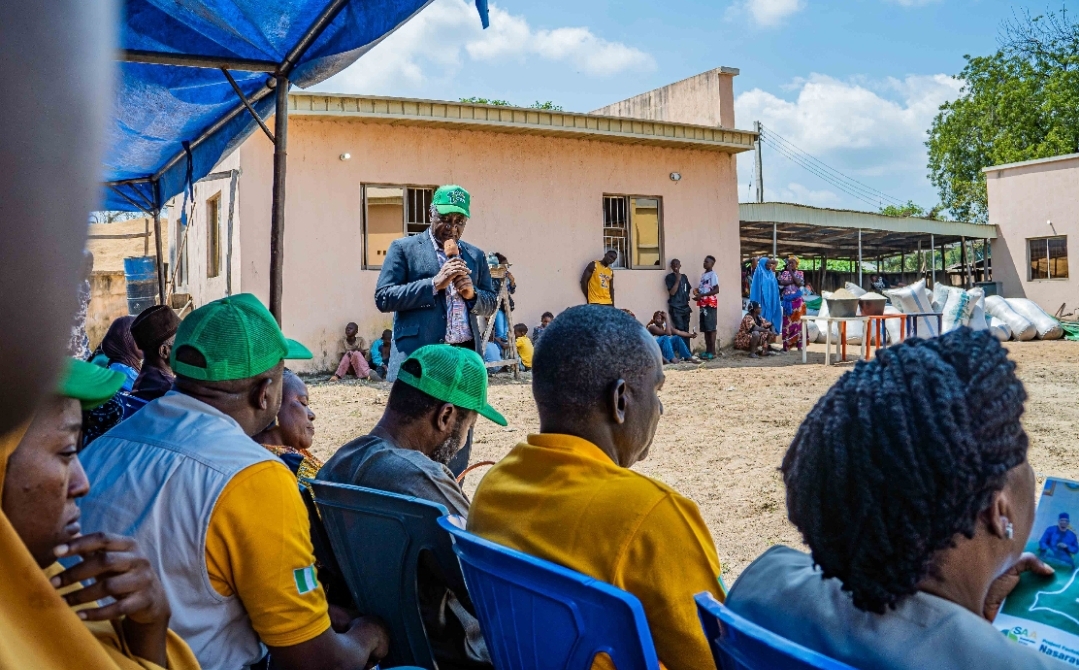
The farmers, mainly rice producers, gave the commendation during a two-day media field visit to communities in Lafia, Doma, and Obi Local Government Areas of the state.
They said that SAA’s programmes on regenerative, nutrition-sensitive, and market-oriented agriculture had exposed them to improved technologies, good agronomic practices, and modern processing and marketing techniques that have significantly boosted their yields and incomes.
Mr. Yusuf Ekom, Chairman of Salama Oklo Cooperative Society in Alagye, Doma LGA, said the intervention had changed their approach to farming.
“We were trained on the production of Bokashi and Biochar organic fertilisers to maintain soil health. We also learnt how to prepare nursery beds and transplant rice in rows with specific spacing rather than broadcasting seeds,” he said.
Ekom added that the introduction of improved rice seed varieties such as Faro 66 increased his harvests remarkably.
“I now harvest about 30 bags of rice from a plot of land where I used to get only 10 bags. This has improved my income and living standard,” he said.
Mrs. Mary Daniel, Chairperson of Muyi Noma Women Cooperative in Sabon Gida, Lafia LGA, said SAA’s training empowered women farmers to become self-reliant.
“We were trained on producing Bokashi and Biochar, which we sell to other farmers at ₦20,000 per bag. Currently, our group has over ₦300,000 in its account,” she said.
According to her, the association also trained them on nutrition and supported the cultivation of pro-vitamin A maize, pumpkin, ginger, and vegetables to promote healthy diets.
In Deddere community, Obi LGA, members of Kauna Cooperative Society, including Mrs. Salome Isaac and Mary Samuel, expressed appreciation for the interventions and appealed for their expansion to other parts of the state to enhance food security.
At Assakio in Lafia LGA, Mr. Emmanuel Odeh, Chairman of Apashi Woza Cooperative, said SAA had transformed rice production and processing in the area.
He explained that the rice aggregation and processing centre established by SAA was equipped with modern facilities such as polishers, dehuskers, and colour sorter machines.
Other News
“The centre processes nearly one metric ton of rice daily and employs 67 workers. We have realised about ₦12 million in revenue within one year of operation,” Odeh said.
SAA’s Country Director, Dr. Godwin Atser, called for sustained partnership with the Nasarawa State Government to strengthen agricultural productivity, food security, and youth inclusion in agribusiness.
He commended Governor Abdullahi Sule for creating an enabling environment for agricultural development in the state.
Atser revealed that SAA, with support from The Nippon Foundation of Japan, had implemented several impactful initiatives worth over $1 million, including the establishment of rice processing centres in Assakio and Agwatashi.
According to him, the interventions have raised rice yields from 1.8 tonnes to 4.8 tonnes per hectare—an increase of over 100 percent.
“Our programmes are anchored on SAA’s 2021–2025 Strategic Plan, which promotes regenerative, market-oriented, and nutrition-sensitive agriculture to improve productivity, resilience, and livelihoods,” he said.
He appealed to the state government to sustain and increase counterpart funding to ensure continuity of ongoing projects and expansion into new areas.
Also speaking, Dr. Habib Diso, Technical Coordinator for Monitoring and Evaluation at SAA, said the media field visit was aimed at enabling journalists and stakeholders to assess the impact of SAA’s interventions directly from beneficiaries.
“The exercise provides valuable feedback that helps us identify areas for improvement and integrate lessons into future programmes,” he said.
Mr. Moses Nongoatse, SAA’s Communication Officer, explained that the organisation’s interventions focus on climate-smart agriculture and the promotion of high-yielding, drought-tolerant, and disease-resistant crop varieties.
He added that SAA currently operates in six local government areas of Nasarawa State — Doma, Lafia, Akwanga, Obi, Awe, and Keffi — with plans to expand further as collaboration with the state government progresses.
Nongoatse reaffirmed the association’s commitment to supporting Nasarawa’s vision for food and nutrition security, climate resilience, and youth empowerment in agriculture.