Follow Us on Google
From Juliana Taiwo-Obalonye, Abuja
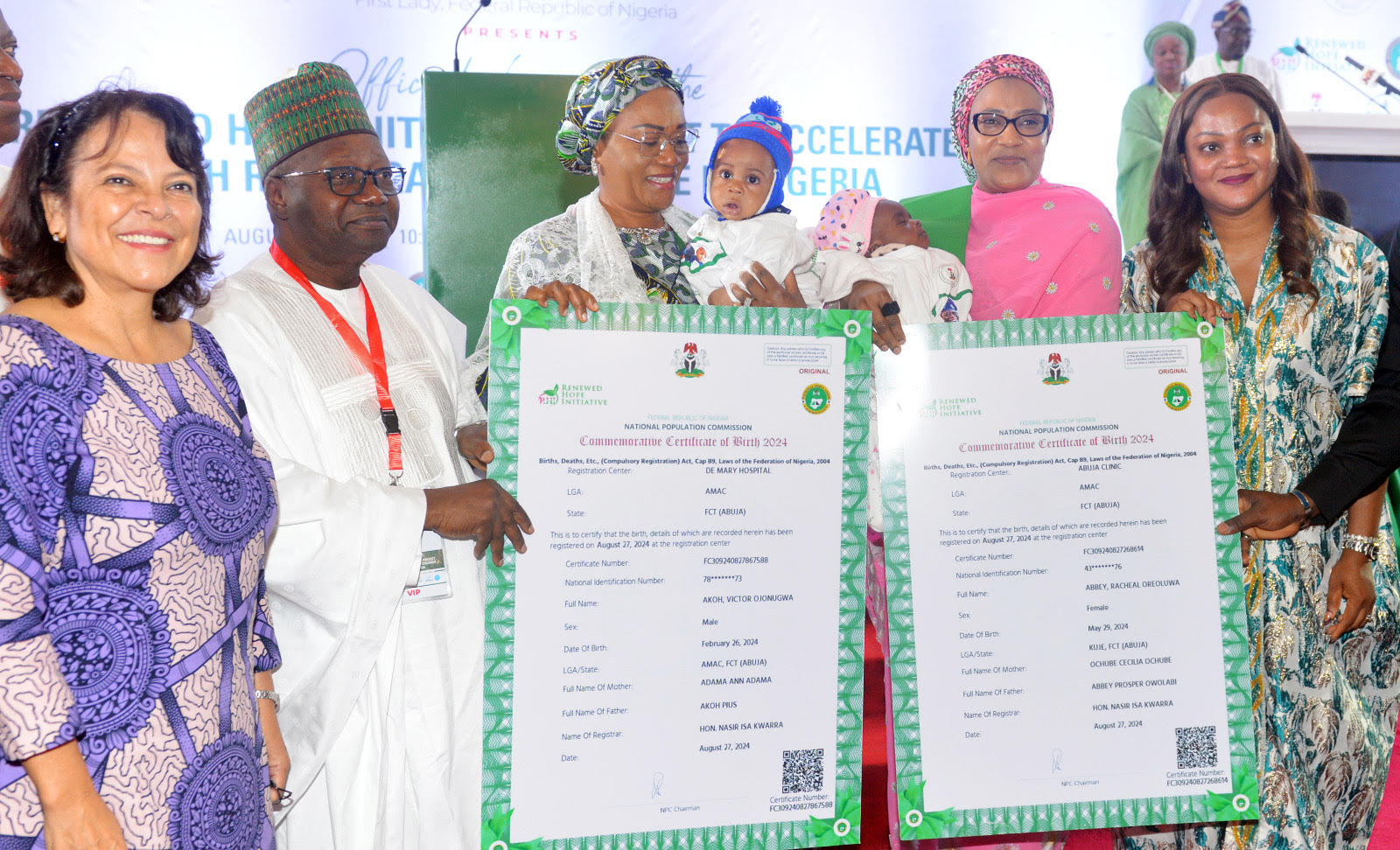
In a significant move to enhance birth registration in Nigeria, First Lady, Oluremi Tinubu, through her Renewed Hope Initiative (RHI), has partnered with the National Population Commission (NPC) and the United Nations Children’s Fund (UNICEF) to launch the UNICEF/RHI Commemorative Birth Certificate for 2024.
The RHI has committed to supporting the current administration’s efforts to accelerate universal free birth registration and certification, especially for newborns, using the national digital civil registration and vital statistics (eCRVS) in all health facilities and communities.
Mrs Tinubu stressed the critical importance of birth registration for Nigerian children at the launch on Thursday, August 29, 2024, at the state House Conference Center Abuja.
The launch of the UNICEF/RHI Commemorative Birth Certificate for 2024 is a significant step towards ensuring that every Nigerian child is counted, considered, and cared for, as the country strives to achieve the Sustainable Development Goal 16.9.2 – “a legal identity for all, including birth registration”.
Mrs Tinubu highlighted that birth registration serves as a child’s legal proof of identity, essential for accessing government services such as healthcare and education.
She said without a birth certificate, children face significant disadvantages, including difficulties in proving their age and potential exclusion from vital social amenities.
The First Lady encouraged all parents to register the birth of their children and obtain authentic birth certificates recognized by the government, emphasizing that without a birth certificate, children may miss out on government provisions and face disadvantages.
“To all parents, birth registration is very vital. It is the child’s legal proof of identity, as a Nigerian, without which children will not be fully recognised by the Government. They could miss out on government’s provision of healthcare, education and other social amenities. Without a birth certificate, children will be unable to prove their age and this puts them at a great disadvantage. I therefore encourage all parents to register the birth of their children and obtain authentic birth certificates recognised by the government.”
The First Lady further stressed the importance of a robust and efficient civil registration system for the country’s development and governance.
She noted that every live birth should be recorded to form the basis for policy, planning, and service delivery that meets the needs of all Nigerians.
President of the Senate, Godswill Akpabio, described the initiative as a clarion call for collective action, urging all Nigerians to support what he called vital cause.
Akpabio praised the First Lady for her leadership and dedication to improving the welfare of children in Nigeria.
Represented by the Senate Committee Chairman on National Population, Abdul Ningi, the President of the Senate highlighted that birth registration is the first official acknowledgment of a child’s existence by the state, granting them access to essential services such as education and healthcare.
Akpabio called on all stakeholders, including government agencies, civil society, and community leaders, to unite in making the initiative a success.
In closing, he urged everyone to embrace their shared responsibility in fostering a future where every Nigerian child is recognized and valued, ensuring they have the opportunity to thrive.
NPC Chairman, Nasir Kwarra, highlighted that the commemorative event represents a significant step forward in the government’s efforts to offer Nigerian children their first foundational identity, which will grant them access to essential government services such as education and healthcare.
UNICEF Representative Cristian Munduate, highlighted the government’s commitment to expanding birth registration services, particularly in remote and underserved communities. She noted the successful rollout of the digital Electronic Civil Registration and Vital Statistics (eCRVS) system, which has improved registration rates and established a foundation for children’s rights and services.
Other News
She recalled that in 2023, the government, with UNICEF’s support, set an ambitious goal to register over 11.5 million children under five. While this achievement is commendable, Munduate acknowledged ongoing challenges in meeting Sustainable Development Goal 16.9, emphasising the need to strengthen the capacities of the National Population Commission (NPC) and enhance public awareness campaigns.
The UNICEF Country Rep, called for increased social mobilization and the involvement of traditional and religious leaders to boost birth registration rates. Munduate praised the eCRVS system for its real-time registration capabilities and urged collective action from all sectors to ensure every child receives the identity they deserve.
She called for optimism and collaboration to create a sustainable birth registration system that serves all Nigerian children.
UNICEF’s Chief Child Protection Officer, Ibrahim Sesay, underscored the significance of the launch in closing existing gaps in birth registration and promoting data-driven development plans for children in Nigeria.