Follow Us on Google
Cross River battling fire outbreaks without firefighting infrastructure, officers lament
From Aniekan Aniekan, Calabar
Cross River State is presently contending with a growing fire epidemic, with multiple incidents reported within the last couple of months.
Between January to date, at least 25 fire incidents have been reported across the state, which has resulted in massive and unquantified loss of properties worth millions of naira.
Some of these incidents include the Fonex Filing station, Akim Timber Market and numerous outbreaks in Calabar at Abasi Orok, Abasi Edem, IBB Way, Watt Market ,Customs line, High Court Calabar, Nyaghasang, Double pole and many others.

The most gripping incident within the year occurred at the Fonex Filing station along Edibe Edibe where a gas station exploded on March 21, 2026.
The incident, which shook the neighbourhood to its marrow, destroyed properties and also led to the hospitalisation of over 60 people, who suffered various degrees of burns.
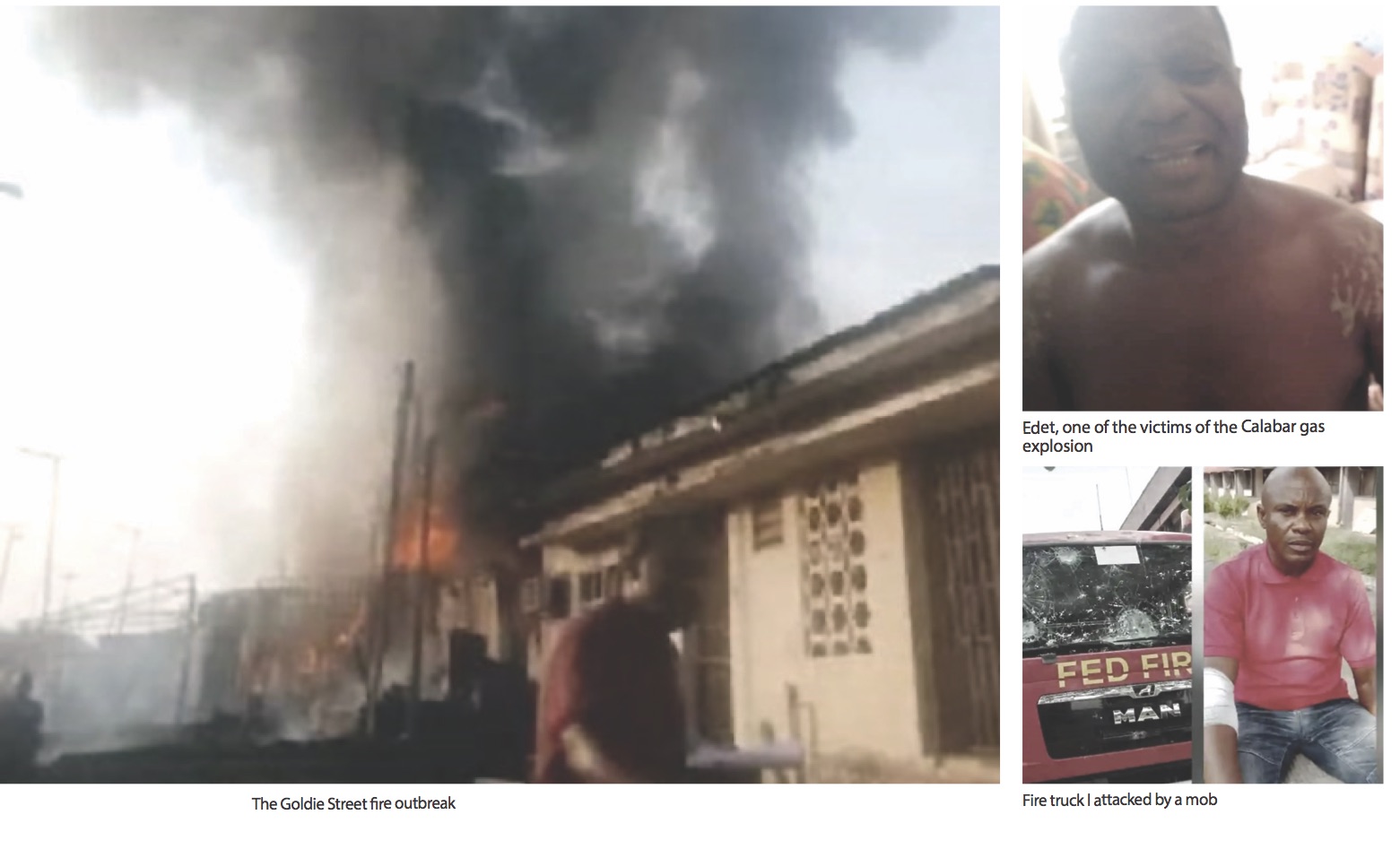
Explaining the impact of the explosion, one of the victims and also a witness, Edet Bassey, narrated what transpired and how he narrowly escaped.
“It started with a loud sound. I heard it, and before I knew what was happening, the entire vicinity was in flames. I tried to run, but my legs had turned to stone.

“The chaos was indescribable. People were screaming, ‘Fire! Fire! Run for your life.’ Some kind individuals ran to my wife and I shouting, ‘Leave this house, go outside! Come out, come out!’ We joined the stampede, trying to escape the blazing inferno.

“As I ran, I heard the thunderous sound of the explosion. The next thing I knew, I was in the gutter, bruised and battered,” he said.
This was followed in quick succession by the Akim Timber Market Fire which resulted in substantial losses by timber dealers amounting to over N600 million naira.
President of the Calabar Akim Timber Market Traders Association, Prince Sunday Ukata, said losses incurred by the association included over 25 shops and damages worth N600 million naira. He added that so many men with families to cater for have been rendered jobless as a result of the fire.
Investigations showed that the major reason for the poor response by the Cross River State Fire Service has to do with decades of underfunding. For instance, the last time the state government bought a fire fighting truck for the fire service was during the administration of former Governor Clement Ebri, which was 33 years ago.
The second major intervention in the fire service in terms of investments was 16 years ago when the Niger Delta Development Commission (NDDC) donated four fire fighting trucks to the state fire service.
Also, as part of its corperate social responsibility, the Cocoa Association of Nigeria (CAN) donated a fire fighting truck to the Cross River State government in 2025.
The chairman of the Cocoa Association of Nigeria (CAN), Cross River State chapter, Pascal Kejie-Bobua, explained the rationale behind the association’s donation of a firefighting truck to the Ikom community.
Speaking during a courtesy visit to Governor Bassey Otu, Kejie-Bobua said the initiative was a response to the frequent fire outbreaks in Ikom local government area of the state, causing significant losses of property worth several millions of naira over the years.
He noted that the absence of firefighting infrastructure in the area has worsened the impact of such incidents, often plunging affected families and traders into severe hardship.
The poor response to fire emergencies has also drawn the ire of victims and people living within the vicinity where these incidents occur.
For instance on January 11 this year, an angry crowd along Goldie Street in Calabar South Local Government Area attacked fire fighters with stones for arriving late to the scene of the fire outbreak in the area.
The Goldie fire consumed houses and shops and goods estimated at over N90 million. Angry victims and residents claimed that the truck showed up very late after the fire had inflicted heavy damages to their properties.
The Federal Fire Service frowned at the attack on its vehicle and personnel, saying such acts are criminal and endangered communities.
P.O. Abraham, the national public relations officer / head, corporate services, Federal Fire Service, said: “The Federal Fire Service has drawn public attention to a disturbing incident that occurred on Sunday, 11th January, 2026 during an emergency response at Goldie Street, Calabar, Cross River State.
“Upon receipt of a distress call, firefighting personnel immediately mobilized to the scene. However, on arrival, the responding officers were violently attacked by a mob. Several personnel sustained injuries, and the firefighting appliance was severely damaged, while the fire continued to consume property unabated.
“A separate viral video from Cross River State showed firefighters and their fire truck being stoned on arrival before operations could even commence. The crew was eventually forced to withdraw for their own safety.”
He added that such conduct is not a show of frustration but violence and is becoming alarmingly frequent. He further said these actions must be condemned without hesitation, excuse or justification.
He insisted that fire fighters do not create emergencies but they respond to them. Delaying or obstructing their operations does not reduce the damage caused by fire but it multiplies it, he argued.
The Cross River State government also condemned the attack on firefighters, describing it as uncalled for. Ekpenyong Akiba, the special adviser to the governor on general duties, said: “The fact that the firefighters came late is not enough reason to attack them.
“This is clearly a gap in communication and a clear misunderstanding between the people and firefighters.”
He said the government had activated a multi-agency disaster management framework to coordinate emergency response and is working on a communication system that will be properly channelled.
Akiba also urged youths and residents to remain calm and cooperative during emergencies, warning that destruction of public assets and attacks on firefighters would only set the state back.
He said the attack on fire trucks and personnel has within the last few months hampered efforts to ensure timely response to emergencies by sister agencies and the state is still reeling from this error of judgment.
Olumayowa Olomola, State Commanding Officer of the Federal Fire Service, attributed the inability of her office to respond to the gas station fire, for instance, to bad fire truck.
Olomola explained that the federal truck was recently vandalized by hoodlums and also officers were inflicted injuries during an operation in Calabar.
Giving an insight into the state of affairs of the service, Emmanuel Ajom, said many factors are responsible for the poor response to these incidents across the state, particularly the Akim Timber Market fire and the gas explosion.
He said: “Our trucks are very old. The trucks were given to us about 16 years ago and for over 14 years, they were abandoned and non-functional until the present administration decided to intervene.
“The service had been down for 16 years, no activity, no fire fighting equipment, no truck, no funding. We are just coming out of the dead and trying to move ahead.”
He said efforts are on to move the fire service forward and disclosed that despite challenges, the agency has successfully contained numerous fire incidents within the state between January to March this year.
He said: “From January till date, over 20 fire incidents have been reported and we have largely contained them except the Edibe Edibe and the Akim Timber Market fire.
“These interventions include incidents at the 1006 Navy Barracks, Customs Line, Federal Housing Estate, High Court at Mary Slessor alongside residential houses at Anderson Street, Abasi Edem, Abasi Orok and others.
On the timber market fire, he said the agency’s truck couldn’t assess the market because all routes were blocked and so needed to get its partners to intervene with smaller trucks.
On the gas explosion incident, he said they had a technical challenge as the agency presently lacks capacity to fight gas fire.
He explained that the government is addressing some of these challenges by fixing the fire trucks and also building a more befitting head office for the service.
On the head office project, which has been stalled, he disclosed that the project needed technical adjustments and the contract is being reviewed.
He added that over 90% of fire incidents across the state stem from electrical faults and also power fluctuations, saying safety is personal and people should take it as if their lives depend on it.
He also addressed concerns on the non implementation of the Fire Service Law enacted and assented to by the state governor.
He disclosed that the controller of fire is mandated to implement the law and they don’t want to go contrary to what the law spells out.
Flames of neglect continue to ravage Cross River State, exposing the state’s vulnerability to fire disasters.
Caption:
Fire truck and personnel attacked by a mob during the Goldie Street fire incident
2. The Goldie Street fire outbreak
3. Ukata
4. The stalled renovation of the Calabar headquarters of the Cross River State Fire Service
5. Edet, one of the victims of the Calabar gas explosion
6. Ajom
2nd story
Gov. Otu with some executives of the Cocoa Association of Nigeria, Cross River State chapter
2. Elumelu, wife; Dr. Awele; widow, Mrs. Ogbue; and son to the deceased patriarch of the Ogbue family
3 Members of Ogbue’s family
Celebrating Ogbue’s profound legacy
The legacy of Chief Israel Chinwuba Ogbue transcends mere achievements, creating a deep, lasting imprint on hearts and minds through authentic actions, values, and service that resonate across continents.
For many who gathered to honour him, there was something profoundly symbolic about the moment. It was, as his first son, Ikechukwu, described, “deeply symbolic, almost biblical, divine, poetic, and profound… beyond human comprehension, but undeniably divine.”
“In that singular moment, a life defined by discipline, faith, service and enduring impact came full circle.”
Born on February 18, 1927, into a family of 10 children, Ogbue’s early years were shaped by a strict, God-fearing upbringing under a catechist father. Those formative values, hard work, integrity, education and faith, would go on to define his journey across continents and generations.
“From humble beginnings, he ventured to Lagos in the early 1950s before travelling by sea to the United Kingdom in pursuit of higher education. There, he built lifelong friendships and embraced the promise of youth as part of a close-knit circle fondly called “the four musketeers”, Ikechukwu explained.
Returning home, he built not just a career, but a family, raising five children with his wife, a legacy his son proudly described as “to the glory of God, all five turned out well.”
Though widely regarded as a disciplinarian, his children remember something deeper.
“His discipline was always rooted in love. We lacked nothing, yet we were taught to treat everyone equally, regardless of status. That lesson has stayed with us”, Ikechukwu said.
As tributes poured in, one theme remained constant: gratitude.
“We mourn, but not as those without hope. Even in grief, we lift our hearts in gratitude for a life well lived.”
“A great tree has fallen,” his son said quietly, “but its roots run very deep.”
And in those roots, in the lives he shaped, the values he instilled, and the legacy he built, Chief Israel Ogbue lives on,” Ikechukwu added.
Beyond boardrooms and responsibilities, Ogbue’s life was rich with melody. Music flowed constantly through his home, sometimes from a stereo, often from his own rich baritone voice. That love for music became one of his most intimate legacies.
For his granddaughter, Dr. Onyinye Judith Ogbue, it was transformative. “One of the most meaningful ways he influenced my life was through music,” she recalled.
“I began learning the piano because of him, and that decision shaped how I experience the world.”
Describing him as a man of quiet kindness, she added: “It wasn’t loud or attention-seeking, it was steady, quiet, and deeply felt.”
“As a baby, I apparently had a habit of taking apart his cassette tapes,” she said with a smile. “I like to think I was already curious about the sounds he loved.”
“To his grandchildren spread across continents, Ogbue was a constant, present, attentive and deeply invested.”
“My grandpa’s absence feels different because, for as long as I’ve been alive, he has always been there,” said Ogechukwu Elumelu.
“He showed up for birthdays, family gatherings and milestones. That presence was a gift. His influence extended beyond affection into purpose and direction.”
“He would often ask, ‘What are you doing with your life?’” she said.
“It reflected his genuine concern about our growth and future. Even across Lagos, the United Kingdom and the United States, he remained connected, an anchor of unity in a globally dispersed family.”
“Family meant everything to him,” she added. “And above all, he was a man of deep and unwavering faith.”
To his son-in-law, Mr. Tony Elumelu, Ogbue was far more than family, he was mentor, partner and inspiration.
“He treated me like his own son,” Elumelu said. “I learned so much from him, especially in the corporate world.”
“ Our relationship extended into business, with Ogbue investing in Standard Trust Bank at my invitation, an illustration of his entrepreneurial instinct and belief in vision.
“He was a strong and astute entrepreneur,” Elumelu noted.
“Even in advanced age, his independence remained remarkable, until about three or four years ago, he still drove himself from Lagos to Delta State.
“Watching him, I learned resilience, discipline and independence.”
In the corporate sphere, Ogbue’s influence was equally profound.
Former Chairman of UBA, Ambassador Joe Keshi, described him as “a well-respected and beloved leader whose service and dedication left an enduring legacy of resilience, vision and a selfless pursuit of excellence.”
At the United Bank for Africa, where he became Chairman in 2011, Ogbue was credited with strengthening corporate governance and institutional integrity.
“His leadership was defined by reason, integrity and a deep commitment to building institutions that outlive individuals,” Keshi said.
Even in his final days, Ogbue remained mentally alert, curious and engaged with the world.
Former Managing Director/CEO of NICON, Mr. Ogala Osoka, recalled hospital visits where discussions ranged from personal reflections to global affairs.
“His mind remained sharp, inquisitive and active until the very end,” Osoka said.
“Conversations with him were never superficial, they were rich, insightful and shaped by nearly a century of lived experience. Ogbue’s life was a lesson in purposeful living.”
“He showed us that life is not merely about passing through time, but about living with depth, meaning and compassion.”
Back home in Onicha-Olona, Delta State, his legacy was etched not just in memory, but in tangible contributions.
Representing the community, Sir Chika Chiejina described him as “a shining example of humanity” whose life brought “honour, peace, progress and dignity” to his people.
“ Among his many acts of generosity was the donation of land for a proposed Grand Civic Centre, a gesture that will serve generations yet unborn.”
“He was a pillar of strength, a voice of truth, and a loving father whose legacy will endure,” Chiejina said.