Follow Us on Google
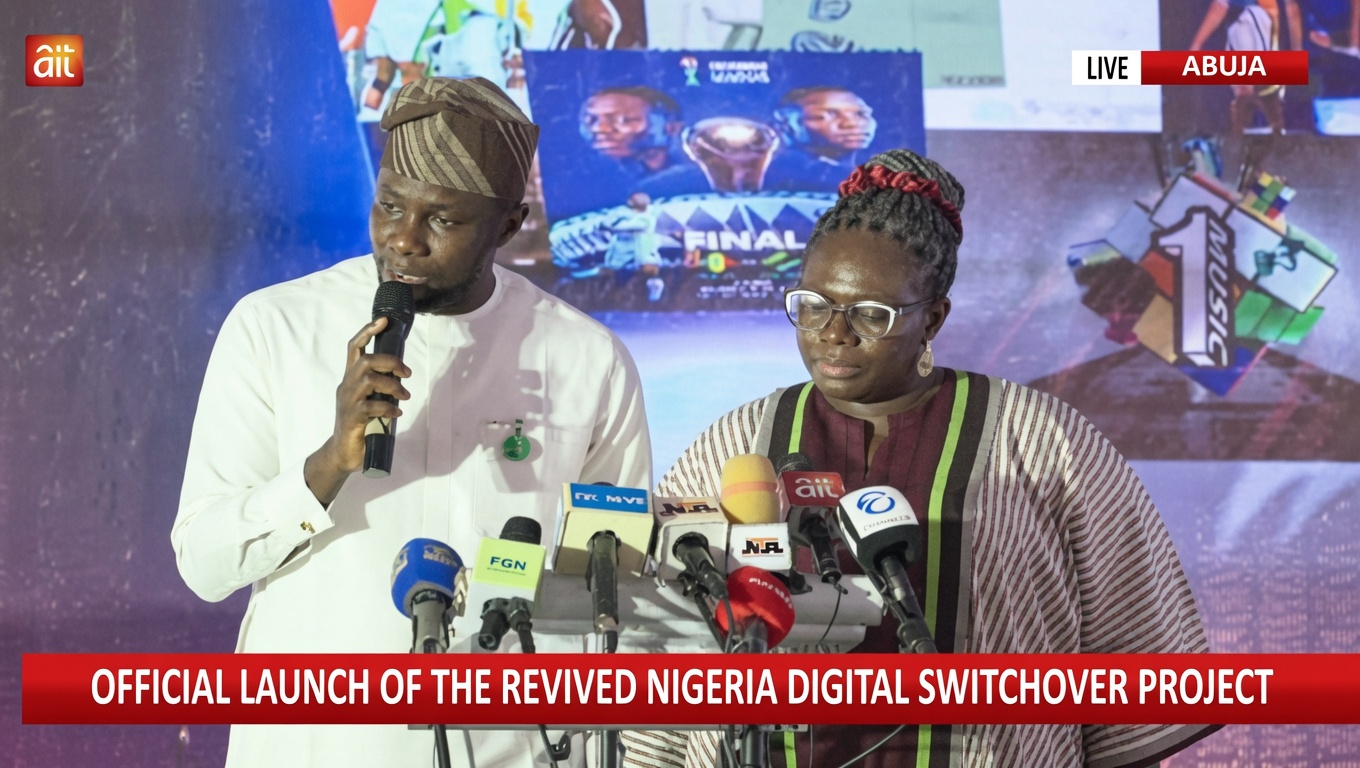
The Federal Government has inaugurated Nigeria’s Digital Switch Over (DSO) programme, projecting that the initiative will serve about 40 million households, generate more than N600bn in economic value, create employment opportunities and broaden access to high-quality broadcasting services nationwide.
The event, held in Abuja on Wednesday, signalled a significant step in the nation’s long-running transition from analogue television broadcasting to digital terrestrial television, a process that has experienced multiple delays over the years.
Addressing stakeholders at the launch, the Minister of Communications, Innovation and Digital Economy, Bosun Tijani, described the programme as a key achievement in the country’s digital transformation efforts and said it aligns with the government’s goal of building a $1tn economy.
He explained that the benefits of the switchover go far beyond television broadcasting, noting that it would improve access to information, educational materials and cultural programming, particularly for people in underserved communities.
“Today, Nigeria joins the ranks of nations that have embraced modern digital broadcasting infrastructure to serve their people.
“While this may appear to be a broadcasting milestone, its true significance lies in what it means for ordinary Nigerians. It means better access to information, broader access to educational and cultural content, an improved quality of service and the ability to ensure that no Nigerian is left behind simply because of where they live,” he said.
Tijani said the DSO forms part of a broader national strategy to strengthen digital infrastructure and highlighted it as one of the earliest tangible outcomes of the administration’s investments in the sector.
He revealed that the government is rolling out 90,000 kilometres of fibre-optic open-access infrastructure across the country and has secured approval for two additional satellites to enhance communications services.
“Under the administration of President Bola Tinubu, Nigeria is embarking on the deployment of 90,000 kilometres of fibre-optic open-access infrastructure across the country,” he said.
According to the minister, the extensive fibre network will link communities, businesses, institutions and public agencies while extending connectivity to border areas and neighbouring countries.
He added that combining the fibre expansion project with new satellite investments would strengthen connectivity and position Nigeria to provide digital and broadcasting services across the West African region.
“Our satellites will not stop at our borders. Our fibre ambitions will connect Nigeria to the wider region, and together they will create the infrastructure through which Nigerian stories, innovation and creativity can reach far beyond our borders,” he said.
Also speaking, the Director-General of the National Broadcasting Commission (NBC), Charles Ebuebu, described the initiative as the foundation of a new communications framework for the country and an important milestone in Nigeria’s digital development.
Ebuebu said the project would create opportunities throughout the broadcasting ecosystem while encouraging investment, supporting local manufacturers and increasing consumer choices.
“The big picture represents our collective ambition to democratise access to information, unlock new opportunities for Nigerian content creators, stimulate investment across the broadcasting value chain, empower local manufacturers, strengthen media plurality, expand consumer choice and improve spectrum efficiency,” he stated.
On her part, the Managing Director and Chief Executive Officer of NigComSat, Jane Egerton-Idehen, described the programme as a major investment in Nigeria’s digital future rather than simply an upgrade of broadcasting technology.
Other News
Egerton-Idehen noted that the transition would improve picture and sound quality, increase content choices and provide new opportunities for broadcasters, creators, investors and technology firms.
She further stated that the initiative would help close connectivity gaps, especially in remote and underserved areas.
“Beyond the N600bn opportunity it brings, beyond delivering broadcast services to 40 million homes, beyond creating jobs for the advertising sector and the wider nation, it is one of the most important steps we can take towards creating a more informed, connected, inclusive and empowered society.
“As Nigeria’s premier satellite communications company, our mission is to ensure that geography does not determine opportunity. Our mission is to ensure that communities in remote locations are not excluded from national development,” she said.
Similarly, the Minister of Information and National Orientation, Mohammed Idris, described the launch as the outcome of years of collaboration among government agencies and industry stakeholders working to bring the project to fruition.
Idris said the programme supports President Bola Tinubu’s Renewed Hope Agenda, which prioritises digital transformation, innovation, economic growth and the development of strategic infrastructure.
“The Digital Switch Over project is therefore not simply a technological transition. It is an investment in Nigeria’s future,” he stated.
He further disclosed that the government engaged extensively with broadcasters, signal distributors, set-top box manufacturers, content producers and other stakeholders ahead of the launch.
According to him, full implementation of the digital broadcasting ecosystem would drive employment, boost local manufacturing, increase audience reach, strengthen content creation, expand advertising opportunities and create additional revenue streams for industry participants.
“The goal is simple: to make quality broadcasting available to more Nigerians than ever before,” Idris added.
Delivering the keynote address, Deputy Speaker of the House of Representatives, Benjamin Kalu, likened the digital switchover to transformative developments such as railways, electricity and the internet.
Kalu argued that digital infrastructure is now as essential to national competitiveness and economic advancement as roads, ports and power facilities.
“What we are witnessing today may appear as a technical milestone, but history consistently shows that the most consequential transformations often begin precisely this way. The digital divide is therefore no longer a technical divide but a development divide,” he stated.
The lawmaker pledged continued legislative support for reforms focused on data protection, cybersecurity, broadband expansion, digital skills development and the effective management of digital assets.
He stressed that the true measure of the programme’s success would be its impact on citizens and communities across the country.
The Digital Switch Over programme is expected to accelerate Nigeria’s migration to digital broadcasting, enhance spectrum efficiency and broaden access to digital television services while supporting wider objectives of digital inclusion and economic growth.