Follow Us on Google

From Okwe Obi, Abuja
Concerned about declining agricultural productivity, the Federal Government has announced plans to intensify a nationwide campaign on soil testing and proper soil management.
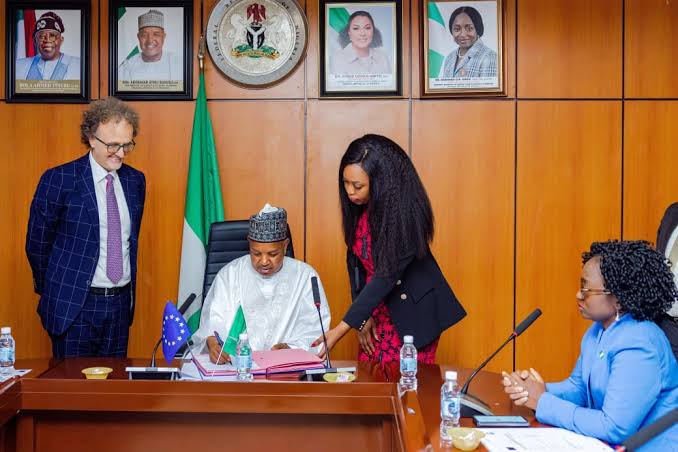
Minister of State for Agriculture and Food Security, Aliyu Sabi Abdullahi, said the move is crucial to reversing years of poor yields and repositioning the sector for sustainable growth. He stressed that the health of Nigeria’s soil must become a national priority if farmers are to produce more food and withstand the pressures of climate change and land degradation.
He emphasized that soil testing is not an optional practice but a critical tool for guiding fertiliser application, preventing wastage, protecting the environment, and unlocking higher yields across the country’s diverse agro-ecological zones.
While speaking during 2025 World Soil Day, Abdullahi stated that soil constituted the backbone of the agricultural sector, supplying 95% of food and providing 15 of the 18 essential elements required for plant growth.
He noted that soil supports crop growth and livestock production, purifies water, regulates climate, sequesters carbon, mitigates greenhouse gas emissions, and offers habitat for beneficial microorganisms, thereby supporting ecosystem services and biodiversity’.
He pointed out that the World Soil Day would enable the government to educate the public, especially farmers, about soil conservation and its advantages, promote sustainable agricultural practices, support the ministry’s initiatives for soil health, encourage research, and advocate for policies that safeguard our soils.
He reaffirmed the commitment of the government to restore and uphold soil health, ensuring sustainable agriculture, food security, and enhanced livelihoods for all Nigerians’’.
While highlighting the federal government efforts to improve soil management by the launch of Nigeria Farmers’ Soil Health Scheme (NFSHS) recently, he said the scheme was part of President Bola Tinubu’s Renewed Hope Agenda for Food Security.
According to him, the programme offers crop- and location-specific fertilizer recommendations to curb indiscriminate fertilizer use, reduce pollution, and cut production costs. It also promotes organic amendments and regenerative agriculture practices to protect soil and water resources.
He said: “A major component of the initiative is the plan to establish soil-testing laboratories in all 774 local government areas, to be run by youth and women agripreneurs. Twelve laboratories, equipped with modern diagnostic tools, have already been installed across the six geopolitical zones.
“We are implementing the Nairobi Declaration on African Fertilizer and Soil Health endorsed by African Heads of State, and strong collaboration with development partners including GIZ, Soil Values, AGRA, the World Bank’s ACReSAL Project, Sasakawa Africa, IITA, and the Bill & Melinda Gates Foundation.”
He added that ‘another significant milestone achieved is the incorporation of the NFSHS into the federal budget and the organization of stakeholder workshops leading to the establishment of the Coalition of the Willing (CoW) platform and Readiness Assessment.
He revealed that on the operational front, training sessions for laboratory technicians and technologists regarding the use of Soil Health Card modules were held in Oyo and Kano States earlier in 2025, along with readiness assessments and pilot soil analyses conducted in 12 states across the six geopolitical zones.
He further said that state-of-the-art soil laboratory equipment had been deployed and successfully installed for operations in twelve states across the six geo-political zones of the country.
“The government is not relenting to reposition Nigeria’s agriculture landscape; and there is a strong synergy with both local and international partners to rejuvenate degraded soil across the country,” he added.
Also, President, Nigerian Institute of Soil Science (NISS), Prof. Abubakar Kundiri, said the theme “Healthy Soils, Healthy Cities” reflected a growing understanding that soil health is central not only to agriculture but also to urban sustainability.
Kundiri, represented by the Vice President, Prof Olumuyiwa James Jayeoba, reiterated NISS’ commitment to promote evidence-based soil management, ethical fertilizer use, urban agriculture, and the enforcement of the Soil Science Profession Act.
A farmer, Abubakar Musa, said the government should go beyond rhetoric and lead the campaign especially in rural communities.
“Honestly, most of us farmers are ignorant of the type of soil to farm on. We just know that when you bury seeds after some years or months it will germinate.
“We need serious education on soil testing and management. That way, we will know when to plant and when not to plant on a particular soil.
“The government should not only focus on Abuja, Lagos or Rivers State, it should deploy experts to local communities to educate farmers.
“It should not be a one-time thing; but a continuous process to boost food production, consumption and exportation.”
The government’s renewed campaign is expected to expand access to testing facilities, promote farmer education and strengthen partnerships with research institutions to ensure that science-driven soil management becomes a standard part of Nigeria’s agricultural culture.