Follow Us on Google
From Okwe Obi, Abuja
In an era where reading culture has declined significantly, especially among young people, the federal government has pushed for knowledge acquisition to boost mental development and to create more opportunities for job seekers.
This is through the distribution of books, mostly to internally displaced persons (IDPs), who are perceived by some people as dregs of the society.
Director, Internally Displaced Persons Affairs, National Commission for Refugees, Migrants and Internally Displaced Persons (NCRFMI), Fatima Mamman Daura, who pledged more distribution of books to IDPs across the country, said only then can they be meaningfully armed for a better tomorrow.
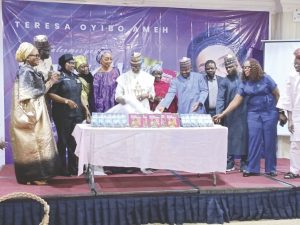
Daura stated this recently the launch of two books, titled ‘The Rise of the Phoenix’ and ‘Mariano and the Bowl of Cashews,’ in Abuja.
She charged IDPs on the need for them to embrace reading as a way of life.
“It is part of our interventions to improve literacy and numeracy and provide education, bridge the gap for the IDP children and transition them into conventional schools.
“Certainly, we will definitely support one of our own for the benefit of the children. This is very important because it is homegrown, written by a Nigerian author that also works with the Refugees Commission.
“We are really supporting this initiative and we are so proud of Teresa Ameh,” Daura said.
She also disclosed that the commission had in the last five years set up transitional learning centres across states with high displaced persons population, designed to provide accelerated learning for displaced children in all IDP camps
She said the author, who is also a humanitarian worker with the commission, stands as a role model to the children of the displaced population, especially the girl-child.
On her part, founder of the Aunty Talatu Read Foundation and author of the books, Teresa Oyibo Ameh, said the launch of the books, which came at a time when the world is celebrating the 16 days of activism, also addresses issues of gender-based violence and the effects of war on the girl-child, especially in the North East, which has been devastated by conflict.
Other News
According to her, instilling the culture of reading early in the lives of children will breed reading adults and eventually produce an informed and educated society.
She said: “When we talk of adults who don’t read, it’s because we brought up children who didn’t read. Children who read will grow up to become adults who read and will not be struggling with reading culture.
“So, we are not just trying to bring up children who, because they know mathematics, can go into the world. We send children who are well grounded, who can discourse into the world because we treat different topics.
“Most of my focus is on our tradition. Bringing it up. We derive pride and joy in seeing our children.”
She, however, noted that the media has a role to play in ensuring that reading culture is revived in early learning stages for children.
She said: “I think the media houses should also help encourage children to read. Maybe come up with jingles or something. Reading is the best because of how it forms the mind.
“We are trying to bring up children that can interact with other children anywhere. We want to go beyond having children who know mathematics, we want them to be well grounded on different topics.
“When we talk about adults who do not read, it is because we brought up children. Children who do not read will grow up to become adults who do not read too. So, we need to start changing and encourage our young.ones to imbibe reading culture.
A poarticipant, Rukayya Abdullahi who has read the books said the lesson learnt in the story is about being resilient.
Abdullahi, therefore urged children to cultivate the habit of reading physical books as they connect the reader to the story.
He said; “So, I would suggest they go and listen to audio books or read e-books. Or they could read the physical books as well. Because they make people more happy when you hold a physical book to read.”