Follow Us on Google
Nigerian policemen deserve some form of apology. We always make it look like they are the only corrupt beings in Nigeria. They are not. The major problem with them is that they flaunt their corruption in your face. At each checkpoint, they usually collect about N200 from each driver. Sometimes, they delay your movement when you don’t give them this money.
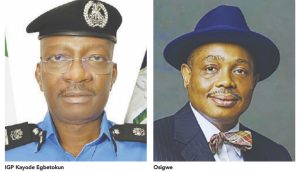
Police extortion is a pittance compared to what happens in many other institutions. In most ministries, departments and agencies of government, you must bribe certain officials before receiving any service.
In the judiciary, bribery is a serious malaise. It is usually mentioned in a hushed whisper. But on February 6, 2026, the President of the Nigerian Bar Association (NBA), Mazi Afam Osigwe (SAN), revealed what amounted to someone telling the world that his mother is not a virgin. In a paper he delivered at the Ralph Opara Memorial Lecture, organized by the National Association of Seadogs in Enugu, Osigwe did not mince words to say that judges and lawyers were among top bribe takers and givers in Nigeria.
“The judiciary, which ought to be the last hope of the common man, is increasingly being seen as an arena where justice can be delayed, manipulated or purchased outright by the highest bidder,” he said. In the paper titled, “Judicial Corruption in Nigeria: A Menace to Democracy and Social Justice,” Osigwe warned that judicial corruption posed existential threat to democracy, social justice and the rule of law. In statistical terms, the NBA President referred to the 2018-2020 survey by the Independent Corrupt Practices and other related offences Commission (ICPC), which noted that lawyers accounted for the highest proportion of bribe-givers in the estimated N9.4 billion paid as bribes within the justice sector. He also cited the 2024 joint survey by the United Nations Office on Drugs and Crime and the National Bureau of Statistics which noted that in 2023, judges were among many Nigerian public officials who received an estimated N721 billion in cash bribes.
Osigwe spoke in general terms. Some other lawyers have made direct accusations. In 2024, legal icon, Chief Afe Babalola (SAN), prompted the arrest and prosecution of human rights lawyer, Dele Farotimi, for criminal defamation. Farotimi had, in his book: “Nigeria and its Criminal Justice System”, pointedly accused Afe Babalola & Co. of corrupting the Supreme Court so as to procure fraudulent judgement for his client in a land case.
Babalola was angry and flabbergasted by Farotimi’s audacity. Nevertheless, in January 2025, he withdrew the case he instituted against him following interventions by some prominent individuals, including the Ooni of Ife.
This allegation of corruption in the judiciary is manifest in election cases. That is why politicians will rig election and gladly tell you to go to court. They know that in the court, justice may be served, not on the altar of law, but on the basis of who knows the judge and can give him fat envelope.
In November 2025, a faction of the Peoples Democratic Party (PDP) held its national convention in Ibadan, the Oyo State capital. Before the convention, two Federal High Courts in Abuja gave orders stopping the convention. An Oyo State High Court gave a conflicting order that the convention should go on. The PDP held its convention based on this order. The matter is not over as the two factions of the party are striving hard to outsmart each other. You can bet that the faction that will laugh last may be the one that has more influence in the courtroom.
You can now understand why someone like Senator Adamu Bulkachuwa confessed in 2023, that he influenced his wife, Zainab, to help his colleagues in their court cases when she was the President of the Court of Appeal.
You can also understand why the judiciary appeared to have functioned better under military regimes than under civilian governments. Most military governments believe in issuing orders and expecting the people to obey without hesitation. Politicians believe more in lobbying and inducement. It is possible that former eminent Supreme Court justices like Kayode Eso, Andrew Obaseki, Augustine Nnamani, Chukwudifu Oputa and some others excelled in their judicial activism and delivery of landmark judgements because it was mostly under the military. It is not certain if they would have done the same under the present civilian government.
Other News
To be fair to judicial authorities, they have tried to sanitise the system. The National Judicial Council (NJC) had disciplined some errant judges in the past for some misconduct. The NJC under the current Chief Justice of Nigeria, Justice Kudirat Kekere-Ekun, had instituted strict measures to make appointment of judges at the federal level open and transparent. The public now has the opportunity to comment on the suitability or otherwise of a nominee before appointment as a judge. This has yielded good results. In December 2025, the Federal Judicial Service Commission (FJSC) dropped 34 out of 62 judge-nominees because they failed integrity test.
In one particular case in 2025, a female police officer, Blessing Ezeala, nominated to be a judge of the Federal High Court, was dropped because she demanded and received a bribe of N1 million to release someone from police detention. The victim wrote a petition against her, detailing how she forced him to pay the bribe.
More efforts should be made to wean Nigeria’s judiciary off the route of corruption. The third arm of government should be insulated from the whims and caprices of the executive arm by making it truly independent, especially in the area of funding. Judges who derail from the track of justice should be prosecuted and sanctioned adequately to serve as a deterrent to others.
In Nigeria’s democracy, the judiciary has become the lost hope of the common man. Efforts must be made to restore that lost hope. A society is doomed when the rule of money replaces the rule of law; when corruption wears the cloak of justice to keep people in perpetual agony. Nigerians must say ‘No’ to such a justice system.
Re: Senate’s coup against Nigeria’s democracy
Fatefully, your piece coincided with the week of our vehemence against entrenched riggers and their methods in the country. The week we agitated for the enactment of clean and unambiguous election legislation in Nigeria at the National Assembly. It is the same week in which the Senate of the Federal Republic of Nigeria clearly showed to Nigerians that their views/preferences do not matter; a week when Monsieur Akpabio disdainfully dared Nigerians to do their worst. But the irony is that he seems to be winning. I am pinning down on Akpabio because he has proven to be a no-nonsense leader of the orchestra called the Nigerian Senate. He is the choir master while the rest sing along to the waves of his hands.
I have repeatedly voiced it to those around me that Nigeria has two persons as the major impediments to the practice of real democracy in Nigeria: Messrs Tinubu and Akpabio. Of the two, Akpabio poses the greatest danger. Apart from superintending the turning over of the Legislative arm into a puppet of the Presidency, his carriage/demeanor and (or) body language depict a man of no or little compunctions/scruples who has little or no regards for principles and morals. Such a man behaves like a bull in a china shop.
But the day of reckoning is near. There is an Igbo folklore about the deceptive King – “Eze n’aghori ndi o na achi (the King who deceives his subjects)”, until when the people said they can no longer be fooled. Right now, the people are yearning for mandatory electronic transmission of election results from the Polling Units to the IReV to be in the Electoral Act (Amended). It is not a hard request. It is not the duty of Akpabio and his co-travellers in the Senate to dictate to the people rather it should be the other way (even though we know we never voted the majority of them in, they manipulated their ways in). The Senators’ fears about this demand still are unfathomable. You claim to have been cleanly elected by your people to represent them but you are flagrantly standing against the wishes of the people whose interests you swore to defend at all times. You are afraid of enthroning a transparent electoral process which will endear you more to your people, save time, resources and other election skirmishes. What type of Representative are you truly?
The new clause the people want will kill the biggest malpractice by politicians on Election Day: the hijacking of the Chief Election Officers (the Returning officers – most times Professors and PhD holders), taking them out of the reach of others and getting them to doctor and announce preferred results. With the new clause, all the results will be out there for anyone to see; no more manipulations, no more midnight announcements.
The fight is still with the people. Will they allow Akpabio and his Senate have their way? Or will they push on till victory is achieved? Whatever, the 2023 “Go to Court” affront need not be allowed to rear its head again. The progress of this country rests with this Electoral Act Amendment. If these men are allowed to succeed, 2023 will be a sub-act to what 2027 portends.
– Aloy Uzoekwe, Anambra, 08038503174