Follow Us on Google

•Say move’ll dampen financial intermediation
…We’re working to identify leakages, tighten surveillance on fintechs –Cardoso
By Merit Ibe, Chinwendu Obienyi and Adanna Nnamani, Abuja
The Monetary Policy Committee of the Central Bank of Nigeria (CBN) rose from its 295th meeting on Tuesday with a decision to raise the interest rate from 24.75 per cent to 26.25 per cent, a move experts have kicked against, describing it as one that will dampen financial intermediation and ultimately hurt the economy.
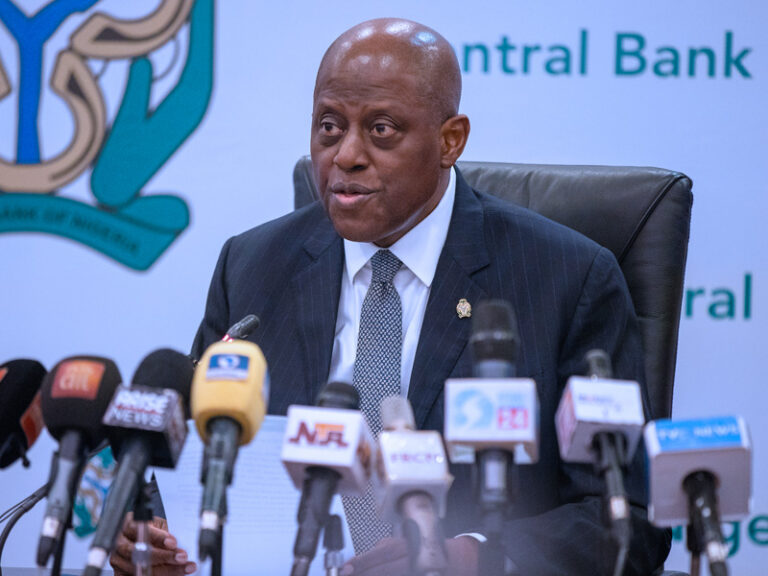
However, the CBN Governor, Dr Yemi Cardoso, at a post-MPC media briefing, revealed that foreign portfolio investors (FPIs) were responding positively to a number of reforms aimed at increasing market transparency.
He added that the apex bank was working on a number of strategies aimed at identifying leakages and tightening surveillance on fintechs so as to insulate the economy from further bruises.
With economic analysts expressing concerns that the soaring inflation would bring further loss of confidence and delay by foreign investors in the market despite the reforms taken by the CBN, Cardoso stated that the bigger issues affecting the market was loss of confidence but added that the CBN has had consistent dialogue with FPIs that are yielding positive results.
“I do not think the FPIs are hesitating. As indeed with any market, there is free entry and free exit, this is how it works. The bigger issue is loss of confidence and we have had consistent dialogue with investors and try to make the market more transparent in which I can tell you that they are responding positively to the transparency initiatives we have rolled out. The distortions that we all know about which had resulted in multiplicity of different circulars to address the issue has helped in no small measure”, he explained.
Giving insights to the committee’s decision to raise Monetary Policy Rate (MPR) by 150 basis points (bps) from 24.75 per cent to 26.25 per cent, Cardoso noted that members of the MPC observed that while headline inflation rose moderately in April, month-on-month (m/m) measures of inflation, food and core all declined significantly.
Furthermore, the committee retained the Cash Reserve Ratio of Deposit Money Banks (DMBs) at 45 per cent and put the asymmetric corridor around the MPR at +100/-300 bps and liquid ratio of banks at 30 per cent.
Whilst stating that inflationary pressure continues to be driven by food inflation, rising cost of transportation, infrastructure-related constraints along the line of distribution network, insecurity in some food producing areas and exchange rate pass through to domestic prices of imported items, Cardoso called on the Federal government to prioritize food production and availability, stating that more needs to be done for food producing communities in terms of adequate security.
Reacting to the development, economic experts stated that the increase in MPC will come as a disappointment to the private sector which had called on the MPC to pause hikes as it was increasing the cost of accessing capital in the country.
The Chief Executive Officer, Financial Derivatives Company Ltd, Bismarck Rewane, during a programme monitored by Daily Sun, said, “I think the MPC went to an extreme position. They have not told us the target. We know that inflation above 12 or 13 per cent is growth retarding but you cannot have a framework of explicit inflation targeting without having a target. Yes, his hope (Cardoso) is to get inflation to 21.4 per cent at the end of the year but there has to be a target even if it is missed. The U.S Feds have a 2 per cent target and have come in at about 3.4 per cent and hence we have to have a target”.
Eze Onyekpere, Lead Director, Centre for Social Justice said: “This is the third consecutive time the apex bank will be raising the benchmark rate this year.
From the foregoing, it is clear that the MPC under Cardoso has run out of ideas as the claim that earlier tightening is working is not true. There are fundamental risks to the economy imposed by this tightening stance.
“Government debts at the federal and state levels have become more expensive to service as bonds, treasury bills and loans from banks will attract rates benchmarked on the MPR.
“Access to credit for the real sector of the economy has been constrained by excessively high interest rates already in excess of thirty percent. Of course, manufacturers and service providers will transfer their costs to customers, the ordinary Nigerians whose purchasing power has been decimated by the administration’s economic policies. This will lead to more factory closures, loss of jobs and reduced economic activities”, he said.
The Director General, Centre for the Promotion of Private Enterprise (CPPE), Dr Muda said: “Previous rate hikes have been quite aggressive, hurting output and real sector investments.
Most economic operators with credit exposures to the banks have not recovered from previous hikes. Interest rates were already around the 30 per cent threshold.
Secondly, the extant CRR of 45 per cent has profound liquidity effects on the financial system. Both measures have dampening effects on financial intermediation, which is the primary role of banks in an economy.
“Thirdly, the monetary policy transmission channels are still very weak, given the level of financial inclusion in the economy. This limits the prospects of monetary policy effectiveness”, he said.
Daniel Dickson-Okezie, Chairman, SME Group of the Lagos Chamber of Commerce and Industry ( LCCI) said the increase was disturbing as it will make it difficult for manufacturers and businesses generally to obtain funds.