Follow Us on Google
With Okorie Uguru
The best way to explain to Nigerians what coffee means to Ethiopians is to tell them that coffee is to the Ethiopians what the Kolanut is to the Nigerian Igbo.
In Ethiopia, coffee is not just an ordinary beverage that goes with morning breakfast or what one sips carelessly during evening relaxation, but something more mystique, more cultural and deeply ingrained in the tradition of the Ethiopian people.
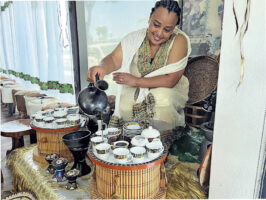
For a non-Ethiopian, it is one of the first indelible experiences to imbibe and understand when touring Ethiopia. From Addis Ababa to the Northern Ethiopian region of Lalibela which is the ancient town of the Amhara people, the Tigray region of Axum and Makele, coffee is offered as the first sign of welcome to guests. At Gondar town, right from the airport, a special place is created for a delectable maiden in native attire, fanning her little portable local stove, to warm the coffee and also serve tourists. The frankincense is sprinkled on the small fire to release the fragrance to gently envelope the building.
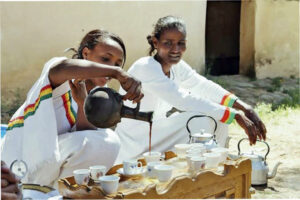
For sure, in Ethiopia, coffee drinking comes with an elaborate ceremony.
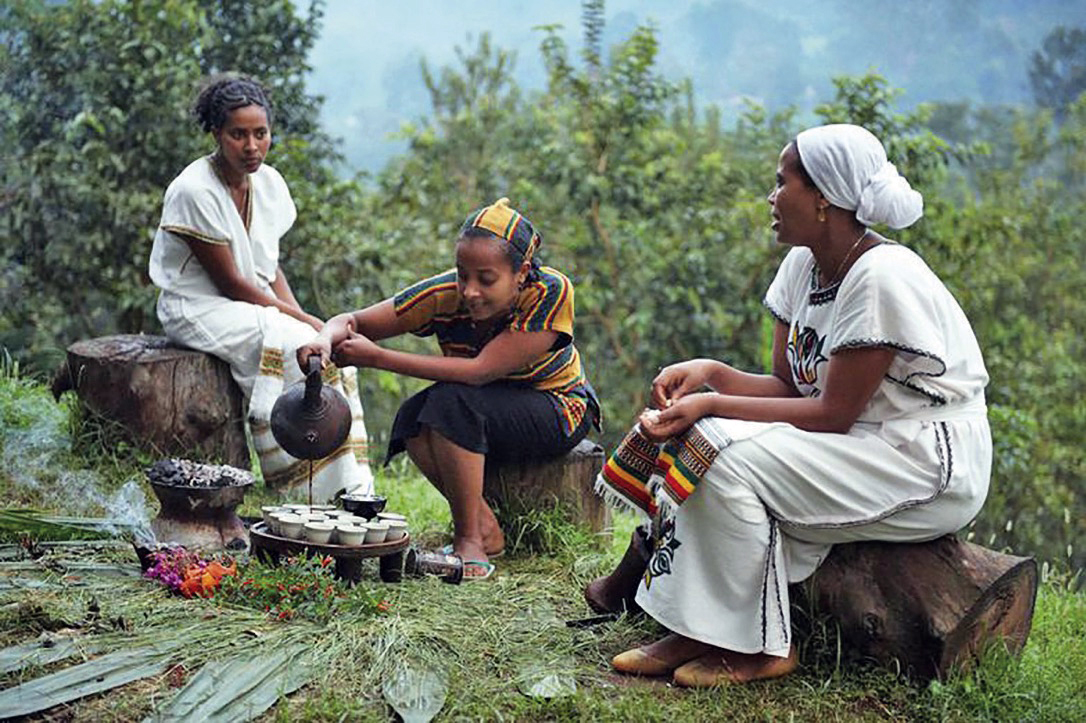
The Ethiopian coffee ceremony (jebena buna) is a ceremony that could go on for hours. The Ethiopian people view it as a social and spiritual ritual showing friendship, respect and welcome. However, coffee here is not the usual branded coffee from different factories with different brand names. The coffee in Ethiopian is organic grown from their farms and manually prepared at home.
A matriarch would roast the green beans over open fire, grind them with a mortar and pestle, and brew them in a clay pot (jebena) to serve three rounds—Abol, Tona, and Bereka—often accompanied by incense and popcorn.
The first taste of this experience was at the ancient city of Lalibela. As tourists, we were treated to a coffee ceremony. It was in the open, in front of a small hut. We made a circle round the young maiden serving the coffee. It was brewed black. No milk, but there was a sugar bowl for those who wanted to sweeten theirs. There was the kettle being heated on the small stove. The small porcelain tea cups were arranged on the mat. Green grasses were cut and spread on the mat to make the ceremony look more natural. At different stages of the ceremony, the tea in the small porcelain cup is served.
Other News
Before getting to the drinking stage, the natural coffee seeds pass through different stages. First, the coffee beans are washed, roasted, and ground. The aroma of the coffee would permeate round the environment while this process is on. According to Ethiopian tradition, roasting beans and burning frankincense ward off bad spirits. The coffee is served using the Jebena, a traditional pottery flask with spherical base, long neck, and spout.
The coffee drinking ceremony is in three rounds. The first is the strongest cup and it is called Tona. The second brew is called Bereka, and the third and final cup is often associated with receiving a blessing.
Coffee is poured from a height into small, handle-less cups. It is typically served with generous amounts of sugar, or salt in rural areas also, but without milk.
“It is really an interesting social event. I have never taken drinking coffee seriously. I didn’t know so much rich culture is attached to it. Only problem is that with the way I am consuming coffee at every stop, I will find it difficult to sleep at night.
“Also, as a Nigerian, I only wish they could allow me to add milk to the coffee, it will even taste better,” said one of the tourists in the group.
Drinking coffee in Ethiopia is part of everyday life, during conversation, gossip, community bonding, and so on. As a sign of respect, often the oldest person is served first. While waiting, guests are often served snacks such as popcorn, roasted barley, or traditional bread (ambasha). The ceremony is common in every part of Ethiopian culture, honouring the nation’s history as the birthplace of coffee.
For many who may not understand the nexus between the Ethiopian people and coffee, Ethiopian is regarded as the birthplace of coffee.
It is said to have been discovered within the Keffa region, South Western Ethiopia, around the 9th century. According to the legend, a goat herd named Kaldi discovered the plant’s energizing effects after his goats became lively upon eating the red berries. Kaldi noticed his flock dancing after consuming red cherries from a wild shrub. After experiencing the energetic boost himself, he brought the berries to a local monastery where monks first deemed them “demonic” before learning to use them to stay awake for prayers.
Even though coffee became popular among both the clergy and the general populace, it was only consumed in Ethiopia. However, it quickly spread to the ancient Arabian peninsula around 9th century AD.
It achieved global popularity through its origins in Ethiopia and started to be cultivated in places like Yemen, spreading via Arab trade routes to Europe in the 17th century.
In Europe, coffeehouses became part of their social life. Top European cities like London, Paris, Rome and others were caught in its consumption. Later on, colonial plantations in Java and the Americas (18th century) made it a major, affordable global commodity.
By the mid-17th century, over 300 coffeehouses thrived in London, serving as hubs for business, news, and intellectual exchange. These spaces quickly spread across Europe and the American colonies, establishing coffee as a social beverage.
To meet increasing demand, European powers expanded cultivation beyond Arabia. The Dutch introduced it to Java, while France, Portugal, and Britain established massive plantations in the Caribbean and South America in the 18th century, making it accessible to all social classes.
During the American Revolution, drinking coffee became a sign of patriotism, replacing tea after the 1773 Boston Tea Party.
Coffee is one of the agricultural exports of Ethiopia, however, even though the country is regarded as the place where coffee originated, other countries like Brazil, Vietnam, Vietnam and Colombia has overtaken Ethiopia in the production of coffee, Ethiopia still retains the mystique of coffee and to them, it is not just an ordinary beverage.