Follow Us on Google
With Okorie Uguru
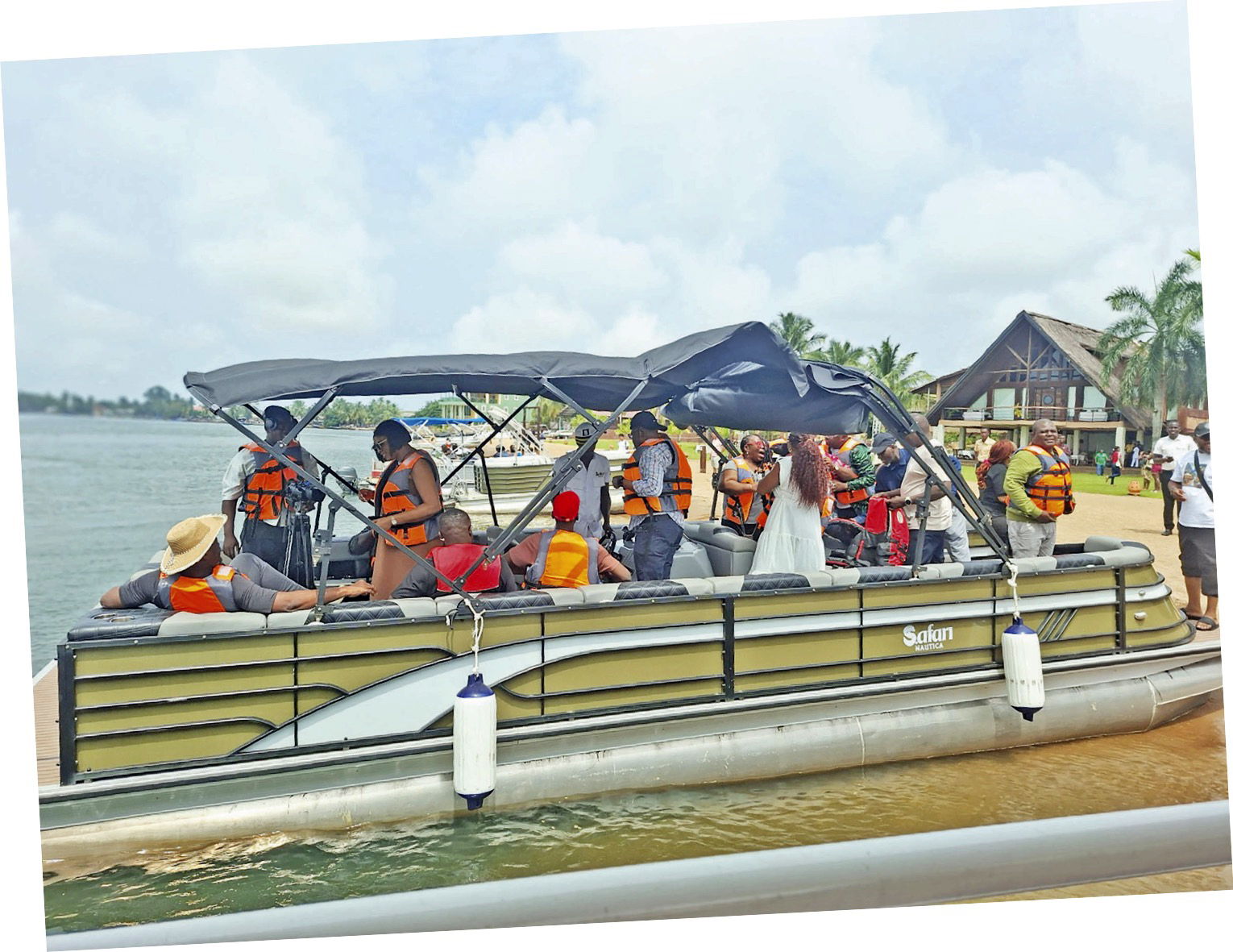
There might just be few things more alluring than having a leisure cruise on a quiet, picturesque river like the Volta River on a beautiful weekend. The sun was mild this late morning, with an occasional isolated cloud blocking the sunlight with hints of rain.
The cruise boat bopped gently, swaying to the mild river current, and maybe, the mid tempo Nigerian Afro-beat music which was wafting through the speaker. The boat’s occupants swayed to the movement of the boat, and the river’s current; they swayed to the music. On the boat cruise were the leaders of the National Association of Nigeria Travel Agencies (NANTA).
Here the world was at peace, and life is for the living. Such is the emotion and sensation the sights and feels cruising on the Volta River brought.
Here in Ada Foah, we were at the end of a 1600-kilometre journey, a few kilometres from the estuary where the Volta River empties into the Atlantic Ocean.
As explained by our tour guide provided by Ghana’s Safari World, Daniel Amankwah, the Volta River for Ghana is more than a river; it is the giver of life and livelihood to the people.
“The Volta River is Ghana’s major water system. It is the biggest, the most dominant, and the longest. It is the biggest in terms of capacity,” he explained, “We have the Volta Lake, built on the Volta River, and the Volta Lake happens to be the biggest man-made lake in terms of volume, you know, and capacity on the Volta River.”
As our tour guide Amankwah continued narration about the Volta River with pride, the boat gently cruised towards the Atlantic Ocean. From Aqua Safari Resort which was the takeoff point, we could the waterfront of Ada-the riverside market seafood, rows of coconut trees, bright -colored canoes are neatly packed on the waterfront. While Ada town is on our right, on the left side is a dense green island with mangrove vegetation.
The majority of activities along the waterfront are water related commercial activities; however, there were a couple of beautiful houses with private jetties lining the waterway.
Occasionally, a daredevil jet ski boat rider headed to our direction spraying water all around and performing stunts to the admiration of the tourists inside the boat.
Amankwah took time to explain the difference between the Volta Lake at Akosombo and the Volta River: “The Volta Lake was created as a result of the creation of the Akosombo Hydroelectric Power Dam. So, the Volta River was dammed to create the Akosombo hydro-electric station power. So that resulted in the creation of the Volta Lake in 1965. The dam was constructed in 1965. The rest of the water flows down south into the Atlantic Ocean, into the Gulf of Gulf of Guinea. That’s the Volta River.”
The enchanting river we were cruising on has had a long journey from the highlands of Burkina Faso. It originated as the Oti River in Benin Republic and Black Volta and White Volta rivers in Burkina Faso, and converged to form the Lower Volta River before emptying into the Atlantic Ocean at the Gulf of Guinea.
Amankwah explained the relationship between Ada town, other riverine communities and the Volta River: “Ada, where we are currently, happens to be very close. In fact, that is where the estuary is. That’s where it empties into the Atlantic Ocean. It empties itself into the Atlantic Ocean. It’s about 45 feet deep. It has so many benefits to the country. The river provides so much socio-economic benefits to the rural folk, to all the communities along the fringe of the river. So, it provides livelihood for over 300,000 Ghanaians. This river produces so many types of fishes. In fact, there are about 140 different species of fishes in the Volta River. We have the catfishes, we have the Nile, you know, tilapia, we have the red tilapia, we have several types, several types of fishes including the mud fishes and all that.
“This river produces about 200 tons of fish every year. The Volta River and the lake in total produce 90 per cent of Ghana’s inland fish production, although now, the people are adopting all kinds of measures to produce fish. So, the fishes in the ocean, in the marine, are depleting. We are currently relying on fresh water fishes. About 90 per cent of the mainland fishes, freshwater fishes, are produced by the Volta River and the lake, you know. People rely on it for employment, source of income, source of protein. You know, fish is a major source of protein in Ghana now.
In addition, it supports the provision of electricity; it takes care of Ghana’s electricity production. Between 50 and 80 per cent of Ghana’s electric power is generated from the river. The Akosombo Dam was created on the Volta River in 1965. Since then, the dam has provided power for the country and also some have been exported to our neighbouring countries.”
Our tour guide also explained how the name Volta came about: “The name of the river is Volta, in fact, Rio da Volta. That is a Portuguese meaning the river that meanders, twisting, turning, referring to the meandering nature of the Volta River right from the north down to the south where it enters the Atlantic Ocean. So, the 15th century Portuguese gold traders named the river Volta. It was their route, and the country where the river takes its source, Burkina Faso, used to be called Upper Volta. They also named their country after the river before the name was changed to Burkina Faso. The Portuguese also named this river the River of Return because after all their exploration, this is where they turned back home.
“Several vegetation species from the north, we have the savannah grassland. As we descend to the south, we have more coastal savannah, coastal grassland and then the dominant mangrove swamps that we see along the south. Yes, before it empties itself into the Atlantic Ocean. “Today, we are enjoying the Volta River as tourists. But for the fringe communities, it is a means of survival. Yeah. It is a means of livelihood. They rely on the river for their fishing activities. They rely on the river for their transportation. They rely on the river for a source of revenue and employment. Now, fishing activities generate a lot of revenue. They trade in it.
and I spoke about the clams market, the Kpomkpo clams market. It is a very prominent, popular, and dominant clams market in the Ada area, one of the biggest in the country. As I mentioned, the interesting fact is that this market is held under a canopy of trees. They don’t have physical infrastructure. They don’t have market structures. They meet under a canopy of trees. You know, that tells us the importance of trees.”
The boat cruise took us very close to the estuary as possible, but being a small boat and considering the turbulent and unpredictable nature of estuaries, we detoured and headed back to Aqua Resort, the starting point, but not before visiting some of the island sanctuaries for animals being catered for by Safari World.