Follow Us on Google
From Jude Chinedu, Enugu
For months, the people of Umuchigbo, Iji-Nike community in Enugu East Local Government Area carried on with their daily lives under the shadow of a leadership crisis. Supporters of two rival chairmen traded accusations, police invitations became routines, while meetings often ended in heated arguments. But nothing prepared the community for the events of October 29, 2025, the day a political quarrel turned into bloodshed.

The crisis began after the community’s election held on February 20, 2025, when Chief Afam Joseph Ogbene, popularly called Akirika Chioku, emerged chairman. A rival faction led by Chief Goddy Ike Ochu rejected the outcome of the election and refused to recognise Ogbene’s leadership.
The Ochu-led faction claimed that the election was an illegality and insisted that it was not the turn of Ogbene’s family to produce the chairman, arguing that he ought not to have stood for the election.
“They told us openly that they would never accept him because it was not the turn of his family. They boycotted the election and began holding separate meetings. From that day, the village was divided into two,” a community member recalled.
Supporters of Ogbene, however, dismissed that argument as baseless and insisted that no clausein the community’s constitution supports a rotational system.
In the words of a youth leader close to his camp, “There is no place in our constitution that says any family is barred or where the chairmanship must rotate. That is why we maintain that their protest is invalid. Chief Afam was duly elected and the whole community knows it.”
The elders of Umuchigbo took the same position and continued attending events and meetings organised by Ogbene. Many described him as a popular leader who enjoyed overwhelming support. According to residents, over 80 percent of the community – women, men, and youths – recognised him as their chairman.
Regardless, Daily Sun gathered that the opposition continued to dig in. For instance, Chief Ochu was said to have obtained a court judgment which, he claimed, named him the rightful chairman.
As tension mounted, the Enugu East Local Government Council intervened. On Thursday, July 17, 2025, the council chairman, Pastor Beloved Dan Anike, inaugurated a Peace Committee to resolve the crisis and supervise a peaceful leadershio transition.
The committee was chaired by HRH Igwe Emmanuel O. Ugwu, the traditional ruler of Ibagwa Nike autonomous community and leader of the Enugu East Traditional Rulers Council, with Pastor Polycarp Ugwu as secretary.
It also included respected community figures, representatives of the Ministry of Lands, the Department of State Services, and the Nigeria Police. Both contending parties, Ogbene and Ochu, served on the committee.
Residents described this as a decisive step. One committee member said, “We wanted to bring everybody to the table: the traditional institution, the government, the security agencies, and the two men fighting over the community. Nobody was left out. That was the only way to guarantee a lasting resolution.”
After a series of closed-door meetings and interviews, the committee took a clear position and presented its recommendation to the council chairman.
A member of the committee, who did not want his name mentioned, said, “Our conclusion was that the previous election should be set aside and a fresh election conducted. We stated that anybody interested should be free to contest. That way, nobody would feel cheated.”
However, the recommendation was never implemented. The crisis was left to grow like a wound no one wanted to clean. The result of that neglect came violently on Wednesday, October 29. On that day, community members loyal to Ogbene went to a piece of land close to Umuchigbo Secondary School to carry out routine land matters. Unknown to them, loyalists of Chief Ochu had also mobilised to the same location.
What began as verbal confrontation quickly escalated into chaos. In minutes, gunshots echoed through the community and people fled in different directions. Two young men, Chukwudi Alum and Onyekachi Alum, were gunned down. They were later confirmed to be brothers and close in-laws of Ogbene, sharing the same parents as his wife.
A resident, who watched the scene from a distance, said, “The moment the gunfire started, everyone knew it had gone beyond politics. Those boys died in cold blood. Their photographs, lying in their own blood, went round the social media within an hour. The entire place emptied. People ran without looking back.”
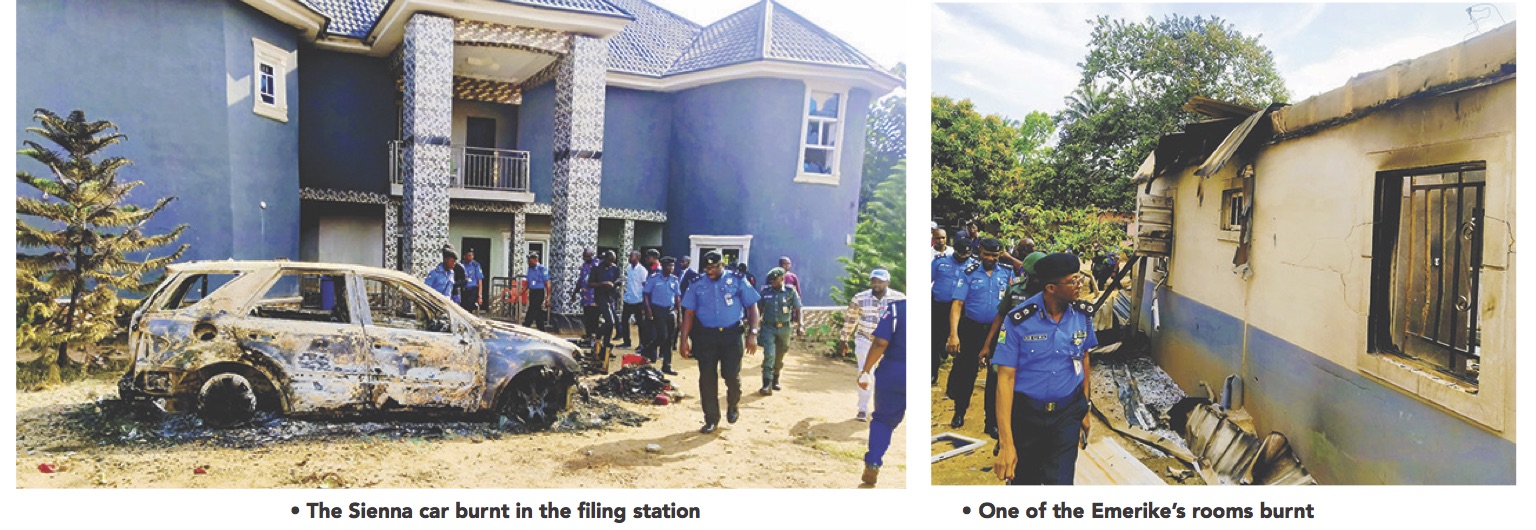
Police arrived, made a few arrests, and restored temporary calm. But the following morning, anger boiled over. Enraged youths began attacking properties belonging to supporters of Chief Ochu. Houses, cars, and shops were set ablaze. Families fled. The community, once noisy and lively, turned silent.
A witness said, “It was like war. They moved from house to house burning anything linked to the other camp. People were shouting, running, crying. We had never seen anything like this in Umuchigbo.”
For more than a week, Umuchigbo became a ghost town. Security operatives patrolled the streets and arrested anyone suspected of involvement. An unofficial curfew prevailed as residents were warned to desert the streets by 7pm. Commuters avoided Umuchigbo once darkness approached.
The Enugu State Police Command confirmed the situation in a detailed press statement. The Commissioner of Police, Bitrus Giwa, who visited the community, condemned the killings and the destruction.
He said, “The Command expresses deep concern over the scale of the avoidable and senseless violence, and has ordered a full-scale, discreet investigation. We assure the public that all those found culpable will be made to face the law.”
He further appealed to leaders of both factions, saying, “We urge traditional rulers, community leaders, and members of the warring groups to sheathe their swords, embrace dialogue, and support the police in ensuring that justice prevails and peace is restored.”
The police confirmed that five houses and several vehicles were destroyed. Twenty-seven suspects have been arrested so far, and more are being hunted. The commissioner insisted that normalcy had been restored and warned that acts of violence, under any guise, would not be tolerated.
But for many residents, normalcy remains a distant thought. Families are scattered, homes reduced to rubble, and business owners counting their losses. In the words of an elderly woman, “One simple election has turned us into refugees in our own land. If our leaders listened to the peace committee, nobody would be dead today. Politics is not worth a single life.”
Umuchigbo now waits for justice, peace, and, perhaps, a new beginning. But the memory of October 29 will not be forgotten. The day two young men died, the day the village went silent, and the day politics tore a community apart.