Follow Us on Google

General Sani Abacha. Military Head of State in Nigeria from 1993-1998. Former Chief of Army Staff. No-nonsense military officer credited with having a hand in most successful military change of government in Nigeria. He died many years ago. Yet he cannot be left alone to rest in peace by Nigerians.
Indeed, more than a quarter of a century after the death of Gen. Abacha, his name continues to dominate conversations about every challenge confronting Nigeria or everything bad. From corruption and insecurity to poor infrastructure, extreme human rights abuses, economic hardship and institutional decay, there is always someone prepared to point a finger at a man who has been dead since 1998. The narrative has become so routine that one would think Nigeria has had no government or no President since 1998.
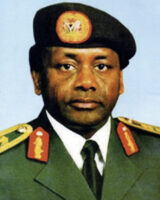
The latest attempt to keep the Abacha story alive came from former Assistant Director of the Department of State Service (DSS), Dennis Amachree, in his memoir, “DSS at 40: My Journey Behind a Shield.” He claimed that the late Head of State died from a “coitus-induced cardiac arrest” while in the company of a woman who was not his wife, dismissing earlier accounts that Abacha died after eating a poisoned apple or was a victim of an international conspiracy. Whether one accepts or rejects Amachree’s account is another matter entirely. However, his version raises questions that deserve scrutiny.
Are Nigerians seriously expected to believe that General Abacha, then a serving Commander-in-Chief of the Armed Forces, a leader protected round the clock by the military, the DSS, the Directorate of Military Intelligence (DMI), the National Intelligence Agency (NIA) and other security formations, could die in the company of a visitor who simply walked out of the Presidential residence, proceeded to the airport and boarded a flight to Lagos without being questioned? This story looks fantastic. But one cannot buy it. Never!
Even an ordinary hotel guest cannot leave unnoticed after the host is alive or found dead. Hotel front office would always call the room to find out if everything is fine. Yet we are expected to believe that a woman who was with Nigeria’s Head of State at the moment of his death quietly disappeared without attracting the attention of any security personnel. The story simply stretches credibility beyond reasonable limits.
One must, however, say that whether the account is true or false is not the central issue. The larger concern is Nigeria’s seeming obsession with keeping Abacha permanently in the dock while excusing those who have governed the country for nearly three decades after him.
For years, the phrase “Abacha loot” became one of the most repeated expressions in Nigeria’s political vocabulary. Virtually every recovered asset abroad was linked to the late Head of State, reinforcing the image of a leader who allegedly emptied the nation’s treasury. Then, this year, former Head of State, General Abdulsalami Abubakar, who came to office immediately after Abacha’s death, in his book, stated that much of the money later recovered abroad represented national savings accumulated during the Abacha administration, rather than personal wealth.
Other News
Whether Nigerians agree with that explanation or not, the revelation inevitably raises questions about why such a clarification came decades after Abacha had long been virtually convicted in the court of public opinion. For every Nigerian, Abacha personifies corruption and looting. Nobody is talking about the monumental looting in government that came after the Abacha government or what is going on currently.
Make no mistake about this. None of this suggests that the Abacha was a saint or that his administration was the best to have happened to Nigeria. Far from it! The Abacha government remains one of the most criticised in Nigeria’s history. Allegations of human rights abuses, suppression of political opposition, self-succession plot, restrictions on civil liberties and corruption continue to define public perception of his regime. The execution of Ken Saro-Wiwa and eight other Ogoni activists attracted worldwide condemnation and deepened Nigeria’s international isolation.
These are historical facts that should neither be forgotten nor trivialised. However, history demands fairness. There should not be selective remembrance. The Abacha administration is also credited with recording notable achievements. Supporters point to improved foreign reserves, reduced external debt, relative macroeconomic stability, the establishment of the Petroleum Trust Fund (PTF) that contributed to infrastructure development, major investments in roads, education and healthcare, the creation of additional states and local governments, strengthening of security institutions, laying foundations for telecommunications reforms, support for sports and efforts to revive strategic industries.
Reasonable people may debate the extent or impact of these accomplishments, but pretending they never existed is no less dishonest than pretending the failures never occurred. The real tragedy is that Abacha has become Nigeria’s permanent political scapegoat. Whenever difficult questions arise about corruption or suppression of the opposition, someone inevitably reaches back to a government that ended in 1998. That is neither responsible leadership nor serious national discourse.
Nigeria has been under democratic rule since 1999. Since then, several elected Presidents have exercised enormous constitutional powers, controlled trillions of naira in public resources and enjoyed fresh mandates to chart new directions for the country. Each administration inherited challenges and the authority to solve them. It is, therefore, intellectually lazy and politically dishonest to continue attributing today’s problems solely to a government that left office almost three decades ago. There is nothing that happened under General Abacha that we are not seeing today. Is it corruption? Is it the emasculation of the opposition? Is it plot for self-perpetuation in office? Is it attempt to suppress the press? What exactly?
Democracy thrives on accountability. That accountability becomes meaningless when today’s leaders continually shift responsibility to yesterday’s rulers. Every government should be judged on its own record. Abacha should answer before history for the decisions taken during his five years in office. Abacha should not be demonised because he is not alive to defend himself, including by those who do not have the moral authority to cast the stone.
Responsibility cannot be outsourced to history forever. Nigeria’s greatest challenge today is no longer what General Abacha did or failed to do. The greater challenge is whether today’s leaders possess the vision, competence and courage to confront the nation’s pressing problems, instead of searching for ghosts to blame. The country deserves honest leadership, not endless historical scapegoating.
History should neither canonise Sani Abacha nor demonise him beyond evidence. It should remember him in full. History should remember his achievements, his failures, his strengths, his excesses and his controversies. Only then can Nigeria finally stop arguing about yesterday and begin taking responsibility for today.