Follow Us on Google

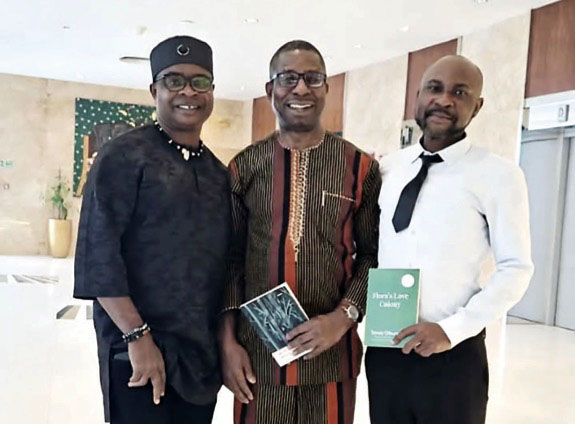
Reginald Ofodile is a multiple award winning playwright, artiste and legal practitioner based in Onitsha, Anambra State. He has acted in movies like Bad Day (2008), Half of a Yellow Sun (2013), Evidence of Existence (2012) among other movies and plays. In this interview with Damiete Braide in Lagos, Ofodili offers a peak into his writings.
When did you notice that you were cut out to be a prolific writer?
I began my creative writing at the age of 13. I would say that was when the call to write came. I did not know then how prolific I would become. Over years, at Old Imo State University, now Abia State University), Uturu, during my service year, I engaged intermittently in creative writing. My very prolific phase came later, in the 1990s, in England. I carried a sports bag with piles of paper and biros, and wrote continually.
How did you feel when you wrote your first play at the age of 14?
I was glad when I wrote that first play, The Entangled Web. I was pleased with myself. I don’t have a copy now, unfortunately.
What inspired you to write Night of Content?
Night of Content was inspired by my fascination with the colonial era. I like history, and I’ve favourite periods: the 1890s, the 1920s, the nationalist period. Night of Content began as a one-act play called A Whirl. Then, one day, in 2001, I began to write it as a novel, which became Night of Content. It was set between 1949 to 1952.
Being multi-talented, why did you focus more on writing rather than being an actor or a performance poet?
I could write on my own without having to involve other people. All I needed were piles of scrap papers, a chair, a desk and pens. To perform necessitates attending to such matters as performance venues and rehearsal spaces and bookings. I had stories bubbling in my mind, so I wrote them, and writing inspires more writing.
You have written more plays than works in other genres of writing, why is this so?
I guess it was the influence of my secondary school teacher of literature, Mr Emmanuel Onuegbu, who rehearsed and produced dramas with his students, and my innate interest in the play form. Furthermore, as I trained as an actor in Exeter and London, writing plays expressed that training. Incidentally, Night of Content is dedicated to Mr Onuegbu. I am glad that I am still in touch with him. His influence was tremendous, and greatly appreciated.
Can you give readers a peak into your work, Evidence of Existence?
Evidence of Existence is not actually a writing of mine. It is a film in which I acted. I remember the shoot, and a certain co-actor whose speech was interesting. I think he was from Eastern Europe.
What was your reaction when you acted in your work, Thou Shall Not and what are the messages in that book?
Thou Shalt Not is a novel that I wrote in 2005. I have not acted in it – it has not been produced as a play or movie. I did a recorded reading of excerpts of it for an interview, which I suppose you’ve seen. I enjoyed doing it. I was exhilarated by my audacity with alliteration! It has this line about the hero’s voyage to England: ‘… the buoyant boat bobbed beyond the bubbly bay of Freetown, bound for the Canaries!’ Thou Shalt Not is set in the 1920s. Its hero is an Anglican clergyman who is inwardly tormented.
I hesitate to say that there are messages in the book. I believe – and practice – the principle of art for its own sake. I simply wrote from the heart. Each reader would make their own deductions.
Can you tell us what motivated you to write from Sin to Splendour?
From Sin to Splendour is a collection of short stories written over a 20-year period. The motivation or inspiration for those stories was simply impulse. They reflect my responses to life, my imagination, my likes and aversions. The first story in the collection is set in the 1890s, and the concluding story, Mark of a Man, is set in the present. Between those two, there are other stories with a broad range of characters, periods and locales
What was the impact of COVID-19 on you and why did you write a poem ” A gift to Art” during that period?
“A gift to Art” was my feeling that the bleakness and isolation of the pandemic could produce enduring, qualitative works of art. Writers and other artists crave solitude, detachment from the flurries of the world, in order to create. I saw a great opportunity for creative minds in the isolation of the pandemic. Consequently, the last two stanzas in that four-stanza poem are:
We moaned that guests, and calls we had to pay derailed our art’s ascent to the sublime the idyll craved, and missed to our dismay was loneliness to create, so now’s the time.
Despite the blights of hunger, debts and fear espy a silver streak in Covid’s cloud arresting, lasting items to appear attesting talent troubled but uncowed.
Do your readers need to consult a dictionary before they can understand your works?
I feel some of my readers would definitely consult dictionaries while reading my works. I am unabashedly and unapologetically literary. I would not sacrifice quality for popularity. Most of my poems are in iambic pentameters with end rhymes, and teem with assonance and consonance. Many of my prose works are essentially poems in prose. I would hesitate to write, ‘he walked to the door.’ I’d rather say he sauntered, or shuffled, or strode, or stalked, or halted, or waddled, or even minced, to that door. I espouse what I call ‘love of words’ in writing. Love of words is not verbosity. It identifies writing as being not merely functional, as not being pedestrian.
Do you experience writer’s block?
I’ve been fortunate not to suffer from writer’s block. For years, I wrote like someone going to an office. I set to the task, and the ideas flowed. The only challenge would be mustering sufficient energy – and finding solitude – to express all that came from the imagination.
How do you feel about winning so many awards?
The awards include University of Exeter Arts Prize for poetry, 1996; Warehouse Theatre Croydon International Playwriting Festival’s Award, 1997; BBC African Performance Award, 1997; International Students’ Playscript Award 2000; Association of Nigerian Authors’/Abubakar Gimba Prize for a short story collection, 2016; Association of Nigerian Authors’ Drama Prize, 2017. The first four were won in the UK, and the last two in Nigeria. I was elated by the awards, and thankful.
You have a large collection of books, do you lend your books and how do you preserve them?
My books are on shelves, on tables, in boxes and cupboards, and sometimes on my bed. I lend books to people, albeit with instinctive reluctance!
Presently, what are you working on and when should your readers expect your next work?
I’ve been researching and writing parts of a new novel, which starts in the 1930s. It has a brilliant and cultivated young man as its protagonist. He is also ambitious. When he finds himself on the path to realising his highest ambition, the call of duty and tugs of conscience urge him to tread a different path. He fought desperately against his conscience, but, ultimately, yielded to its promptings.
What is your advice to up-and-coming writers?
My advice to up-and-coming writers would be: ‘Continue to slave at your craft, not only in how you write your stories, but also over the language that you use.’ I use English, and I know it requires lifelong studentship. I’ll never finish learning it. I would also ask young writers to be determined over publishing and promoting their work. For an unknown writer, rejection is assured. Of course, a few might be fortunate over early acceptance and promotion. It’s what some people call luck, and what I call the grace of the Lord. I would tell up-and-coming writers, ‘Brace yourselves for what I call three D factors: desolation, denigration, destitution.’ Writing brings mostly hardship and scorn. I meet young Nigerian writers who feel that, if they were in Europe or America, they would become instant and amazing successes. I try to explain that they are deluded. They hear of a few Africans who are acclaimed as writers in the West, and feel that, if their works are accomplished (however ‘accomplished’ is defined), they would enjoy global success and celebrity. Those famous ones constitute only a minuscule minority. For most writers, the writer’s life brings unrelieved misery.