Follow Us on Google
By Oluseye Ojo
Across Nigeria these days, hunger is no longer merely about empty stomachs. Increasingly, it is also about empty gas cylinders, cold kitchens and families trapped between rising food prices and the frightening cost of cooking.

In cities and villages alike, preparing an ordinary meal has become a daily battle. Pepper is expensive. Tomatoes are costly. Kerosene is scarce and expensive. Charcoal prices are climbing. Cooking gas has become both unaffordable and difficult to find.
For millions of Nigerians, the crisis is no longer theoretical. It is now deeply personal.
Ahead of the Eid-el-Kabir celebration, a man identified Bayo Akande, a resident of Olorunda-Aaba in Lagelu Local Government Area of Oyo State spent hours moving from one gas station to another in desperate search of cooking gas.
From Olorunda-Aaba, Akobo, Iwo Road to Alakia and later Adegbayi, the story remained the same. No gas.
Tired and frustrated, he was already heading home when he spotted a young lady carrying a freshly-filled cylinder around Ojurin in Akobo. That encounter eventually led him to Taifek Gas Station at Yawiri, Akobo, where he finally obtained the product after an exhausting search.
The experience now mirrors the reality confronting countless Nigerians across the country.
The struggle to cook has become a struggle to survive.
From Lagos to Kano, Ibadan to Maiduguri, Makurdi to Port Harcourt, households are battling a painful combination of rising food prices, cooking gas scarcity, transportation costs and shrinking incomes.
What used to be routine household expenses have suddenly become major economic decisions. As gathered, families no longer simply ask what they want to eat. They first ask whether they can afford to cook at all.
Inside Nigerian kitchens
In many homes today, cooking has become an emotional exercise.
Women who once filled their cylinders conveniently now buy gas in tiny quantities just to survive the week.
Food vendors reduce portions quietly to avoid losing customers. Some families deliberately skip breakfast so there can be enough food for dinner.
Only months ago, cooking gas sold for around N1,200 or N1,300 per kilogramme in several parts of the country.
Today, prices in many places have climbed to between N1,700 and N2,000 per kilogramme depending on location and availability.
Even at those prices, it was argued that supply is not even guaranteed.
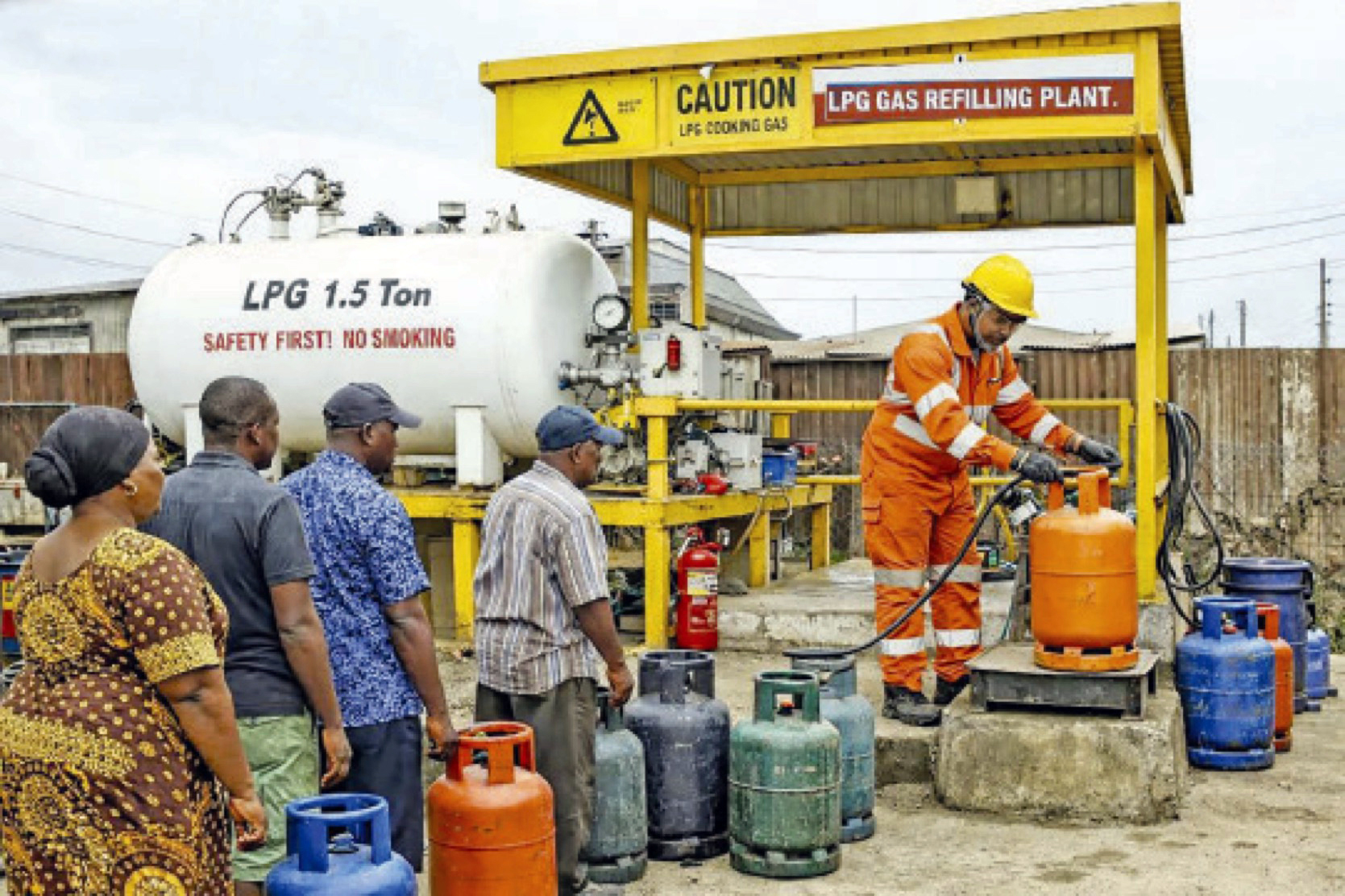
Consumers now move endlessly from one gas station to another, hoping to find available LPG. In some communities, residents wake up early to queue at filling plants once rumours spread that supply has arrived.
It was further gathered that for many households, the psychological pressure is becoming unbearable. People are no longer only afraid of hunger. They are afraid of the cost of preventing it.
The alternatives offer little comfort.
Kerosene, once regarded as the fuel of struggling families, has become expensive. Charcoal prices continue climbing steadily. Electricity remains unreliable, leaving households with very few options.
Everything required to keep a kitchen running is becoming expensive at the same time.
At Okokomaiko and Ajangbadi areas of Lagos, the LPG was sold for N2,000 per kilogramme. Also, at Ikotun-Egbe side in Lagos, a middle aged woman lamented: “Honestly, I bought 12.5kg for N21,900. Not just funny.
At the Sango-Ota axis of Ogun State, it was gathered that the LPG also sold for N2, 000 per kilogramme.
Reports from Abuja, the Federal Capital Territory/(FCT),.also stated that about three months ago, a kilogramme of LPG, which was sold for between N1,000 and N1,300 three months ago in some parts, has increased to between N1,700 and N2,200, depending on the area.
‘Even at N26m, you still cannot get LPG easily’
The escalation in cooking gas prices was vividly captured by Chairman and Chief Executive Officer of Taifek Gas, Yawiri, Akobo, Ibadan, Oyo State, Kehinde Adeosun Gbadebo, an engineer.
Speaking with Saturday Sun, the gas station operator painted a grim picture of how sharply LPG prices have risen within just a few years.
According to him, in July 2020, 20 metric tonnes of LPG sold at depots in Lagos for about N3.55million.
“In September of the same year, especially at NIPCO, a notice was sent to us that the depot price had increased to N3.85 million per 20 metric tonnes.
“That meant there was an increase of N300,000 within two to three months,” he recalled.
But what operators face today, he said, is far worse. His words: “Now in 2026, we are buying the same 20 metric tonnes of LPG at about N26million. You can see the difference. Even at N26million, you still cannot get it easily,” he lamented.
According to him, cooking gas sold for around N250 per kilogramme in Ibadan in 2020. At that time, a 12.5kg cylinder cost roughly N3,100 to refill.
Today, many stations sell between N1,700 and N2,000 per kilogramme.
Even at Taifek Gas, where the management deliberately tries to maintain a relatively moderate price, consumers still pay around N1,550 per kilogramme.
“When you interpolate, you will discover that even the profit margin has really dropped. The business people in this country are really feeling the heat,” he stated.
But he admitted that hearing the prices charged in some stations troubles him personally.
“But as a human being, there is a way I feel when I hear all these outrageous prices. That is why we are still maintaining N1,550 per kilogramme at our station.”
Yet the bigger challenge, he explained, is not only price but supply. He described the current scarcity as largely artificial.
“The reason I called it artificial scarcity is that from the information we are getting from Lagos, most depots actually have gas, but they are not selling adequately to independent gas station owners.
“There are people we call offtakers. They are the ones taking the products and selling at outrageous prices,” he alleged.
According to him, operators willing to sell at more humane rates are finding it difficult to access supply.
“People like us that are ready to earn little profit and reduce the pain of the people are not getting enough supply,” he said.
He disclosed that his station only managed to continue selling because it restocked barely two weeks before the scarcity worsened.
“I thank God for the wisdom and divine arrangement. We restocked about two weeks ago and that is what we are still selling now.
“But looking at the situation, in the next few days the product may finish and honestly, we are not even sure how the next supply will come.”
Food as luxury
The cooking gas crisis is unfolding at the same time food prices are rising aggressively across the country.
Reports from markets in Ibadan, Lagos and some other places showed that consumers now stare helplessly at prices that change almost weekly.
Other News
A measure of pepper, tomatoes, tatashe and bawa that used to be sold for N2,,000 has skyrocketed to N5,000. Also onions have become difficult for many households to buy in large quantities.
Food traders, according to market surveys, have also been complaining that customers now buy ingredients in tiny portions just to manage daily survival.
A restaurant operator in Bodija, Ibadan described the situation as exhausting: “Everything is increasing at the same time. Pepper and tomatoes are costly, onions are costly and gas is expensive and scarce too. Yet customers still expect affordable food. If we are not careful, we would run at a loss. Yet some customers would complain that we did not give them enough soup. Pricing has also become an issue for us too.”
The survey also revealed that families now cook fewer times weekly in order to conserve both ingredients and gas, and meals that once looked ordinary are increasingly becoming luxuries.
Changing survival strategies
Across the nation, survival strategies are also changing rapidly. Apart from the fact that breakfast has disappeared in many homes, lunch is becoming optional. Then, dinner portions continue shrinking.
Parents now devise quiet coping mechanisms to hide hardship from children. Some drink more water to suppress hunger. Others deliberately sleep early to avoid discussing food.
In tertiary institutions, many students survive on biscuits, noodles and sachet drinks for entire days. Workers spend huge portions of their salaries on transportation, leaving little for feeding.
At markets, customers move from one stall to another pricing food before leaving empty-handed.
Traders complain of poor patronage despite rising prices.
A trader at Bodija Market in Ibadan lamented, “People price food and go away. Everybody is suffering.”
Civil servants, artisans, teachers, traders and small business owners openly admit that feeding their families has become their biggest challenge.
Ordeals of farmers
As consumers complain bitterly about food inflation, many farmers insist they are not benefiting from the rising prices. Sources said in different parts of the country, especially in agricultural communities, frustration is deepening.
Insecurity was said to have forced many farmers away from their farmlands, while others cultivate in fear, uncertain whether they will return home safely after entering isolated rural areas vulnerable to attacks by bandits and kidnappers.
In states such as Benue, Niger, Plateau, Kaduna and Zamfara, numerous farmers have reduced cultivation or abandoned farming entirely because of insecurity.
Those who continue farming face high production costs. Available information stated that fertilisers are expensive, transportation costs have risen sharply, farm equipment has become increasingly unaffordable, and fuel prices continue affecting every stage of food production and distribution.
A farmer in the Aroro-Makinde community, Akinyele Local Government Area of Oyo State, Sikiru Jimoh, said many people wrongly assume farmers are making huge profits from rising food prices.
“We are suffering too. After paying for fertiliser, labour and transportation, almost nothing remains.
“Do you know that many farmers always take their best products to the market, while they leave those that somehow have issues for their family to eat? The painful part is that we cannot be eating what we produce alone. We have to buy some things as well, which are also expensive.”
Factors driving food inflation
One of the biggest drivers of food inflation in Nigeria today remains transportation. The removal of fuel subsidy in May 2023,sharply increased transportation costs nationwide, affecting every stage of the food supply chain.
Moving produce from villages to urban markets has become expensive and risky. Truck drivers complain about rising diesel prices, poor roads, extortion at checkpoints and insecurity along highways.
Perishable goods now spend long hours in transit because of terrible roads and logistical delays.
Tomatoes spoil inside vehicles. Pepper rots before reaching markets. Vegetables lose freshness during transportation. Every additional delay pushes prices higher.
By the time food reaches urban consumers, costs have multiplied several times over.
Experts insist that Nigeria’s food crisis can no longer be treated merely as an agricultural problem. It is also an infrastructure crisis, an energy crisis and a security crisis.
Post-harvest losses
Perhaps one of the most tragic dimensions of Nigeria’s food crisis is the enormous quantity of food lost yearly after harvest.
Across farming communities, tomatoes, onions, fruits, vegetables and other perishables waste away before reaching consumers because of poor storage facilities, weak transportation systems and inadequate cold-chain infrastructure.
According to the Organisation for Technology Advancement of Cold Chain in West Africa (OTACCWA), Nigeria loses between 30 million and 40 million metric tonnes of food annually to post-harvest inefficiencies. The estimated economic losses range between N3.5trillion and N5trillion every year.
For fruits, vegetables and tubers, experts estimate that between 40 and 60 per cent are lost before reaching consumers. Fish losses are estimated at roughly 20 per cent due to poor preservation systems and transportation challenges.
As gathered, food rots away in villages while hunger spreads across cities.
Farmers lose huge investments after spending heavily on fertilisers, labour, irrigation and transportation, only for produce to perish because storage systems remain weak and rural roads remain poor.
Agricultural experts warn that unless Nigeria invests aggressively in storage infrastructure, cold-chain systems and rural road networks, food inflation may remain difficult to control regardless of harvest levels.
Small businesses feeling pain
The crisis is equally crippling small businesses nationwide. Restaurants, bakeries, local cafeteria bukas and roadside food vendors now operate under intense pressure.
Every ingredient is expensive. Cooking gas is unstable. Electricity supply remains unreliable. Customers complain whenever prices increase.
Investigation revealed that Nigerian Midstream and Downstream Petroleum Regulatory Authority (NMDPRA), in its December 2025 LPG report, said Nigeria’s total LPG supply hit 1.6 Million Metric Tonnes in 2025, up from around one million metric tonnes in 2020.
The quantity of cooking gas a bakery uses in Nigeria depends largely on the size of the bakery, the number of ovens, the type of oven, which could be gas deck oven, rotary oven, or industrial oven, as well as daily production volume.
Investigation further showed that a small neighbourhood baker, which produces about 200 to 500 loaves daily, could use between 25kg and 75kg of LPG per day.
If LPG sells at around N1,550 per kg, a bakery using 200kg daily may spend about N310,000 daily on gas alone. Over a month, that becomes about N9.3million monthly spent only on LPG.
Also, a medium-scale bakery, which produces around 1,000 to 3,000 loaves daily, might consume between 100kg and 300kg of LPG daily.
Then, a large commercial bakery, which produces several thousands of loaves daily with industrial ovens could consume between 500kg and over 2,000kg daily
Many bakeries have also reduced loaf sizes quietly while trying to avoid increasing prices too aggressively.
A manager of a bakery in Ogba, Lagos, who introduced himself as Eric Johnson, lamented that operating ovens has become financially exhausting.
“Flour is expensive. Sugar is expensive. Butter is expensive. Gas is expensive. We increased prices and customers complained, but we are also struggling,” he said.
Children paying highest price
Children have also been identified as the most heartbreaking victims of the crisis. Teachers in some public schools report that increasing numbers of pupils now arrive in school hungry. Some struggle to concentrate during lessons. Others sleep in classrooms because of poor nutrition.
The teacher recounted how some pupils now beg classmates for food during break periods.
“The children are suffering quietly,” she said.
It was further gathered that despite everything, Nigerians have continued to endure with resilience. Markets still open every morning, and farmers still enter dangerous farmlands. Mothers still improvise meals from almost nothing. Workers still leave home daily searching for income.